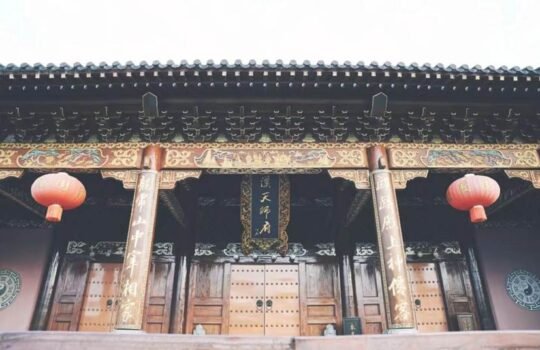
Origin of Taoism:
Taoism is the earliest indigenous religion in China, with a long history. Before the emergence of the term “Taoism”, its essence and framework had already deeply rooted in the mother body of Chinese culture. Its origin was a wonderful fusion of multiple cultural genes.
1. Spirits and Witchcraft: The cradle of rituals and magic
In ancient times, the ancestors held deep reverence for nature, forming a cosmic view that everything has a spirit. Mountains, stars, ancestors, and the spirits of the deceased were all regarded as beings with mysterious powers. The witchcraft known as “Wazi” for communicating with gods and driving away evil spirits became the earliest “professional clergy”. The rituals, dances, divination, and medical skills they mastered laid a solid practical foundation for the Taoist Fasting and Sacrificial Rituals ceremonies, talismans, and incantations of later Taoism. It can be said that Taoists were systematic and philosophical “witches”, incorporating ancient witchcraft rituals into a grand framework of cosmic theory.
2. Huang-Lao Taoism: The backbone of philosophy
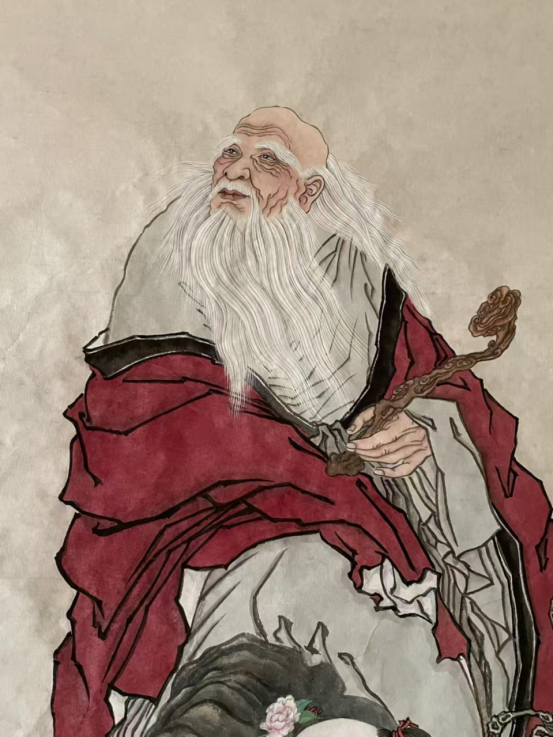
Without the infusion of philosophical thought, Taoism might have remained at the level of magic. During the Warring States period, Taoist thought represented by “Laozi” and “Zhuangzi” proposed the origin of the universe – “Dao”. This intangible and formless, creating the world and governing all things, ultimate concept became the highest belief core of Taoism. The “Huang-Lao School” that was popular in the early Western Han Dynasty honored both Huangdi and Laozi. The principle of “clearness and non-action” once became the guiding ideology for governing the country. After Emperor Wu of Han “solemnly promoted Confucianism”, the “Huang-Lao School” shifted from the imperial court to the common people and combined with the magic of immortals, evolving from the way of governing the country to the way of “self-cultivation” (self-cultivation, pursuit of immortality). Laozi himself was gradually deified and became the supreme deity “Tai Shang Laojun” of Taoism.
3. Immortal Magicians: The depiction of the ultimate goal
During the Warring States and Han dynasties, the legend of three immortal mountains – Penglai, Fangtang, and Yingzhou – spread widely. There lived immortal beings who were immortal and lived freely. This charming ideal gave rise to the “Fang-Shen Dao”. A group of magicians went to the sea to seek immortality for the emperors (such as Qin Shi Huang and Emperor Wu of Han), and prepared elixirs. Their practices were divided into two paths: one was the external alchemy, seeking the “Jin Dan” that could make the human body immortal by smelting minerals and metals; the other was the internal alchemy, using the human body as a furnace to refine the “jing, qi, and shen” within and condensing them into “Sheng Tai” (internal alchemy). These explorations provided the most core ultimate goal of Taoism – achieving enlightenment and becoming an immortal, as well as a complex technical system.
4. Yin-Yang and Five Elements: The framework of the universe
The Yin-Yang theory and the Five Elements theory that prevailed during the Warring States period provided Taoism with a set of “grammar” to explain the world. All phenomena in the universe could be attributed to the waxing and waning of Yin and Yang and the generation and destruction of the Five Elements (gold, wood, water, fire, earth). This theory not only formed the foundation of Taoism’s cosmic view but was also directly applied to medicine, alchemy, feng shui, and magic, enabling its complex magical system to be theorized and systematized.
II. The Melt of History:
The emergence of Taoist organizations
When the preparation of ideas met the historical opportunity of society, institutionalized religion emerged. In the middle and late Eastern Han Dynasty, due to political corruption, frequent disasters, and social unrest, the people, in suffering, yearned for spiritual comfort and redemption. This provided a breeding ground for the formation of Taoism.
1. A great work – “Tai Ping Jing”, quietly circulated in the Han Dynasty. It was not written by one person but a collective wisdom. This book combined Taoist philosophy, Confucian ethics, Yin-Yang theory, and magic of immortals and proposed the social ideal of “Achieving Peace” and the concept of “Responsibility and Accountability” (that is, the fortune and misfortune of an individual are related to the good or bad deeds of their ancestors). It completed the final theological theoretical preparation for the birth of Taoism.
2. Around the end of the Eastern Han Dynasty, a magician named Zhang Ling (also known as Zhang Daoling) practiced and preached in the Heliming Mountain in Sichuan. He honored Laozi as the leader of the religion and took “Tao Te Ching” as the core scripture, establishing the Five-Dou-Mi Dao (named for the requirement that practitioners pay five dou of millet). Zhang Ling and his successors established the “Twenty-Four Regiments” organizational structure for the religious community, using amulets and incantations to cure diseases and requiring believers to confess their sins. They also established the first Chinese Taoist entity with scriptures, a leader, and a strict organization. His grandson Zhang Lu even established a political and religious unified regime in Hanzhong, setting up “Yishi” to carry out public welfare activities, which had a significant impact. Zhang Ling was later revered as “Tianshi Zhang”, so the Five-Doumi Taoism was also called “Tianshi Taoism”, and its emergence is recognized as the official establishment of Taoism.
3. Almost at the same time as the Tianshi Taoism, the Guoliu person Zhang Ge used “Taiping Jing” as the scripture and founded the Taiping Taoism. He also used amulets to cure diseases, and his followers spread throughout the Central Plains, reaching tens of thousands. Zhang Ge launched a large-scale Yellow Turban Rebellion, with the slogan “Crown of Heaven is dead, Yellow Heaven should be established”, aiming to create a “peaceful” world. Although the rebellion was brutally suppressed, the Taiping Taoism as an organization also collapsed, but it proved through a stormy manner that the Taoist ideology had great energy in mobilizing the masses, and accelerated the collapse of the Eastern Han Dynasty.
4. During the Wei, Jin, and Southern and Northern Dynasties, Taoism further developed. Ge Hong wrote “Baopu Zi”, systematically expounding on the belief in immortals and alchemy theories, enriching the doctrines and cultivation methods of Taoism. At the same time, Kou Qianzhi carried out Taoist reforms in the Northern Wei Dynasty, removing some folk witchcraft elements from the Five-Doumi Taoism and absorbing Confucian legalistic thought, establishing a relatively complete set of Taoist rules, doctrines, and rituals, making Taoism more in line with the needs of the rulers, and being revered as “Guo Shi”, and Taoism thus flourished in the north. In the south, Tao Hongjing compiled and edited Taoist scriptures, writing “Zhenyao”, constructing a Taoist divine system, perfecting Taoist theories and cultivation methods, and making Taoism widely spread in the south.
5. From the Sui Dynasty to the Northern Song Dynasty: Taoism entered its peak stage. The Tang Dynasty rulers claimed to be descendants of Laozi Li Er, vigorously promoting Taoism, and revered Laozi as “Taishang Xuan Yuan Emperor”, establishing Taoist doctoral positions, and including Taoist examinations in the imperial examinations. Taoism held an extremely high position in society. The emperors of the Song Dynasty also mostly believed in Taoism, Emperor Zhenzong revered Zhao Xuanlang as the ancestor, and Emperor Huizong called himself “Taoist Emperor”, and Taoist temples were scattered throughout the country, with a large number of Taoists. The doctrines, rituals, and cultivation methods of Taoism also continued to develop and improve.
6. In the Southern Song Dynasty and the Jin and Yuan periods: New sects of Taoism emerged, such as Wang Chongyang founding the Quanzhen Taoism, advocating the unification of the three religions, promoting “Complete Spirit and Qi Cultivation” and “Entering Monastic Life for Immortal Practice”, and his disciple Qiu Chuji was treated with respect by Genghis Khan. The Quanzhen Taoism rapidly developed in the north. At the same time, the Zheng Dao in the south also continued to develop in its inheritance, standing alongside the Quanzhen Taoism as the two main sects of Taoism.
7. In the Ming and Qing Dynasties: Taoism gradually declined, although it still had some development, but in terms of theoretical innovation and social influence, it was much less than before. However, Taoism still had widespread beliefs in the folk, and its doctrines and thoughts also integrated into folk culture and customs.
The origin of Taoism is a grand narrative from dispersion to unity, from thought to organization. It was not founded by a single sage in one day, but was the crystallization of ancient Chinese civilization naturally formed over a long historical period. It absorbed the rituals of the Witch View, the philosophy of Taoism, the skills of the Sorcerer, and the framework of Yin-Yang and Five Elements, and finally emerged in the social crisis of the Eastern Han Dynasty through the organizational forms of the Tianshi Taoism and the Taiping Taoism, announcing the birth of a great religion.
从那时起,这条源自遥远过去的古老智慧之河开始流淌于魏晋时期的形而上学,与唐宋时期的炼丹术相融合,滋养了民间信仰,深刻地塑造了中华民族的精神气质和文化面貌,直至今日。