The Five Elements Theory is an important symbolic system in ancient Chinese philosophy, used to explain the composition, connection, and change of all things in the universe. It does not merely refer to “five substances”, but represents five basic attributes, energies, and movement tendencies.
Its core can be summarized as follows:
1. Basic Elements and Attributes of the Five Elements
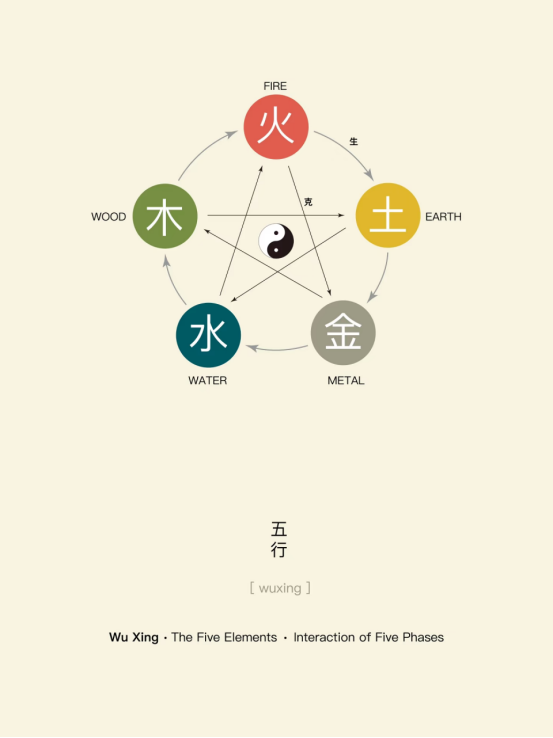
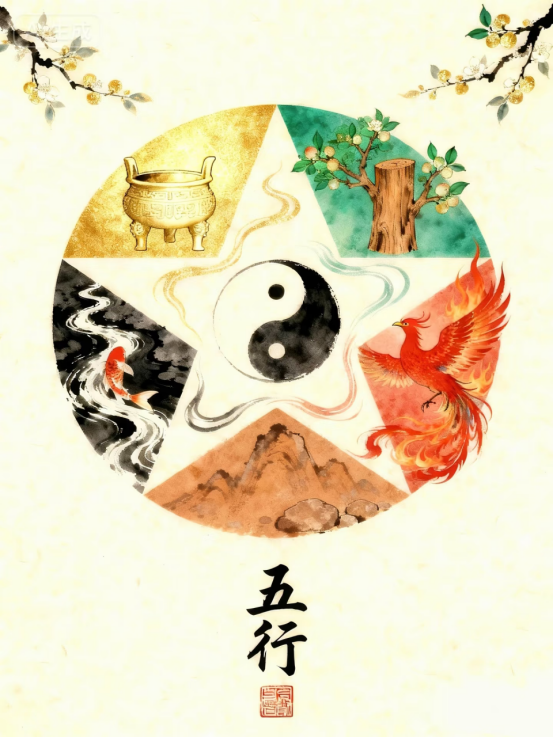
The Five Elements refer to Wood, Fire, Earth, Metal, and Water. Each element represents a characteristic:
Wood: represents growth, generation, flexibility, and expansion. Such as spring, plants, liver and gallbladder.
Fire: represents heat, upward movement, light, and ascent. Such as summer, the sun, heart.
Earth: represents bearing, nurturing, transformation, and stability. Such as the late summer, the earth, the spleen and stomach.
Metal: represents descent, suppression, contraction, and transformation. Such as autumn, metal, lungs.
Water: represents coldness, moisture, downward movement, and concealment. Such as winter, flowing water, kidneys.
2. Basic Relationships among the Five Elements
The Five Elements are not isolated; they maintain a dynamic balance through “generation” and “restraint”.
Generation Relationship: One element promotes and breeds another element, forming a cycle.
Wood generates Fire (Wood burns to produce Fire)
Fire generates Earth (Ash from fire turns into soil)
Earth generates Metal (Minerals are contained in Earth)
Metal generates Water (Metal surfaces condense water droplets, or symbolizes “metal melting into water”)
Water generates Wood (Water nourishes trees)
Restraint Relationship: One element restrains and restricts another element, forming another cycle.
Wood restrains Earth (The roots of trees can break through the soil and stabilize it)
Earth restrains Water (Earth can absorb and block water flow)
Water restrains Fire (Water can extinguish fire)
Fire restrains Metal (Fire can melt metal)
Metal restrains Wood (Metal tools can cut down trees)
3. Application and Extension of the Theory
The Five Elements Theory provides a universal “model” and is widely used to explain various systems:
Traditional Chinese Medicine: It is the core theory. The five zang organs (liver, heart, spleen, lung, kidney), five orifices, emotions, etc. all correspond to the Five Elements. When treating diseases, attention is paid to adjusting the imbalance of the Five Elements (such as “nourishing water to support wood” and “cultivating earth to generate metal”).
Dynastic Changes: The “Five Elements Restriction” is used to explain the legitimacy of the regime (such as Zhou as “fire dynasty”, and Qin as “water dynasty to suppress it”).
Feng Shui and Astrology: Used to analyze environmental layout and personal destiny trends.
Daily Life: Seasons, directions, colors, flavors, music, etc. can all be classified under the Five Elements. core idea
The essence of the Five Elements theory lies in its systematic nature, dynamic balance and interconnection. It holds that the world is a unified whole, and everything moves and changes within a network of mutual generation and inhibition. Excess or deficiency will disrupt the balance. Understanding the Five Elements is to understand an ancient and profound way of thinking about the interrelationships and cycles of all things in the universe.