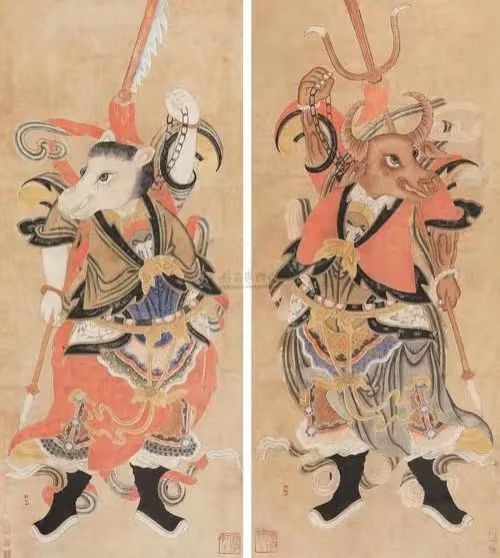
The Twenty-Eight Lunar Mansions (Ershi Ba Xiu) is the most fundamental and core asterism system in ancient Chinese astronomy and mythology. It serves not only as a coordinate system for dividing the celestial sphere and observing the movements of the sun, moon, and Five Planets but also as a shared cornerstone of timekeeping, directionality, divination, mythology, and Taoist magic, profoundly shaping the cosmic outlook and cultural expressions of Chinese civilization for millennia. The character “Xiu” (Mansion) originally means “lodging place,” referring to the 28 stellar background regions where the moon “lodges” each night as it orbits Earth (approximately 28 days). These 28 regions constitute the Twenty-Eight Lunar Mansions.
Basic Structure and Grouping: The Four Symbols and Seven Luminaries
The core framework of the Twenty-Eight Lunar Mansions is the “Four Symbols (Siling) and Seven Mansions per Symbol”:
Four Symbols: The celestial sphere is divided into four major regions (East, West, South, North), each symbolized by a sacred animal—Azure Dragon, White Tiger, Vermilion Bird, and Black Tortoise—collectively known as the “Four Symbols” or “Four Celestial Animals.”
每个符号对应七个宫位:每个符号对应七个“宫位”,共计 28 个。每个宫位由数量不等的星星组成,每个宫位都有其独特的名称、星群神话和象征意义。
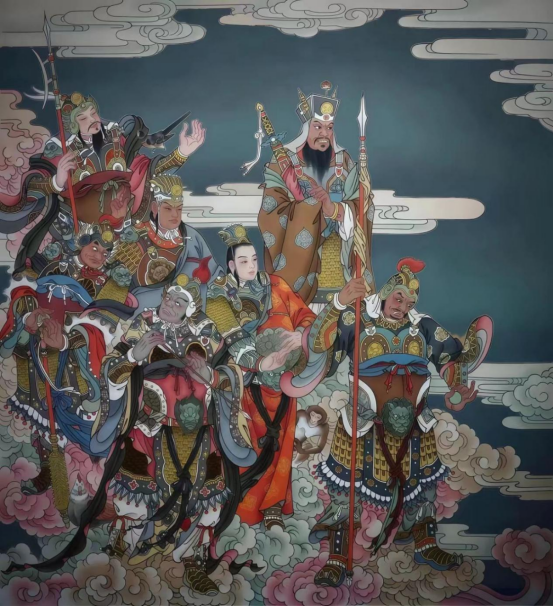
Specific Affiliations of the Twenty-Eight Lunar Mansions
东方青龙(象征春天,五行属木,颜色为青色):角修(龙角)、康修(颈项)、地修(根项)、房修(室项)、心修(心项)、尾修(尾项)、篆修(尾项)。想象成一条蓝色的龙:角修是龙角,康修是龙颈,地修是龙胸,房修是龙腹,心修是龙心(带有著名的心宿二,或称“大火星”),尾修是龙尾,篆修是尾尖的篆。
Black Tortoise of the North (symbolizing winter, Water element, black color):Dou Xiu (Dipper), Niu Xiu (Ox), Nü Xiu (Girl), Xu Xiu (Emptiness), Wei Xiu (Peril), Shi Xiu (Room), Bi Xiu (Wall).Imagined as a tortoise-snake hybrid: Dou Xiu (Southern Dipper) as the snake’s head, Niu Xiu as the snake’s body, Nü Xiu, Xu Xiu, Wei Xiu as the tortoise’s body, and Shi Xiu, Bi Xiu as the tortoise’s shell (also called “Yingshi,” related to architecture).
White Tiger of the West (symbolizing autumn, Metal element, white color):Kui Xiu (Strand), Lou Xiu (Bond), Wei Xiu (Stomach), Mao Xiu (Hairy Head), Bi Xiu (Net), Zi Xiu (Beak), Shen Xiu (Three Stars).Imagined as a white tiger: Kui Xiu as the tiger’s tail, Lou Xiu and Wei Xiu as its body, Mao Xiu (the famous Pleiades star cluster) and Bi Xiu (like a rabbit trap) as its torso, Zi Xiu as its head, and Shen Xiu (containing the bright Rigel and Betelgeuse) as its forelimbs.
南方朱雀(象征夏季、火元素、红色):井绣、鬼绣、柳绣、星绣、张绣、翼绣、震绣。想象成一只朱雀:井绣(形似井)和鬼绣(包含“尸聚星团”)为鸟头,柳绣为鸟喙,星绣为鸟颈,张绣为嗉囊,翼绣为鸟翼,震绣为鸟尾。
Core Functions and Cultural Applications
The Twenty-Eight Lunar Mansions transcend astronomy, serving as a “cultural operating system” connecting heaven and humanity.
Ruler of Calendars and Solar Terms:Observing the Mansion rising in the southern meridian at dusk determines seasons and months. For example, “When the Dipper’s handle points east, spring prevails under heaven.”It correlates with the Twenty-Four Solar Terms, acting as the ultimate celestial clock guiding agricultural activities.
Language of Astrology and Numerology:In astrology, the position of the Seven Luminaries (sun, moon, and Five Planets) within a Mansion omens good or ill for the corresponding mortal region (fenye, “astrological division”). For instance, “Yinghuo (Mars) guarding Xin Xiu” was regarded as an extremely inauspicious omen.In fortune-telling, feng shui, Bazi (Four Pillars of Destiny), and Ziwei Dou Shu (Purple Star Astrology), the Twenty-Eight Lunar Mansions are foundational data for calculating divine influences, selecting auspicious times, and judging directional fortune.
Sacred Space in Taoism and Magic:In Taoist belief, each Mansion is ruled by a Star Lord, with dedicated talismans and mantras. They are “low-level officials of heaven,” each overseeing specific duties (life and death, wind and rain, wealth, etc.).When Taoists perform rituals (e.g., Walking the Celestial Steps, drawing talismans, reciting mantras, or conducting sacrificial ceremonies), they must “invoke” or “meditate on” the Star Lords of the Twenty-Eight Lunar Mansions, drawing on their divine power to summon deities, dispel evil, heal the sick, or control wind and rain. The “Twenty-Eight Mansions Step” in Taoist rituals involves pacing the directions of the Mansions on the ground.
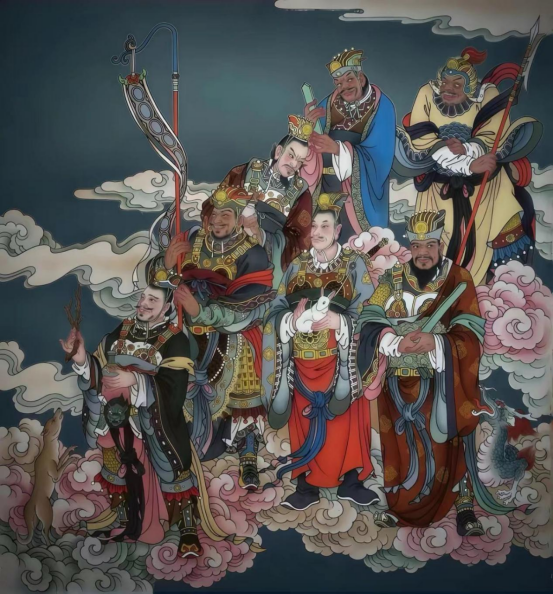
Treasure Trove of Literary and Artistic Imagery:It became a common elegant motif in poetry and literature. For example, Su Shi’s line: “I will draw my carved bow like a full moon, looking northwest, shooting the Heavenly Wolf” (the Heavenly Wolf Star lies near Jing Xiu); in Journey to the West, the “Twenty-Eight Lunar Mansions” descend collectively to rescue Tang Sanzang at Little Thunder Sound Temple.Star maps of the Twenty-Eight Lunar Mansions frequently appear on ancient architecture, murals, bronze artifacts, and costumes, symbolizing power and cosmic order.
Comparison with Western Zodiac
The Twenty-Eight Lunar Mansions and the Western Zodiac cover roughly the same celestial belt (ecliptic) but differ in division philosophy:
Twenty-Eight Lunar Mansions: Unevenly divided regions based on the moon’s cycle and stellar backgrounds, “lodgings for the moon.”
Western Zodiac: Twelve equal divisions of the ecliptic based on the sun’s cycle, “path of the sun.”They have corresponding relationships (e.g., Jiao Xiu and Kang Xiu correspond to Virgo, Xin Xiu to Scorpio), reflecting different civilizations’ interpretations of the same starry sky.
The Twenty-Eight Lunar Mansions is a “sacred administrative map” drawn by ancient Chinese in the sky. It organizes the chaotic starry expanse into a vast system with coordinates, officials, rules, and interactivity. It is not only a product of scientific observation but also the cosmological foundation of philosophy, religion, politics, and daily life. Understanding the Twenty-Eight Lunar Mansions holds the key to unlocking ancient Chinese concepts of time, spatial order, the idea of “heaven-human resonance,” and the mysterious world of magic. It reveals that in the hearts of ancient Chinese, the brilliant starry sky was not a distant spectacle, but another realm closely connected to the mortal world, interacting constantly, and filled with divinity and order.