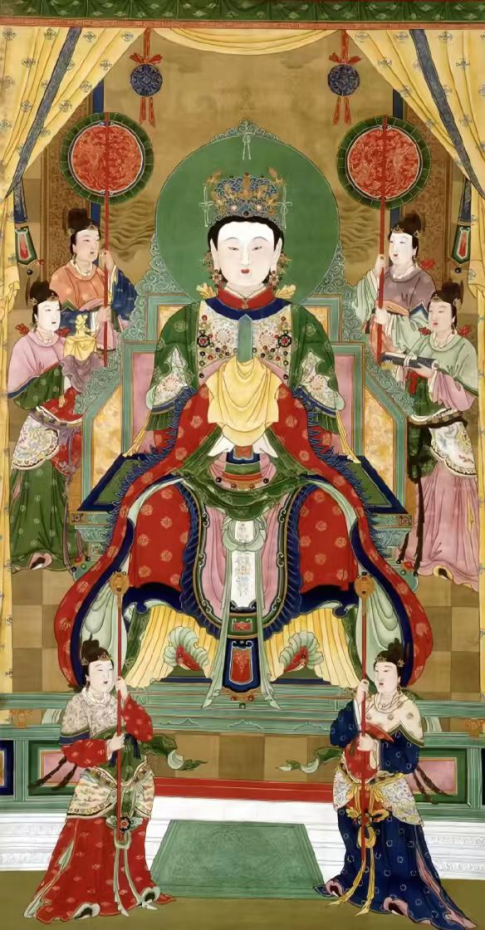
The full title of the Goddess of Mount Tai, also known as the “Bixia Yuanjun”, is “Tianxian Yvnü Bixia Yuanjun”. She is an important deity revered in Taoism and is affectionately called “Tai Shan Nainai”, “Tai Shan Niangniang”, or “Tai Shan Shengmu” by the common people. “Bixia” symbolizes the rosy glow of the rising sun in the east, representing vitality and hope; “Yuanjun” is a respectful title for female immortals in Taoism, highlighting her exalted status.
Taoist titles: Tianxian Yvnü Bixia Hushì Hongji Zhenren, Tianxian Yvnü Baosheng Zhenren Hongde Bixia Yuanjun, Jinguang Puzhao Tianzun, etc.
The Origin and Historical Evolution of the Deity’s Status
The belief in the Goddess of Mount Tai originated from the ancient worship of Mount Tai and can be traced back to the mountain worship in the Pre-Qin period. Her official title was first bestowed during the Song Dynasty.
When Emperor Zhenzong of the Song Dynasty made a pilgrimage to Mount Tai in the east in 1009, he discovered a stone statue of a jade maiden on the summit. He ordered the statue to be replaced with a jade one and built the “Zhaozhen Shrine” to enshrine it, bestowing upon it the title of “Heavenly Immortal Jade Maiden, Lady of the Green Haze”.
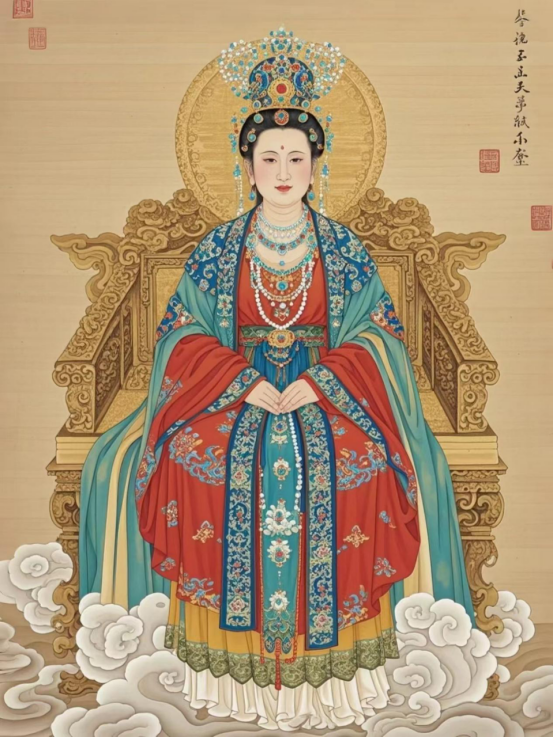
During the Ming and Qing dynasties, the faith reached its peak and its influence even surpassed that of the main deity of Mount Tai, the Great Emperor of the East. Emperors such as Emperor Shizong of the Ming Dynasty and Emperors Yongzheng and Qianlong of the Qing Dynasty all bestowed additional titles upon her, such as “Heavenly Immortal Holy Mother, Green Spirit, Universal Benefactor, Grand Virtue, Everlasting Protection, and Efficacious Response, Lady of the Green Haze.”
The Bixia Temple is located at the summit of Mount Tai and is the ancestral temple of Bixia Yuanjun. It is the highest and largest Taoist temple in terms of altitude and scale in East China and is known as the “Heavenly Palace”.
Architectural features: The golden roof is resplendent, and the 360 roof ridges symbolize the 360 days of the year. Inside the temple, there are three gilded bronze statues of Bixia Yuanjun, the Goddess of Eyesight, and the Goddess of Fertility.
Imperial inscriptions: Inside the temple, there is an inscription by Emperor Yongzheng reading “Fushui Haiyu”, and outside the temple, there is an inscription by Emperor Qianlong reading “Zanhua Donghuang”, highlighting the imperial respect for the Bixia Temple on Mount Tai.
Belief network: Centered around Mount Tai, the belief spreads northward along the Grand Canal, forming a belief network covering North and East China. There are Bixia Yuanjun palaces (commonly known as “Grandma Temples”) in places such as Tianjin, Henan, Hebei, and Shanxi, such as the Bixia Palace in Junxian County, Henan Province, and the Xiding Temple in Beijing.
Cultural status:
She is as renowned as Mazu (the sea goddess) of Fujian, and is known as “Yuanjun in the North, Mazu in the South”, together forming the two major goddess worship systems in the north and south of China.
During the Ming and Qing dynasties, her worship transcended the simple religious realm and integrated into folk customs, literature, art and other fields, becoming a symbol of traditional Chinese culture.
In folk beliefs, she is regarded as the guardian who “commands the divine soldiers of Mount Yueshan and oversees the good and evil of the human world”, as well as a compassionate goddess who “protects all beings and responds to the nine provinces”.