Taoist Taboos: Three Things Not to Ask, Three Things Not to Say, Three Times Not to Rise
—
Three Things Not to Say
Do not speak of dreams in the morning. Do not speak of killing at noon. Do not speak of ghosts and spirits in the evening.
A day’s plan is made in the morning. The morning hours should be spent thoughtfully arranging the day’s affairs, striving for their successful completion. Thus, one does not speak of dreams—the vague and unsettled—at dawn.
Noon is when yang energy reaches its peak. To speak of killing goes against the virtue of cherishing life and the heart of compassion. Therefore, one does not speak of killing at midday.
Night is when yin energy gathers. To speak of ghosts and spirits at this time may invite misfortune. Thus, one does not speak of such things in the evening.
Three Times Not to Rise
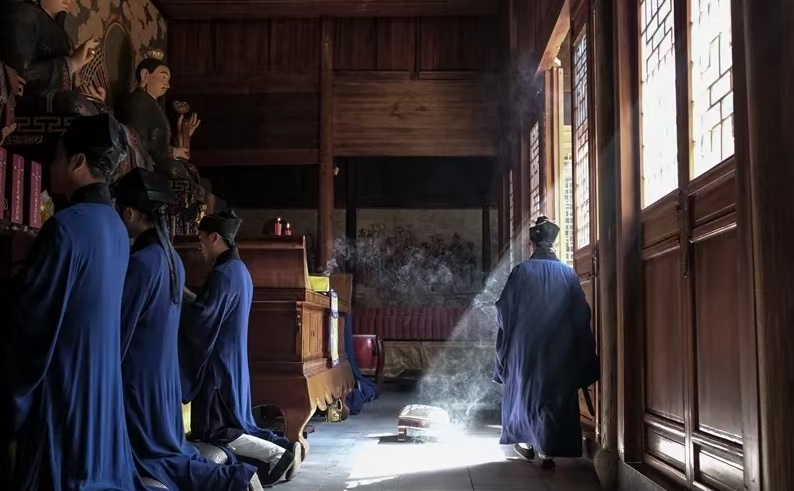
These are the times when a Taoist practitioner must not be disturbed, nor should they rise in response to anyone: during meals, during scripture chanting, and during meditation.
An old saying goes: “Eating is as important as an official’s duty.” Another says: “Even the God of Thunder does not strike a person at mealtime.” This illustrates that one should not disturb others while they are eating.
When Taoist monastics dine together in the refectory, it is called “passing through the dining hall”—a formal ritual of Taoist observance. The act of eating for a Taoist differs greatly from worldly custom. Before every meal, offerings are made, contemplating that “the ten directions provide offerings, hard-won and not to be enjoyed without merit, lest one incur transgression.” Food is first offered to spirits, making a universal offering to gods, humans, and hungry ghosts alike—a practice known as “forming connections with the three realms.”
Thus, a Taoist’s meal is also a moment of cultivation. No one may disturb them, nor may they rise in response to anyone.
Scripture chanting is a sacred act. As stated in the Preface to the Taishang Xuanmen Daily Scripture Course: “Those who chant scriptures must first purify themselves through fasting, straighten their robes, calm their hearts, steady their breath, click their teeth, and only then recite aloud. Be careful not to be irreverent, nor to whisper to one another. One must be solemn and upright, thought after thought without deviation…”
Therefore, no one may disturb a Taoist chanting scriptures, nor may the chanter rise and leave the scripture table.
Meditation is the practice of quiet cultivation. Taoists take the Tao as their calling. In meditation, they must set aside all distractions to reach a state where self and all things are forgotten. Hence, when a Taoist is in meditation, no one may disturb them, nor may they rise in response to anyone.
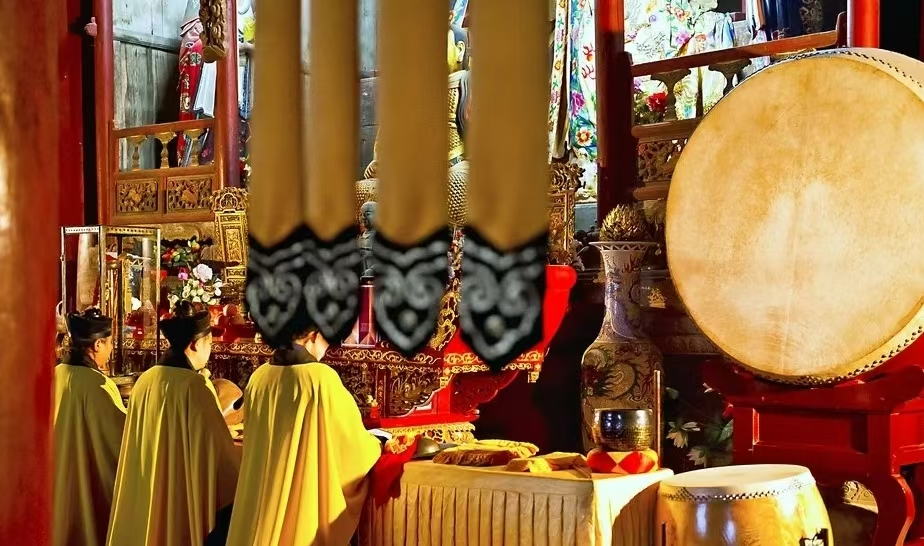
Three Things Not to Ask
Do not ask about age. Do not ask about worldly affairs. Do not ask about family origin or hometown.
Taoist monastics wear cloud shoes and white socks, blue or black robes, and keep their hair fully grown with large collars—a continuation of the Han Chinese tradition from the Han and Tang dynasties. Since ancient times, Taoism has maintained many customs. Those who leave family life to become Taoists change only their religious name, not their surname. Hence the saying: “The Tao does not speak of age.”
Age is of the worldly realm; the Tao concerns itself with cultivation and transcendence. One’s years in this life are but a fleeting moment—why ask? Worldly affairs distract from the path; why discuss them? Family origin ties one to mundane attachments; why inquire? The Taoist leaves such things behind to pursue the eternal.