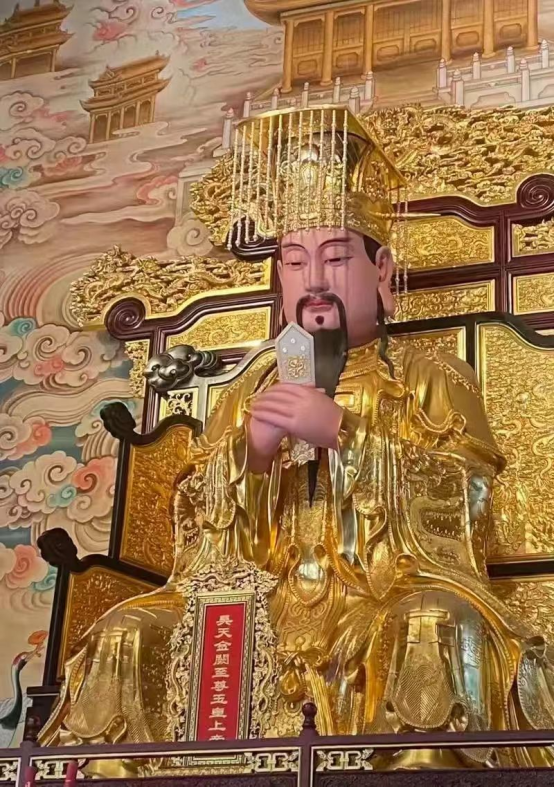
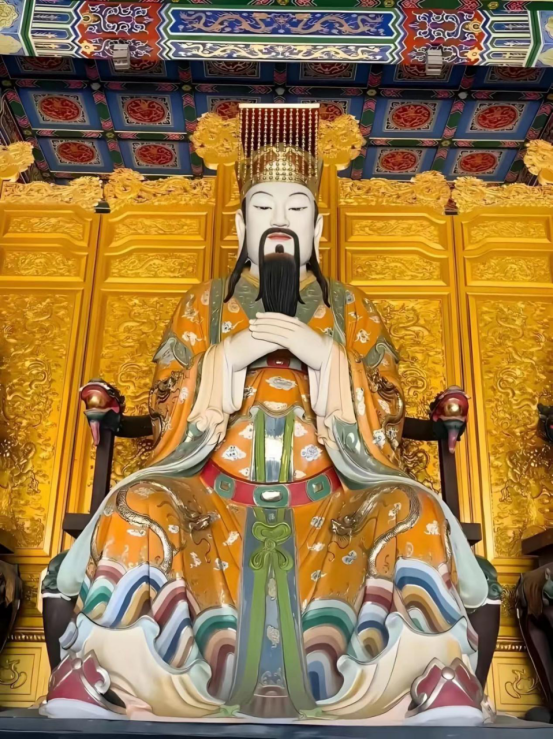
The Jade Emperor, whose full honorific title is “The Supreme Sovereign of the Heavenly Golden Tower, the Unsurpassed and Ultimate Ruler, the Naturally Wondrous and Infinite, the Universal and True Jade Emperor of the Highest Heaven”, is the paramount celestial deity in Chinese Taoism and folk belief. Revered as the ruler of the universe and the emperor of the celestial realm, he governs all beings across the Three Realms and Ten Directions, and exercises authority over all gods, immortals, Buddhas, sages, as well as the mortal world and the netherworld. His worship integrates ancient celestial emperor veneration, Confucian views on the Mandate of Heaven, and Taoist theology, occupying an extremely significant position in traditional Chinese culture.
I. Origin and Evolution of the Belief
1. Ancient Origins
The belief traces its roots to the worship of the “Supreme Deity of Heaven” (also known as the Heavenly Sovereign or the August Heavenly Emperor) during the Shang and Zhou dynasties. It represents the personification and deification of “Heaven” by the Chinese nation, embodying the supreme natural and moral authority.
2. Taoist Integration
After the rise of Taoism in the Eastern Han Dynasty, the faith in the Heavenly Sovereign was absorbed, and the concept of the “Jade Emperor” (or “Jade Ruler”) gradually took shape. During the Wei, Jin, Southern and Northern Dynasties, the Jade Emperor’s status within the Taoist pantheon was elevated, and he was officially established as the supreme deity in the Tang and Song dynasties.
Emperors such as Emperor Zhenzong and Emperor Huizong of the Song Dynasty conferred additional honorific titles upon the Jade Emperor, integrating his worship into state sacrificial rituals and promoting the popularization of his faith among the entire nation.
II. Divine Nature and Functions
1. Ruler of the Universe
He exercises overall governance over the Three Realms (Heaven, Earth, and Mortal Realm), the Ten Directions (the four cardinal directions, four intermediate directions, and the realms above and below), the Four Forms of Birth (womb-born, egg-born, moisture-born, and transformation-born), and the Six Paths of Reincarnation (heavenly beings, humans, asuras, denizens of hell, hungry ghosts, and animals).
2. Supreme Divine Authority
He commands all celestial deities, earthly spirits, mortal ghosts, and all immortals and Buddhas in the heavens. In the Taoist concept of “the unity of the Three Teachings”, the Jade Emperor is regarded as the “source of all doctrines”, with Buddhism and Confucianism also subject to his rule.
3. Rewarder of Good and Punisher of Evil
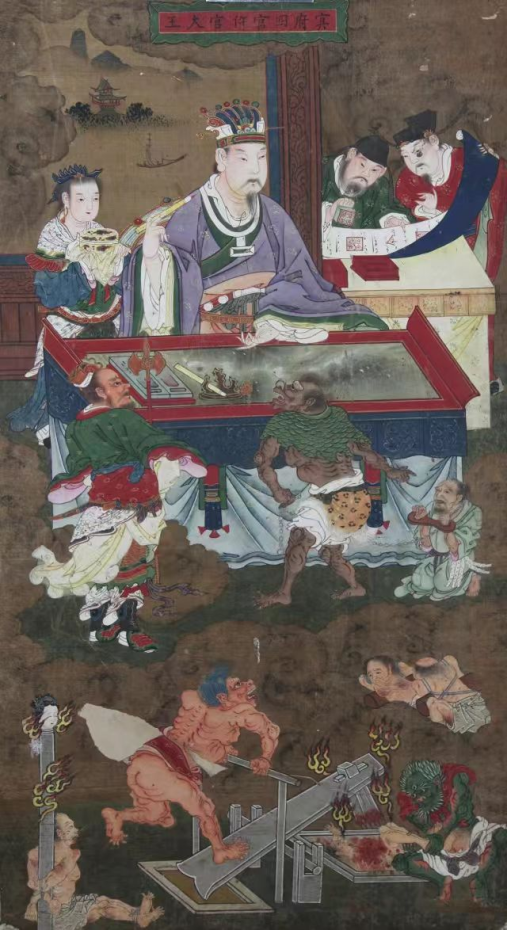
He oversees the good and evil deeds of all beings, and administers rewards and punishments through the celestial bureaucratic system (such as civil and military celestial ministers, the Thunder Department, the Pestilence Department, mountain and river gods, and city gods). He determines individual destinies, the rise and fall of nations, and the occurrence of natural disasters.
4. Hub of Belief
He is the source of legitimacy for mortal emperors’ status as “Sons of Heaven”. He is also the direct object of prayers for ordinary people seeking favorable weather, the elimination of calamities, and the resolution of misfortunes.
III. Modern Significance of the Belief
The worship of the Jade Emperor integrates Chinese cultural views on the Dao of Heaven, ethics, and order, embodying the values of “resonance between heaven and humanity” and “rewarding good and punishing evil”. In contemporary times, his sacrifices and veneration remain an important carrier connecting traditional culture, family ethics, and social cohesion, exerting a profound influence especially among overseas Chinese communities in Southeast Asia.
The Jade Emperor is not only the supreme deity in Taoism and folk belief, but also the concentrated symbol of Chinese civilization’s cosmology and view of order. From an ancient celestial emperor to the principal deity of Taoism, the evolution of his image reflects the interactive integration of religion, politics, and society in China. As the “emperor of the heavens”, he both carries people’s sacred imagination of cosmic order and embodies the eternal pursuit of justice, compassion, and harmony with nature.