“Qi” and “Yin-Yang” are the core concepts of Taoist thought, and they are also the important foundation of Taoist theory and practice. They are both independent yet deeply interrelated, jointly shaping the cosmology and life philosophy of traditional Chinese Taoism. The detailed analysis is as follows:
Core Essence
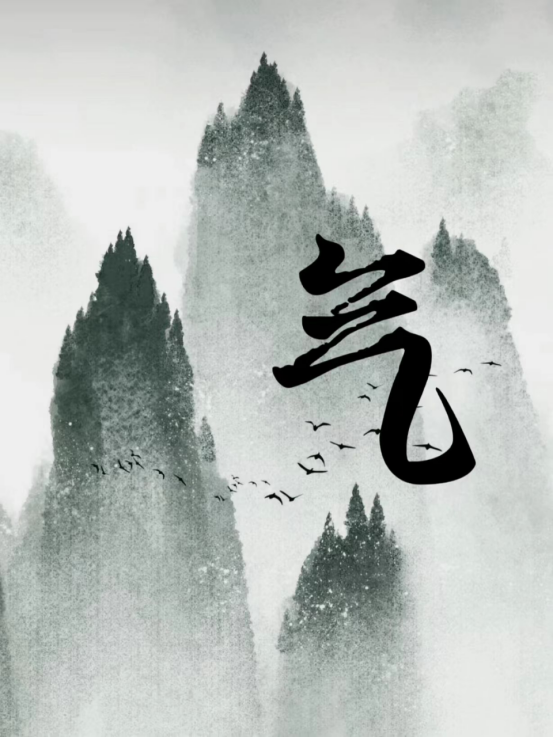
“Qi” is a fundamental concept that runs through Taoist culture. Taoism holds that “Qi” is the ultimate material and energy source of all things in the universe, and all things in the world are born from “Qi”. The Taoist scripture, “The Tao gives birth to One, One gives birth to Two, Two gives birth to Three, and Three gives birth to all things”, where “One” refers to “primordial Qi”, which is the intermediate carrier through which the Tao gives birth to all things. From the perspective of life, “Qi” is divided into the “primordial Qi” (the inherent life source inherited from birth) and the “Zong Qi, Ying Qi, Wei Qi” (derived from breathing and diet), which governs the physiological activities and mental state of the human body; Taoism also regards “Qi” as the core of cultivation, believing that through the practice of purifying Qi and nourishing Qi, one can achieve “Qi fullness and spirit sufficiency”, thereby approaching the state of “attaining enlightenment”.
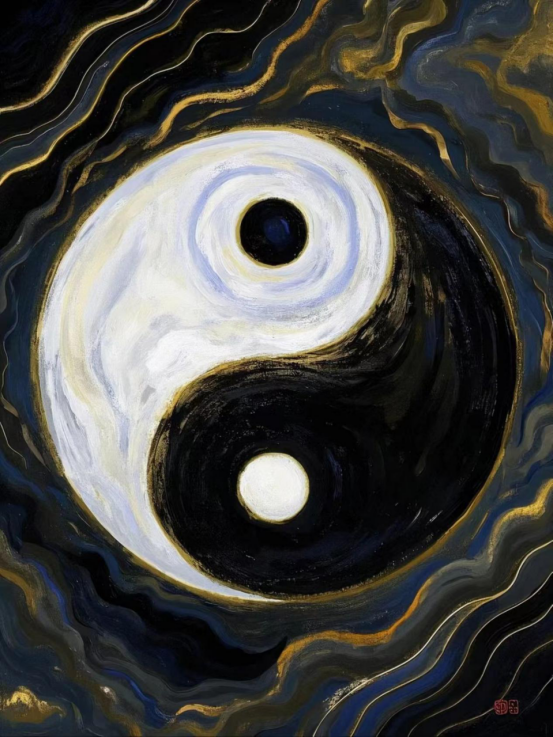
“Yin and Yang” “Yin and Yang” is the basic category used to describe the opposing and unified relationship of all things in the universe. According to Taoism, the universe is divided into yin and yang energies from “primordial qi”. The growth, transformation, and interaction of yin and yang are the fundamental driving forces for the generation and change of all things. The core characteristics of yin and yang are “opposition and restriction” (such as heaven being yang and earth being yin, movement being yang and stillness being yin), “mutual dependence and mutual use” (yin depends on yang and yang depends on yin, without yin there is no yang), “balance of growth and decline” (yin and yang grow and decline within a certain range to maintain overall stability), and “mutual transformation” (from the negative pole to the positive pole, from the positive pole to the negative pole, such as the alternation of day and night and the change of seasons). Taoism integrates the theory of yin and yang into practices such as alchemy and rituals, for example, in internal alchemy cultivation, it emphasizes “harmonizing the yin and yang energies” to form the elixir.
The connection between the two
Yin and Yang are the basic attributes of qi. The “primordial qi” of the universe is not a single form; it inherently contains the two properties of Yin and Yang. During the evolution process, it differentiates into “Yin Qi” and “Yang Qi”, and the interaction and integration of these two kinds of qi give birth to all things in the universe. That is to say, “qi” is the material carrier of all things, “Yin and Yang” are the movement and existence forms of qi, without qi, Yin and Yang have no basis; without Yin and Yang, qi has no principle of transformation.
Together, they construct the order of life and the universe. At the cosmic level, Yang Qi is light and ascending to become the sky, while Yin Qi is heavy and descending to become the earth. The combination of the two kinds of qi of heaven and earth forms natural laws such as wind, rain, thunder, lightning, and the cycle of the four seasons. At the level of life, the “qi” in the human body is also divided into Yin and Yang. For example, the defensive qi on the body surface is Yang, while the nutritive qi within the body is Yin. The heart is Yang, and the kidney is Yin. The balance of Yin and Yang is the key to the health of life. Once it is out of balance, it will cause diseases. This is also the core logic of Taoist health preservation and the theory of traditional Chinese medicine.
Both are the core basis of Taoist cultivation. The essence of Taoist internal alchemy cultivation is to adjust the body, breathing, and mind to harmonize and unify the two kinds of qi within the body, allowing the postnatal qi to return to the “primordial qi” of the beginning, ultimately achieving “the cultivation of life and soul simultaneously”. External alchemy also emphasizes the ratio of Yin and Yang raw materials (such as lead as Yin and mercury as Yang), and strives for the balance of Yin and Yang in the elixir to achieve the effect of immortality.
The concept of cultural extension qi and the ideas of yin and yang are not only the core of Taoist culture, but also permeate every aspect of traditional Chinese society: Traditional Chinese medicine uses “qi and blood” and “imbalance of yin and yang” to diagnose diseases, Feng Shui theory uses “the circulation of qi” and “the directions of yin and yang” to determine auspiciousness and misfortune, and martial arts emphasizes “qi control” to balance yin and yang within the body and enhance physical strength, becoming one of the underlying logics of Chinese traditional culture.