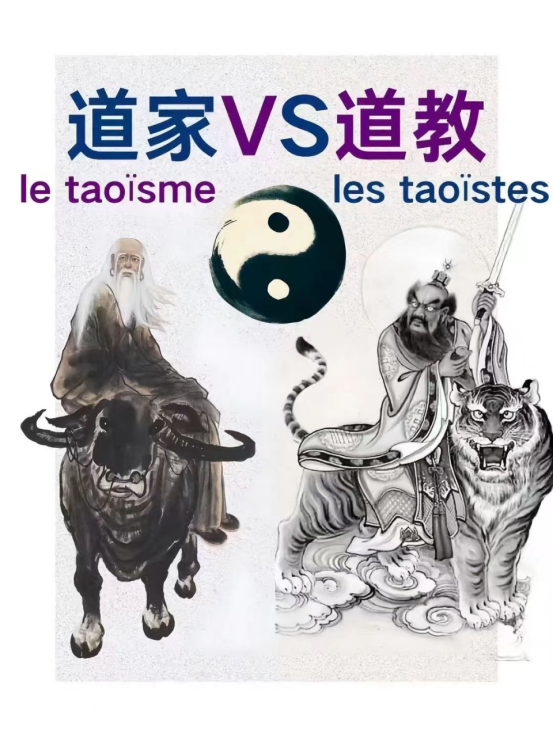
Although Daoism and Taoism have a long history of connection, they are fundamentally different concepts of different natures. One is a school of thought, while the other is a religious system. Their core connotations and scopes of application are significantly distinct. The following dimensions can be used to distinguish them:
Core Attributes
Taoism: This is a philosophical school of thought that emerged during the Spring and Autumn and Warring States periods. It has no religious organization, rituals, or priesthood system. Its core focuses on exploring the origin of the universe, the laws of life, and the principles of governing the state. Representative figures include Laozi, Zhuangzi, and Liezi, and its core scriptures are The Tao Te Ching, Zhuangzi, and Liezi.
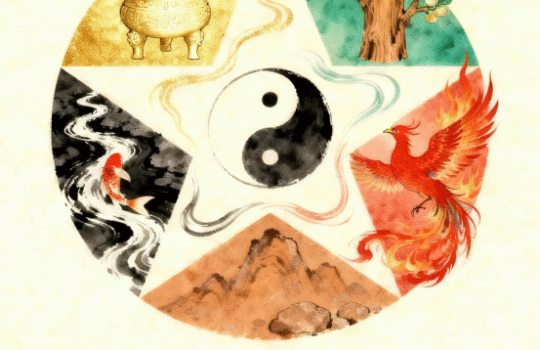
Taoism: This is a native religion that emerged during the Eastern Han Dynasty. It is based on Taoist thought as its core theoretical foundation, integrating elements such as yin-yang and five elements theory, alchemical techniques of immortals, and folk witchcraft. It has complete religious doctrines, a system of immortals, ritual systems, Taoist temple organizations, and clergy ( Taoist priests). In addition to Taoist classics, its core scriptures also include The Great Peace Scripture, The Book of Co-creation of Yin-Yang and Five Elements, and The Daoist Canon.
Core Propositions
Taoism: The core of its ideology is “Tao”, advocating “following the Tao naturally”, “non-interference in governance”, “purity and frugality”, and “harmony between heaven and humanity”. It focuses on speculative thinking about the essence of the universe and the wisdom of life, pursuing spiritual freedom and detachment. For instance, Zhuangzi’s “Wandering in Freedom” is a pursuit of spiritual realm, rather than a religious goal of achieving immortality through alchemy or ascending to the celestial realm after death.
Taoism: Based on the “Tao” of Taoism, it develops the core goal of “achieving immortality through cultivation”, advocating through internal alchemy (breath control, spiritual nourishment), external alchemy (ancient alchemy techniques), accumulating virtue and doing good deeds, and abiding by precepts, to achieve immortality, physical immortality, or ascending to the celestial realm after death. It also incorporates “Responsibility and Accountability” (an extension of cause and effect, involving family fortune and misfortune) as religious ethics.
Development Overview
Taoism: Originated in the Spring and Autumn Period by Laozi. During the Warring States Period, Zhuangzi further developed its ideology. In the early Western Han Dynasty, it became the guiding ideology for governance (Huang-Lao philosophy, integrating Taoism and Legalism). In the Wei-Jin period, it was combined with Neo-Confucianism, and since then, it has long existed as an important school of traditional Chinese philosophy, influencing various fields such as Chinese culture, art, and thought.
Taoism: Its early forms were the Taiping Dao (established by Zhang Jiao) and the Wudoumi Dao (established by Zhang Daoling, also known as the Celestial Master Dao). During the Wei-Jin and Northern and Southern Dynasties periods, it gradually became systematic. During the Sui, Tang, and Song Dynasties, it reached its peak. The imperial court often respected Taoism. In the Ming and Qing Dynasties, it gradually became more popular among the common people, forming major sects such as the Zhengdao Dao and the Quanzhen Dao (Zhengdao Dao focused on spells and rituals, while Quanzhen Dao emphasized internal alchemy cultivation and monastic retreat).
Social Roles
Taoism: Primarily serves as an academic and ideological resource, influencing the spiritual world of scholars and literati, the governance concepts of rulers, as well as the development of cultural fields such as traditional Chinese medicine, calligraphy, and painting. It does not have specific religious practices or organizational constraints.
Taoism: As a religious entity, it undertakes social functions such as providing religious services, conducting folk sacrifices, and preserving cultural heritage. Taoist temples are its religious activity venues. Taoist priests must abide by specific precepts and provide religious rituals for believers, such as blessings, exorcisms, and exhumations. At the same time, it also retains a large amount of traditional medical knowledge, health preservation techniques, astronomy, and other cultural heritages.
In simple terms, Taoism is the ideological source of Taoism, and Taoism is the religious extension of Taoist thought. Although they are closely related, they essentially belong to the two categories of philosophy and religion.