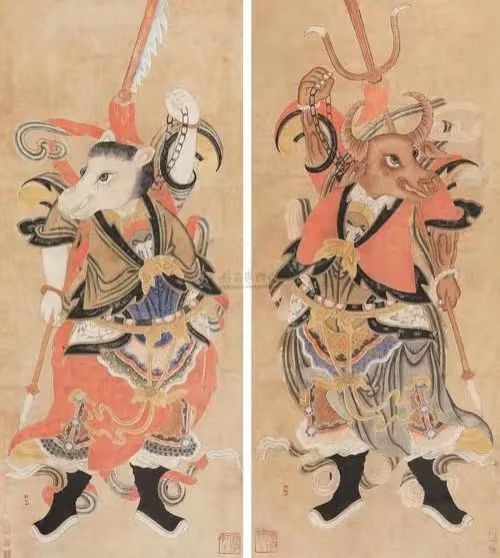
The Five Water Deities are the core five water deities in Taoism and ancient water deity beliefs, composed of the four sea deities and the River God. Their names are clearly recorded in the Taoist scripture “Taichong Jinli Shengqi Jing”. They are He Guiju Jun from the East Sea, Liu Xiao Jun from the South Sea, Guosui Jun from the West Sea, Wu Yuqiang Jun from the North Sea, and Feng Yi (with the courtesy name Junping) from the River God. Their main functions are to oversee the water systems of the oceans and rivers, responsible for distributing clouds and rain, preventing floods and droughts, safeguarding shipping safety and agricultural harvests. They are the key deities that connect the ocean and inland water systems.
The belief in the Five Water Deities originated from the ancient natural worship of rivers, seas, and lakes. After Taoism incorporated them into its pantheon, it designated them as the five primary water deities under the jurisdiction of the Heavenly Court, subject to the control of the Water Official Emperor. They need to cooperate with the Four Sea Dragon Kings and the Well Sea Dragon King, etc., to carry out water management tasks. In the divine system, the Five Water Deities have a lower status than the Five Dragon Deities (Five Emperor Dragon Kings), but a higher status than the Well Deity, Stream Deity, and other local small water deities. They are an important group of deities for ensuring the communication of water systems and the stability of people’s livelihoods in official and folk sacrifices during ancient times.
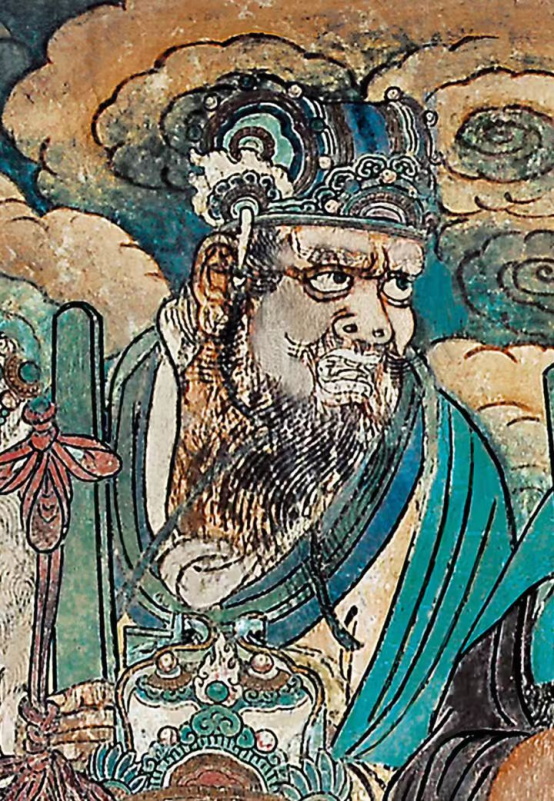
The East Sea Deity He Guiju Jun governs the entire East Sea and the eastern coast, responsible for regulating the tides and ensuring shipping safety, protecting the development of fishing in the eastern coast and regulating rainfall. He also undertakes the duty of conveying the water orders from the Heavenly Court. His image is often depicted with a green face and long beard, wearing a blue and white dragon-patterned official robe, holding an ocean deity flag, and having a solemn and steady expression. The South Sea Deity Liu Xiao Jun governs the entire South Sea and the southern coast, responsible for regulating the warm current and typhoons in the South Sea, protecting maritime and trade activities in the south, and ensuring the balance of rainfall in the tropical region. His image is red-faced and red-bearded, wearing a red official robe, holding a coral staff, and having a magnificent appearance. The West Sea Deity Guosui Jun governs the West Sea, which in ancient times mostly referred to the Qinghai Lake and the waters in the west. He is responsible for managing the inland lakes and river sources in the west, protecting agricultural irrigation and ecological stability, and playing a role in preventing drought and reducing disasters. His image is white-faced and white-bearded, wearing a silver-white official robe, holding a jade net bottle, and having a peaceful expression. The North Sea Deity Wu Yuqiang Jun governs the North Sea (mostly referring to the Bohai Sea, Baikal Lake, etc.) and the northern waters, responsible for regulating the ice and thawing of the northern waters, controlling snowfall and cold waves, protecting the fishing and shipping safety in the north, and having a black face and black beard, wearing a black official robe, holding a black iron cane, and having a solemn and majestic expression. The River God Feng Yi (with the courtesy name Junping) governs all the rivers in the world, with the Yellow River as the core management area. He is responsible for regulating the water flow of inland rivers, preventing floods and droughts, protecting fishing and shipping safety, and mediating water-related disputes in the human world. His image can be a white dragon incarnation, riding a water cart, wearing a jade crown, holding the river map, symbolizing the control of water flow directions.
The core functions of the Five Water Deities are reflected in four aspects. First, they oversee water areas and coordinate water systems. The four sea deities each manage a part of the ocean, and the River God governs the inland rivers, jointly forming a water system management system that connects the ocean and rivers, ensuring orderly water flow and avoiding conflicts of water disasters. Second, they distribute clouds and rain and prevent disasters. They follow the instructions of the Heavenly Court and cooperate with the Five Dragon Deities and the Four Sea Dragon Kings to carry out rainfall tasks. The River God focuses on rainfall and flood control along the riverbanks, while the sea deities are responsible for rainfall and tidal regulation along the coast, protecting agriculture and people’s livelihoods. Third, they safeguard shipping and fishing. They ensure the safety of maritime and inland river shipping, protecting fishermen and boatmen’s safe voyages, promoting trade and agricultural harvests, and are important guardians for ancient shipping and fishing practitioners. Fourth, they mediate water affairs and purify water bodies. They supervise aquatic life in water bodies, prevent disturbances from water monsters, mediate human water affairs disputes, and maintain the dignity of the water court. In Taoist rituals, they can also use water rituals to purify the altar area with divine water and remove impurities.
In sacrificial customs, ancient dynasties would establish sea god temples and River God temples along the coast and rivers, and hold sacrificial ceremonies in spring and autumn, praying for stable water systems and prosperous national fortune. For example, Emperor Qin Shi Huang once sacrificed to the sea god of the East Sea, and Emperor Wu of Han sacrificed to the River God to pray for the stability of the Yellow River. In folk sacrifices, fishermen would offer sacrifices to the four sea deities before going to sea, and boatmen would offer sacrifices before sailing. When people encounter droughts or floods, they will go to the River God Temple to worship and pray for rain or to calm the floods; in some areas, during the River God’s birthday on the sixth day of the sixth lunar month and the Tide God Festival on the 18th of August, large-scale sacrificial activities will be held. In Taoist rituals, when Taoist priests perform rain-praying and blessing ceremonies, they will invoke the rituals of the five water deities to pray for their arrival for assistance, to harmonize yin and yang, and to bring down rain.
The cultural influence of the five water deities is far-reaching. In the fields of literature and art, their images often appear in ancient books such as “Chu Ci” and “Shan Hai Jing”, and River God is even a classic water deity image in classical literature. For example, Qu Yuan’s “River God” has related depictions of him. In traditional paintings and sculptures, the five water deities are mostly presented as ocean officials and the masters of rivers, and are an important part of China’s water deity culture. At the level of folk symbols, the belief in the five water deities has given rise to auspicious meanings such as “harmony in all four seas” and “tranquility of rivers”, expressing the people’s yearning for a better life. In Taoist cultural ornaments, the elements of the five water deities are often used in water-repellent and evil-avoidance designs, as well as designs for protecting travel, and carry the meaning of pure water and peaceful and smooth flow. In terms of regional culture, many places name temples after sea gods and River Gods, such as the Hai Shen Temple in Quanzhou and the River God Temple in Henan. These temples have become important symbols of regional culture, carrying the beliefs and worship of local people towards water deities.
In terms of the subordinate position and status of the five water deities, they are under the control of the Water God Emperor and the Five Dragon Festival, and need to cooperate with the Four Seas Dragon Kings to carry out tasks. The division basis is the combination of the four seas and inland water systems of the ocean and land, and is different from the Five Dragon God who divides based on the five directions and macro-controls the climate and water areas of the world, and also different from the Four Seas Dragon Kings who divide based on the ocean territory and specifically manage ocean affairs. It is also different from the Jing Hai Wang who governs the four river basins and is responsible for local river management. The five water deities have the same status as the Four Seas Dragon Kings, but their divisions of labor are different.