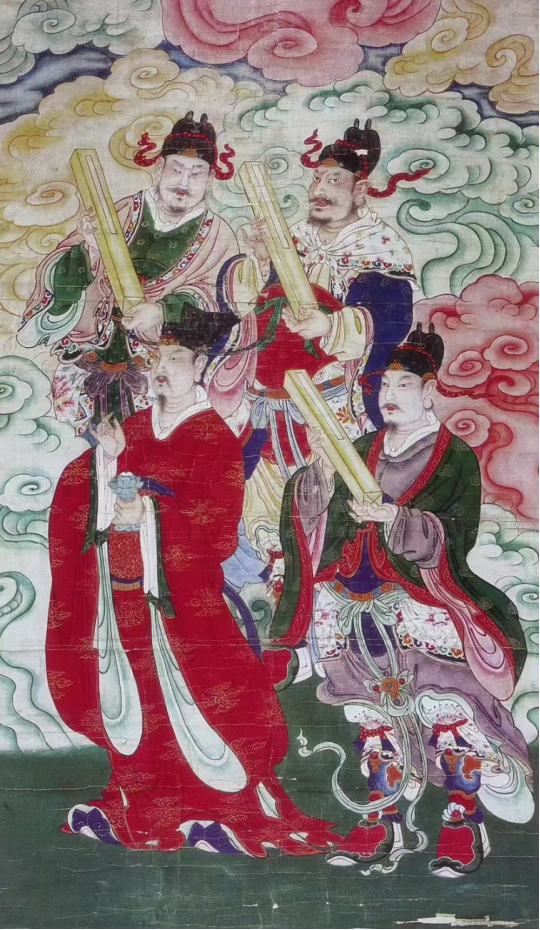
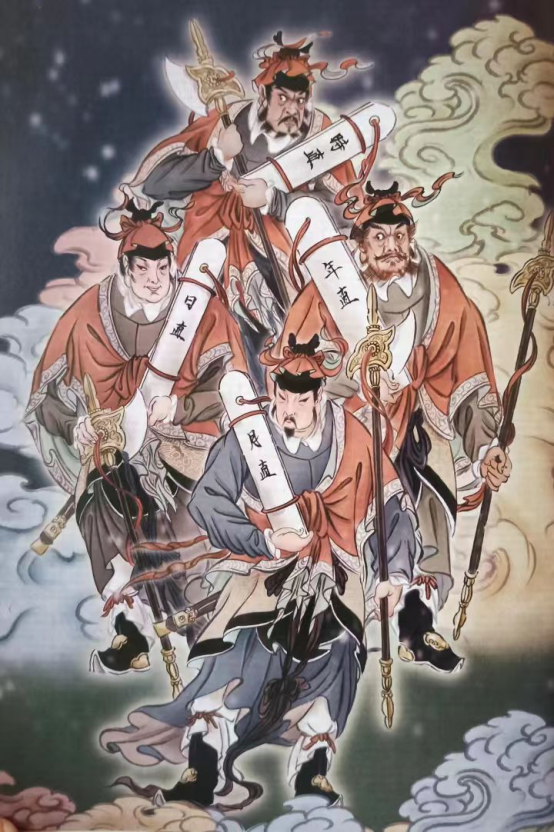
The Four Duty Magistrates are four “on-duty celestial deities” in the Taoist pantheon who are responsible for recording, presenting, and supervising all the affairs and documents within the three realms. They are equivalent to the “timekeeping secretaries” and “delivery supervisors” of the Heavenly Court. They are the core grassroots deities that maintain the smooth flow of information and administrative operations in the Heavenly Realm, the Underworld, and the Human Realm. The “Four Duties” refer to the four deities who take turns being in charge of the years, months, days, and hours; “Duty Magistrates” originally referred to the officials in ancient Chinese counties who were in charge of documents and recording virtues and vices, and were borrowed as a religious title.
Detailed explanations of the duties of the four duty magistrates:
1. The Yearly Duty God Li Bing: He is in charge of all the major and minor affairs that occur within the jurisdiction for the entire year, as well as the annual summary of the good and evil deeds of all beings. At the end of the year, he must submit the summary report to the Heavenly Court.
2. The Monthly Duty God Huang Chengyi: He is in charge of the affairs and monthly summaries within one month. At the end of each month, he must submit the report.
3. The Daily Duty God Zhou Deng: He is in charge of the affairs and daily summaries within one day. At the end of each day, he must submit the report. “Daily Duty” is the core of his work, so “Daily Duty Duty Magistrate” is often used as a collective term for the four.
4. The Hourly Duty God Liu Hong: He is in charge of the immediate records and urgent reports of the affairs that occur within one hour (two hours). He is responsible for the most timely information transmission.
Core work process: The “Postage and Archives” of the Heavenly Court
Their work process perfectly mimics the administrative system of an ancient empire:
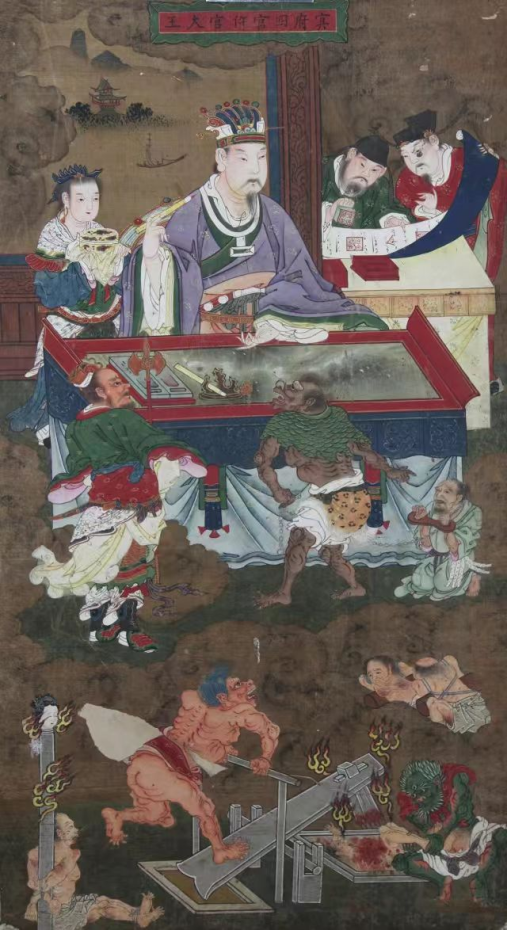
1. Recording: Like the “Celestial Book Record Official”, they will meticulously record every word and deed, virtues and vices, of every deity, immortal, human, ghost, and spirit. From national sacrifices to the slightest good deed of the common people, all are recorded. The saying “Three Feet Above the Head There Are Gods” is the important executor of this.
2. Transmission: They are the most important “messengers” of the Heavenly Court. When Taoist temples and temples hold rituals and ceremonies, the scriptures, forms, seals, and proclamations (i.e., prayers, reports, and documents submitted to the Heavenly Court) written by the priests all need to be “burned and dispatched” by the four duty magistrates before they can reach the Heavenly Court and be presented to the corresponding deities (such as the Jade Emperor, the Three Purities, and the Star Deities). Without them, humans and deities cannot “communicate”.
3. Supervision: Heavenly Court edicts and the decrees of immortals are often delivered and supervised for execution in the human realm. They are the key link to ensure that “the will of Heaven is implemented”.
In the roles in Taoist rituals and folk beliefs:
• Central hub of rituals: In any formal Taoist ritual ceremony, “dispatching duty magistrates” or “sending reports” are always the core环节. The high-ranking priest will burn the “duty magistrate seal” or “report” and loudly recite “burn incense and bow, pray to the four duty magistrates, carry the report, and go to a certain palace to present it” and other documents, indicating that the ritual documents have been sent through the “divine courier”.
• Supervision and retribution: It is believed by the people that the good deeds and evil deeds of humans are all seen and recorded by the four duty magistrates and reported regularly. This directly relates to the increase or decrease of one’s fortune and the length of one’s life, and is the specific operator of the concept of “good deeds and evil deeds will eventually be retributed” in the religious teaching of Taoism.
• Literary image: In “Journey to the West”, the four duty magistrates often, along with the Six Darts, Six Ones, Five Directions Abhors, and eighteen guardian guardian deities, are summoned by Sun Wukong, undertaking tasks such as secretly protecting Tang Xing, sending messages, and passing on information, vividly presenting their functions as “base-level messengers” and “on-duty guards”.
In summary, the Four Duty Magistrates are the “nerve endings” and “information vessels” of the Taoist “Heavenly Sensation” and “Manifestation of Heaven’s Law” belief system. They make the supreme “Heavenly Law” traceable, communicable, and feedbackable. Through them, the grand cosmic laws are decomposed into specific records every day and every hour; through them, the humble and sincere prayers of individuals can also be delivered to the highest deity palace. They represent a strict, precise and all-encompassing sacred order that ensures the smooth “communication of orders” and the “transmission of lower-level information” from the Heavenly Emperor to the common people in the mountains and fields. This is the most fundamental guarantee for the efficient and fair operation of the entire celestial bureaucratic system.