Queen Mother of the West
The Queen Mother of the West, commonly known as Goddess Wangmu, is the highest-ranking goddess in Chinese mythology and Taoism. She holds dominion over longevity, fertility, punishment, and the yin energy of the universe. Her image has undergone a complex evolution—transforming from a half-beast, fearsome deity in ancient times into the dignified and magnificent leader of all goddesses.
Evolution of Her Image
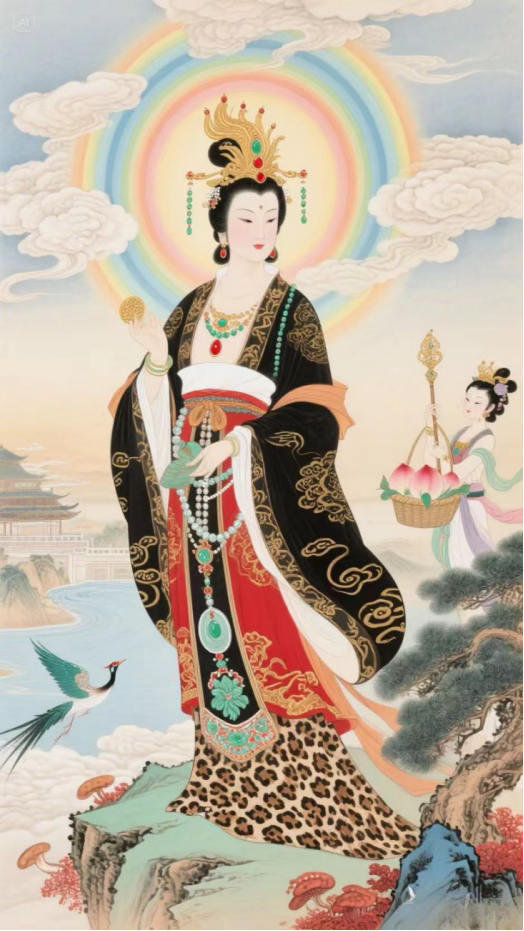
In her earliest depiction in Classic of Mountains and Seas, the Queen Mother of the West was a monstrous deity with a leopard’s tail and tiger’s teeth, disheveled hair, who ruled over plagues and executions. By the Han Dynasty, as the craze for immortality-seeking prevailed, she evolved into a goddess bestowing the elixir of eternal life. Legend has it that she gave the elixir of immortality to Hou Yi and hosted King Mu of Zhou at the Jade Pool. After the Wei and Jin dynasties, Taoism enshrined her as the leader of all goddesses. She was believed to reside at the Jade Pool on the Kunlun Mountains in the West, possessing flat peaches that grant immortality upon consumption, and hosting peach banquets for immortals. Her image was thus completely transformed into that of a solemn and elegant goddess.
Core Divine Functions
Governing Longevity: She presides over the Flat Peach Garden. The flat peaches, which ripen once every three thousand years, confer immortality, making her a symbol of longevity.
Fertility and Marriage: In folk belief, she is also revered as a goddess who blesses people with offspring, harmonious marriages, and the well-being of women and children.
Punishment and Calamities: She retains her ancient power to inflict disasters and punish evildoers, meting out retribution to the wicked.
Harmonizing Yin and Yang: As the counterpart of the King of the East (also known as the Wood Lord), who embodies yang energy, she symbolizes the primordial source of yin in the universe. Together, they regulate and balance heaven and earth.
Status in Taoism and Folk Belief
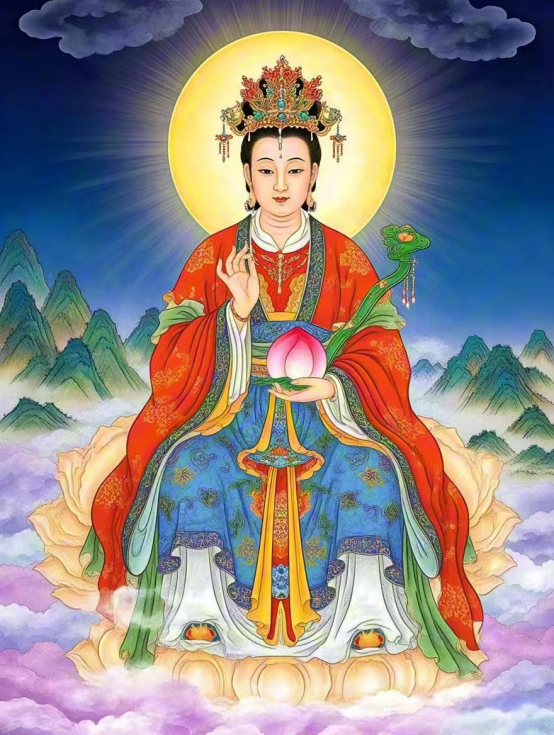
Within the Taoist pantheon, she is the supreme leader of all goddesses; every goddess who attains immortality must pay homage to her first. In folk belief, her influence surpasses that of many high-ranking deities, making her the benevolent yet majestic “Mistress of the Heavenly Realm” in the hearts of ordinary people. Her birthday—celebrated either on the third day of the third lunar month or the eighteenth day of the seventh lunar month—is a major religious festival, during which Taoist temples hold grand “Flat Peach Sacred Festivals”.
Cultural Influence
The Queen Mother of the West is widely featured in Chinese literature and legends. For instance, the Peach Banquet crashed by Sun Wukong in Journey to the West was hosted by her; in the legend of Chang’e Flying to the Moon, Hou Yi obtained the elixir of immortality from her. In folk art forms such as New Year paintings and traditional operas, she is often portrayed as a deity who bestows blessings and celebrates birthdays. She has become a cultural symbol of longevity, motherhood, and feminine power.
The evolution of the Queen Mother of the West reflects the changes in Chinese cultural perceptions of life, death, power, and the concepts of yin and yang. From a primitive, fearsome deity, she has evolved into a supreme goddess embodying authority, benevolence, and sacredness, and continues to hold a vital position in religious beliefs and folk customs to this day.