
What Are Gemstone and Crystal Bracelets? Materials, Meaning, and How to Choose
Explore gemstone and crystal bracelets, their materials, symbolism, design types, fit, care, and how to choose a piece responsibly.
Introduction
Gemstone and crystal bracelets are often introduced through color, stone names, or symbolic promises. Yet those descriptions can blur several different questions: What is the bracelet actually made from? Is every polished bead a crystal? Does a traditional association describe a cultural idea, a personal intention, or a scientifically demonstrated effect?
A useful guide should keep those questions separate. The material tells us about appearance, texture, and care. The design explains how beads, metals, woods, and symbolic elements have been arranged. Cultural meaning provides context, while the wearer decides whether that meaning feels personally relevant.
This article introduces the gemstone and crystal bracelets in the Taoist World collection without treating every stone as interchangeable. It explains the principal material families, explores how Taoist-inspired ideas enter contemporary bracelet design, and offers practical guidance on choosing, wearing, and caring for a piece.
What Are Gemstone and Crystal Bracelets?
Gemstone and crystal bracelets are wearable arrangements made with polished mineral, rock, glass, or organic-material beads. In everyday jewelry language, “gemstone bracelet” and “crystal bracelet” are sometimes used broadly, but they are not perfect scientific synonyms.
A gemstone is a material valued for beauty, durability, rarity, or suitability for ornament. “Crystal” can refer to an ordered internal structure, but in retail language it is also used more loosely for transparent or visually distinctive stones. Obsidian provides a helpful example: it is natural volcanic glass rather than a mineral crystal, yet it is commonly sold beside crystal jewelry because it can be polished into attractive beads.
The Gemological Institute of America’s Gem Encyclopedia is a useful starting point for checking established gemstone names and learning how different gem materials are described. Scientific identity should come from reliable gemological information, while symbolic interpretations should be presented as beliefs or design meanings.
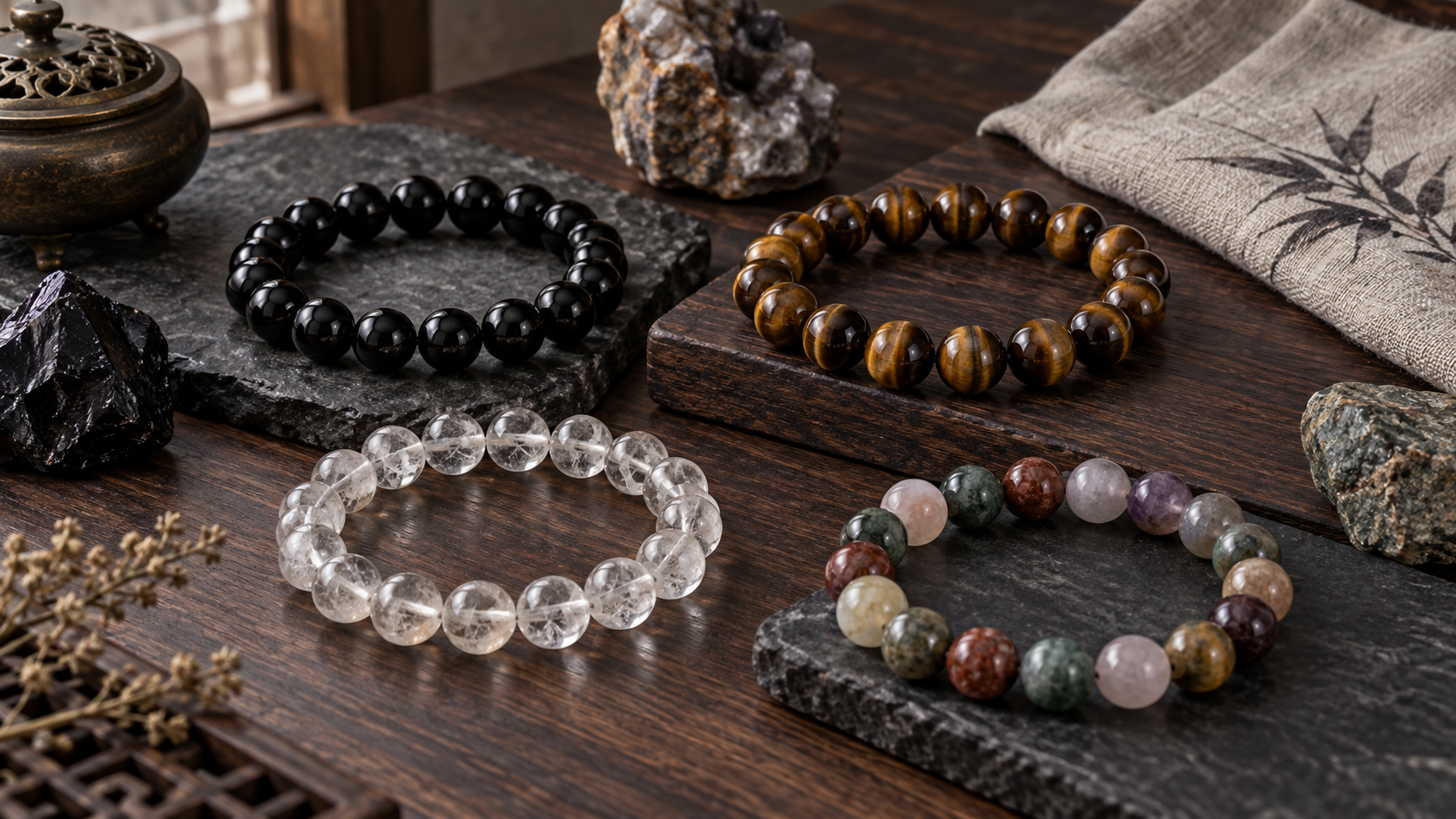
The Taoist World Gemstone & Crystal Bracelets collection includes obsidian, quartz varieties, tiger’s eye, agate, aquamarine, kunzite, serpentine, and mixed-material designs. Some pieces also combine stones with wood, metal, seeds, shell, liuli, or other materials. The collection name therefore describes a broad design family rather than one identical composition.

Understanding the Main Bracelet Materials
Quartz and Quartz-Based Designs
Quartz appears in many colors and visual forms. Clear quartz may contain veils, fractures, or inclusions; rose quartz is known for its pink color; rutilated quartz contains visible needle-like inclusions; and commercial names such as phantom quartz describe internal growth patterns or inclusions that create a layered appearance.
The Qi Yao Bracelet uses Super Seven Crystal, while the Plain White Ink-Wash Bracelet combines several quartz descriptions, including clear, phantom, rutilated, and black-flash varieties. These names help describe appearance and composition, but photographs should still be read as examples: natural beads will not repeat the same inclusion pattern perfectly.
Obsidian: Dark Glass with Several Appearances
Obsidian forms when volcanic material cools rapidly, producing natural glass. Its familiar black surface can look uniform, softly translucent at an edge, or reflective under directed light. Trade descriptions such as silver obsidian often refer to an optical appearance rather than a different basic category of material.
That range can be seen across the collection. The Xuan Ying Bracelet centers on retro black obsidian, while Yue Hua uses silver obsidian. The Yin Yang Fortune Eye Bracelet places black and white beads together so that contrast becomes part of the design’s message.
Tiger’s Eye and Moving Bands of Light
Tiger’s eye is appreciated for chatoyancy: a band of reflected light that appears to move as the polished bead or viewing angle changes. Brown-gold and red-toned versions create different visual moods, but color should not be used by itself to determine whether a stone is natural, treated, or correctly named.
The Tiger’s Eye Bracelet pairs red tiger’s eye with silver, whereas Double Light uses a layered arrangement of tiger’s-eye beads and copper. One emphasizes a repeated seven-stone detail; the other builds its character through multiple strands.
Multi-Gemstone and Mixed-Material Bracelets
A multi-gemstone bracelet is not simply “more powerful” because it contains more materials. Its real, observable difference is design complexity: several colors, levels of translucency, surface textures, and bead types must be balanced within one wearable composition.
The Earth Multi-Gemstone Aquamarine Golden Tiger Bracelet, for example, lists aquamarine, rose quartz, strawberry quartz, tiger’s eye, kunzite, agate, serpentine, and other stones. By contrast, the Golden Agarwood Bracelet combines agarwood and shell with southern red agate. These pieces should be understood through their complete material lists rather than being reduced to whichever stone is most visually prominent.
This mixed approach also connects with the broader world of aromatic and botanical jewelry. Our guide to Chinese herbal bracelets explains how fragrance beads can be combined with crystals, pearls, and symbolic details in a different bracelet family.
How Design Families Create Different Choices
Material names are useful, but they do not fully describe how a bracelet will look or feel. Within one collection, four broad design approaches can produce very different results.
- Single-material emphasis: one stone family creates a consistent color and rhythm, as in a largely obsidian design.
- Color contrast: black and white, warm and cool, or opaque and translucent beads are placed together for visual balance.
- Layered construction: two or more strands add volume and allow repeated motifs to interact.
- Mixed-material storytelling: stone, wood, metal, shell, seeds, or symbolic fittings contribute different textures and associations.
Bead size matters as well. Larger round beads create a bolder profile and add weight. Smaller beads can make a multi-strand bracelet easier to layer, although the complete construction—not size alone—determines comfort. Metal fittings, carved beads, bells, coins, and animal motifs may become the visual center even when most of the bracelet is stone.
This is why two bracelets made with the same material can serve different tastes. One wearer may prefer a quiet ring of polished beads; another may want an explicit symbol, contrasting centerpiece, or layered silhouette.
Meaning, Symbolism, and Taoist-Inspired Design
The meaning of a bracelet can arise from several places: the historical associations of a material, the name given to the design, a recognizable Chinese symbol, or the intention of the wearer. These layers should not be collapsed into a claim that a mineral has one universal meaning.
Balance and Yin–Yang
Black-and-white arrangements often evoke yin and yang. In a bracelet, this can be expressed through contrast and interdependence rather than through the idea that one color is good and the other is bad. The design becomes a wearable reminder that apparently opposite qualities can define and complete one another.
Readers interested in the wider philosophical framework can begin with our introduction to yin and yang in Taoist thought.
Color and the Five Elements
Contemporary designs sometimes connect colors or materials with the Five Elements—Wood, Fire, Earth, Metal, and Water. This is a symbolic system of relationships, transformations, and correspondences, not a scientific classification of gemstones.
The distinction is important. A bracelet can thoughtfully reference wuxing without implying that its beads have been scientifically proven to alter a person’s elemental constitution. Our Five Elements bracelet guide explores how this traditional framework can be expressed in a specific wearable design.
Names, Motifs, and Personal Intention
Names such as Mystic Shadow, Moonlight, Seven Luminaries, Fortune Eye, and Flowing Light create a narrative around appearance. A bell, coin, lion-dance motif, or animal form adds another cultural layer. These elements may express wishes for steadiness, clarity, protection, prosperity, or balance, but they do not guarantee an outcome.
Personal intention is most useful when it remains grounded. A bracelet may remind you of a value you want to practice, commemorate a transition, or connect you with a cultural idea you have taken time to understand. That meaning can be sincere without turning jewelry into a substitute for medical, financial, or professional action.
How to Choose a Gemstone or Crystal Bracelet
Begin with the Complete Material List
Read beyond the product name. Check every listed bead material, metal fitting, cord type, and decorative element. This is especially important for mixed designs, because the most memorable word in a title may represent only one part of the bracelet.
If natural origin, treatment status, or an exact gemstone variety is important to you, ask what documentation is available. Color and photography alone cannot confirm identity, treatment, grade, geographical origin, or rarity.
Choose an Appearance You Will Actually Wear
Consider the clothing colors and metal tones you already use. Dark obsidian is visually restrained; tiger’s eye introduces warm moving bands; clear and pale quartz reflects more light; a multi-gemstone bracelet becomes a stronger color statement.
Natural variation is part of the choice. Look for product photographs of the actual design, but expect individual beads to differ slightly in color, inclusions, and pattern. Uniformity can be a design preference, yet variation is not automatically a defect.
Check Wrist Size, Bead Size, and Construction
A meaningful bracelet still needs to fit. Compare your wrist measurement with the range on the individual product page, and note whether the bracelet is elastic, fixed, adjustable, or layered. Bead diameter affects both appearance and weight.
If you are between sizes, ask how the stated measurement was taken rather than assuming every bracelet stretches in the same way. Comfort, cord tension, and the placement of metal parts can matter as much as the nominal circumference.
Understand Symbolism and Consecration Separately
A symbolic design is not automatically a consecrated religious object. If a product is presented as consecrated, its listing should state that status and explain what is meant. Readers who want cultural background can consult our guide to the Taoist consecration ceremony.
You can also choose a bracelet purely because you appreciate its material and craftsmanship. Respectful interest does not require you to adopt every symbolic interpretation attached to a design.
How to Care for Gemstone and Crystal Bracelets
Care should be based on the most sensitive part of the complete bracelet—not on the reputation of its hardest stone. An elastic cord, plated fitting, shell bead, wood element, porous material, adhesive, or surface treatment may require gentler handling than the main gemstone.
- Remove the bracelet before swimming, bathing, heavy exercise, or using household cleaners.
- Avoid perfume, cosmetics, oils, and cleaning chemicals unless the maker confirms they are suitable for every material.
- Wipe the bracelet gently with a clean, soft, dry cloth after wear.
- Store it separately so harder beads or metal fittings do not scratch softer surfaces.
- Do not rely on sunlight, saltwater, smoke, or soaking as a universal “cleansing” method; these practices may damage particular materials or components.
Inspect elastic cord and connection points periodically. If the cord looks frayed, stretched, or brittle, stop wearing the bracelet until it can be restrung. Product-specific guidance should take priority over any general care list.
Bracelets used during reflection or meditation do not need aggressive physical cleansing. A simple practice such as handling the piece carefully and storing it deliberately may preserve both the object and the personal meaning attached to it. If you are interested in how beads appear in practice, see our overview of Taoist prayer beads, while remembering that an everyday bracelet is not automatically a formal prayer-bead strand.
Meaning Without Medical or Guaranteed Claims
Gemstone jewelry can carry beauty, memory, cultural symbolism, and personal intention. Those forms of value are different from clinical evidence.
Wearing a crystal bracelet should not be presented as a treatment for anxiety, insomnia, pain, or another health condition. Likewise, a prosperity symbol cannot guarantee income, investment success, or protection from loss. If a bracelet helps you remember to pause, focus, or act according to a chosen value, that is a personal practice—not proof that the material caused an external result.
Precise language strengthens rather than weakens a meaningful design. “Traditionally associated with,” “symbolizes,” and “serves as a personal reminder” communicate cultural context without turning belief into an unsupported promise.
Conclusion
Gemstone and crystal bracelets are best understood as complete designs. Stone identity matters, but so do bead size, construction, metalwork, color relationships, natural variation, and the symbols chosen to accompany the materials.
Start with accurate product information. Then consider how the bracelet looks, whether it fits comfortably, what care its most sensitive component requires, and whether its cultural meaning genuinely speaks to you. This approach allows science, craftsmanship, symbolism, and personal preference to remain distinct while still contributing to the same object.
To compare the available designs, visit the Gemstone & Crystal Bracelets collection. Future articles in this series will examine obsidian, tiger’s eye, quartz families, and mixed-material bracelets in greater detail.
Frequently Asked Questions
Are gemstone and crystal bracelets the same?
The terms overlap in everyday jewelry language, but they are not exact scientific synonyms. A gemstone is a material used and valued for ornament, while “crystal” may describe internal structure or be used more loosely as a retail term. Obsidian, for example, is natural volcanic glass rather than a mineral crystal.
How can I tell what a bracelet is made from?
Begin with the complete material specification and ask the seller about treatments or documentation when these details matter to you. A photograph or color alone cannot reliably confirm a gemstone’s identity, grade, treatment status, or origin.
Do crystal bracelets have proven healing effects?
They should not be presented as medical treatment. You may value a bracelet as jewelry, cultural symbolism, or a personal reminder, but it should not replace qualified healthcare or be used to promise a clinical result.
What is the best stone for a bracelet?
There is no universally best material. Choose according to accurate identification, appearance, durability, care needs, comfort, and the meaning you personally value. The best choice is one whose complete design suits how you intend to wear it.
Can I wear different gemstones together?
Yes. Multi-gemstone bracelets combine different colors and textures by design. From a practical perspective, consider whether the materials have different hardness or care requirements and store the bracelet carefully to reduce scratching.
Can I get my gemstone bracelet wet?
Do not assume water is safe for the whole bracelet. Elastic, metal, wood, shell, porous beads, adhesives, and surface treatments may react differently. Remove the bracelet before bathing or swimming and follow the individual product’s care instructions.
Is a symbolic bracelet automatically consecrated?
No. A bracelet can use Taoist-inspired colors, names, or motifs without being a consecrated religious object. Check the product specification for an explicit consecration status and explanation.


Comments & Reflections (0)