
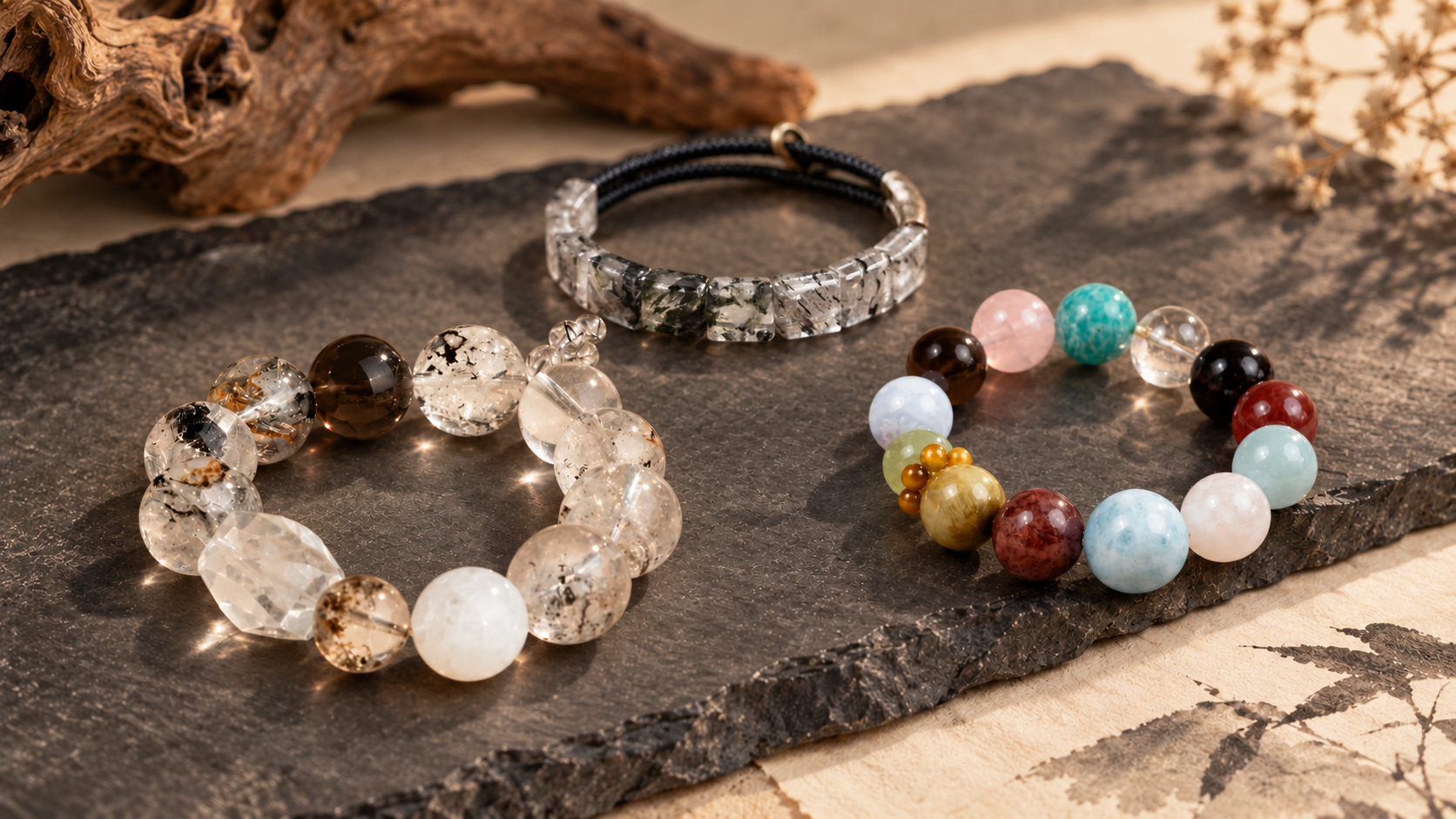
A quartz bracelet is jewelry made with quartz beads, sometimes combined with other stones, wood, or metal. Its meaning depends on the variety, the complete design, and the interpretation given to it—not on one universal promised benefit. Clear, pink, smoky, purple, and inclusion-rich quartz can look very different, so understanding the material is a useful starting point.
This guide treats quartz bracelet meaning in five separate contexts: mineral facts, documented Chinese material culture, Taoist-inspired design, modern symbolism, and Taoist World’s own bracelet compositions. A historical object can show how a material was used; it does not establish that every modern bracelet carries an ancient religious meaning. Likewise, a symbolic association is not evidence of a medical effect.
Below, you can compare common quartz types, understand how their appearance contributes to a design, and consider practical questions about choosing and caring for a bracelet. This is a broad overview rather than a complete guide to every subtype. Rose quartz and clear quartz receive brief introductions here, while the design examples show how quartz works alongside other materials.
What Is Quartz, and How Does It Form?
Quartz is crystalline silicon dioxide, built from silicon and oxygen. The Smithsonian National Museum of Natural History describes it as one of the most abundant minerals in Earth’s crust and a major component of beach sand and many rocks, including granite. Small amounts of impurities can contribute to its range of colors.
Well-formed quartz commonly develops six-sided prismatic crystals, although bracelet beads are cut and polished rather than left in their original crystal habit. Pure quartz is colorless. Color, transparency, and internal features help describe a bead’s appearance, but do not by themselves establish its identity, treatment, or origin.
Quartz is rated 7 on the Mohs hardness scale, which concerns resistance to scratching. As GIA’s guide to gem durability explains, hardness, toughness, and stability are different properties. Hardness alone does not make a bracelet resistant to every impact or exposure; its cord, fittings, and companion materials also need consideration.
For the larger distinction between minerals, rocks, glass, and organic materials used in wearable objects, see our guide to gemstone and crystal bracelets.
Quartz Types Used in Bracelets
The most reliable way to compare quartz bracelets is to look at transparency, color, internal features, bead cut, and the complete material list. Some names identify established mineral varieties; others describe inclusions or are commercial labels whose use varies among sellers.
Clear Quartz or Rock Crystal
Colorless, visibly crystalline quartz is commonly called rock crystal. Bracelet beads may be water-clear, cloudy, or crossed by veils and internal fractures. Its visual neutrality allows it to sit beside dark wood, colorful stones, or metal without dominating the palette. In modern design language, transparency often suggests clarity, openness, or reflection; these are symbolic readings, not medical findings.
Phantom Quartz
Phantom quartz can show an earlier crystal outline enclosed within later growth. The Mindat mineralogical glossary describes this preserved outline, including examples associated with changes in color or opacity. Internal features in a polished bead can suggest a landscape, but appearance alone does not establish the inclusion material. In the designs discussed here, phantom-like layers can be read as a visual metaphor for time and continuity.
Rutilated Quartz
Rutilated quartz is quartz containing rutile inclusions, which can have a needle-like appearance. Their arrangement contributes to the visual character of a bead. Needle-like inclusions alone do not identify the enclosed mineral; use reliable material documentation when composition matters. Names in a product listing, including “Black Rutilated Quartz,” should be understood as reported material labels unless identification is independently verified.
Rose Quartz
Rose quartz is the pink variety of quartz. Here it is one part of the broader material overview, not a complete guide to rose quartz bracelet symbolism. Color alone cannot establish the identity of every pink bead.
Other Colored Quartz Varieties
Smoky quartz ranges from pale gray-brown to deep brown; amethyst is purple quartz; and citrine is yellow to orange quartz. The Smithsonian also includes aventurine, agate, jasper, onyx, and tiger’s eye within the wider family of quartz gem materials, although their textures and structures differ from transparent macrocrystalline quartz.
Trade Names and Inclusion-Rich Materials
Names such as “Strawberry Quartz,” “Super Seven,” and “Black Flash Quartz” occur in jewelry descriptions, but a trade name alone does not verify composition, origin, or treatment. Treat the material list as the seller’s description and request appropriate documentation or gemological testing when exact identification matters.
Quartz in Chinese History and Material Culture
Quartz has a place in Chinese material culture, but it should not be collapsed into the history of jade. Nephrite and jadeite belong to different mineral families from quartz. Their long ritual, moral, and courtly histories are related to—but not the same as—the history of rock crystal, chalcedony, agate, amethyst, and other quartz materials.
The National Palace Museum’s exhibition Dazzling Gemstones and Jewelry places rock crystal among the quartz types used and collected in China. It also displays chalcedony earrings dated to the Neolithic period, an agate cup from the Qing dynasty, and a Qing amethyst carving of an immortal. These objects demonstrate that quartz-family materials entered Chinese ornament, carving, and elite collecting across different periods and forms.
The same museum cautions that historical naming did not always match modern mineral identification: at the Qing court, some colored transparent stones with visible internal cracks were broadly labeled in ways later testing could correct. That historical detail matters today. A poetic or traditional name can preserve cultural meaning, but it is not a substitute for mineralogical identification.
Quartz therefore carries two histories at once. One is geological: crystal structure, color, inclusions, and formation. The other is human: carving, collecting, ornament, naming, and interpretation. A responsible bracelet description keeps both visible instead of claiming that every modern quartz variety held one fixed meaning in ancient China.
Quartz Bracelet Meaning in Taoist-Inspired Design
Quartz is not inherently or exclusively Taoist. The interpretations below concern the complete designs discussed here: their visual contrasts, named themes, and Chinese artistic references. They are contemporary brand/design readings rather than evidence of a universal ancient Taoist rule or a property shared by every quartz bracelet.
Clarity and empty space. Transparent quartz can create visual openness between darker beads. In a design influenced by Chinese ink painting, that openness may work like unpainted paper: absence is not a lack, but an active part of the composition.
Change held within form. Phantom layers and mineral inclusions make growth visible. They can symbolize continuity, transformation, or the way a present form contains earlier stages without erasing them.
Contrast and mutual definition. Clear and opaque, light and dark, still surfaces and moving inclusions can be arranged as complementary qualities. This offers a visual analogy to yin–yang thinking without claiming that a quartz bead itself possesses a scientifically measurable yin or yang force.
Celestial movement and patterned order. Fine rutile needles or complex inclusions can resemble rays, constellations, or paths. In a named celestial design, that appearance supports the story created by the bracelet’s composition.
These are contemporary design interpretations. For the philosophical concept of naturalness, see Tao Follows Nature; the link does not establish an ancient quartz-specific doctrine.
Quartz in Taoist World Bracelet Designs
Plain White Ink-Wash Bracelet: Emptiness, Ink, and Restraint
The product description for the Plain White Ink-Wash Bracelet lists Black Flash Quartz, Clear Quartz, White Phantom Quartz, Green Phantom Quartz, and a Black Rutilated Quartz spinning ring. Dark beads supply visual weight; clear and white beads open space; green phantom quartz introduces a restrained natural accent. The design is best read as a complete black-and-white composition inspired by ink wash—not as a list of isolated crystal promises.
Earth Multi-Gemstone Bracelet: Quartz Within a Wider Landscape
The product description for the Earth Multi-Gemstone Aquamarine Golden Tiger Bracelet lists Snow Phantom Quartz, Strawberry Quartz, Rose Quartz, and Rutilated Quartz alongside aquamarine, kunzite, amazonite, serpentine, blue lace agate, tiger’s eye, and other stones. Here quartz is not one uniform center. Several quartz appearances contribute color, depth, and internal texture to a larger “earth” palette.
Qi Yao: Inclusions and the Seven Luminaries
The product description for the Qi Yao (Seven Luminaries) Bracelet describes a double-layer design centered on Super Seven Crystal. Its shifting inclusions and layered construction support a visual story of starlight and celestial movement. The meaning comes from the meeting of material appearance, the Seven Luminaries theme, and the bracelet’s structure; the trade name alone does not establish an ancient Taoist function.
Quartz also appears in mixed botanical designs. The Jiang Zhen Xiang Bracelet guide shows how White Phantom Quartz changes character when paired with dark aromatic beads and cinnabar. Readers can compare more combinations in the Gemstone & Crystal Bracelets collection.

A Short Practical Guide: Choosing, Wearing, and Caring
Choose by material and design first. Read the complete material list, then compare transparency, inclusions, bead diameter, wrist size, elastic tension, metal components, and overall weight. Natural variation is normal, but a photograph cannot confirm origin, treatment, or every commercial label.
Wear it according to comfort and intention. Choose the wrist that feels comfortable and suits your routine. A personal gesture, such as pausing to recall an intention, may give the bracelet meaning for you; this guide does not assign either wrist a universal energy function or a prescribed Taoist ritual.
Care for the whole bracelet. Follow care instructions for the cord, fittings, treatments, and companion materials, not just the quartz beads. For routine handling, use a soft cloth and avoid unnecessary soaking, strong chemicals, and impacts. Ask the seller or a qualified jeweler before using ultrasonic or steam cleaning when the materials or treatments are uncertain. GIA’s gem durability guidance distinguishes scratch resistance from resistance to breaking and exposure, and notes that some gems and treatments need special care.
Frequently Asked Questions
What does a quartz bracelet symbolize?
There is no single meaning shared by all quartz bracelets. In the design interpretations discussed here, clear quartz can suggest openness, phantom-like layers can suggest continuity, and visible inclusions can contribute a sense of movement. These are interpretations of appearance and composition, not guaranteed effects or universal ancient Taoist rules.
Is quartz a Taoist stone?
Quartz is a natural mineral used by many cultures, not an exclusively Taoist material. A bracelet becomes Taoist-inspired through its theme, motifs, arrangement, cultural references, and intended practice rather than through quartz alone.
How can I tell quartz types apart?
Color, transparency, and internal features are useful starting points, but appearance alone cannot confirm every mineral, inclusion, treatment, or trade label. Request reliable material documentation or gemological testing when exact identification matters.
Can quartz bracelets go in water?
Treat a bracelet as a multi-part object: care depends on the cord, fittings, treatments, and companion beads as well as the quartz. Follow its care instructions and remove it before bathing or swimming when those components are uncertain. This avoids assuming that a quartz bead makes the whole bracelet suitable for soaking.
Are inclusions defects?
Not necessarily. In phantom and rutilated quartz, inclusions are central to the material’s appearance and identity. They also make each bead different. Large fractures can affect durability, so beauty, identification, and structural condition should be considered separately.
Conclusion
A useful way to understand a quartz bracelet is to identify its materials, consider the complete design, and separate documented cultural history from personal symbolism. Clear, colored, and inclusion-rich quartz offer different visual possibilities; none requires one universal meaning. Use the examples above to compare compositions, then choose according to reliable material information, comfort, and the design that interests you.
Related Posts
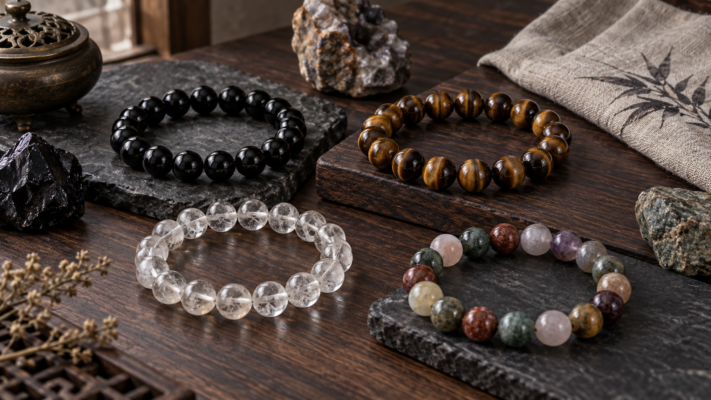
What Are Gemstone and Crystal Bracelets? Materials, Meaning, and How to Choose
Explore gemstone and crystal bracelets, their materials, symbolism, design types, fit, care, and how to [...]
Sep
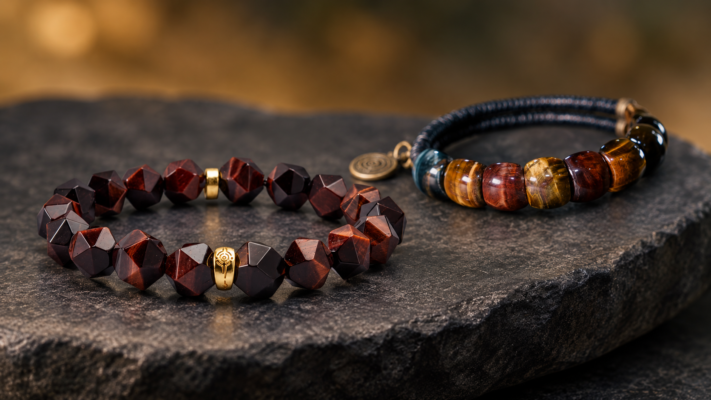
Tiger Eye Bracelet Meaning: Chatoyancy, Chinese Symbolism, and Taoist World Designs
Explore tiger eye formation, chatoyancy, golden, red and blue varieties, Chinese tiger symbolism, and Taoist [...]
Sep
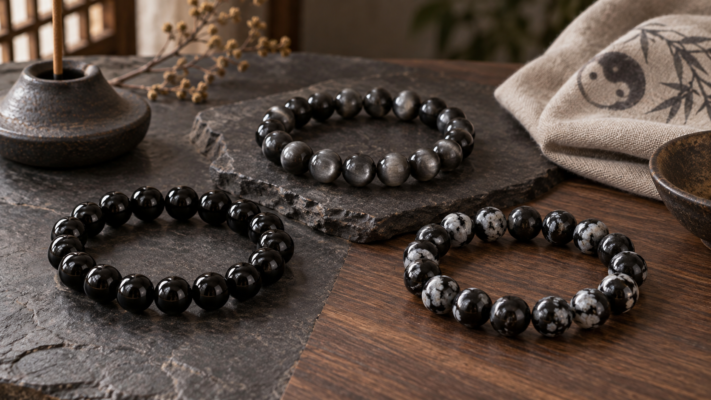
Obsidian Bracelets: Volcanic Glass, Chinese Symbolism, and Taoist World Designs
Explore obsidian bracelet meaning through volcanic-glass formation, black, snowflake and sheen types, cultural context, symbolism, [...]
Sep