
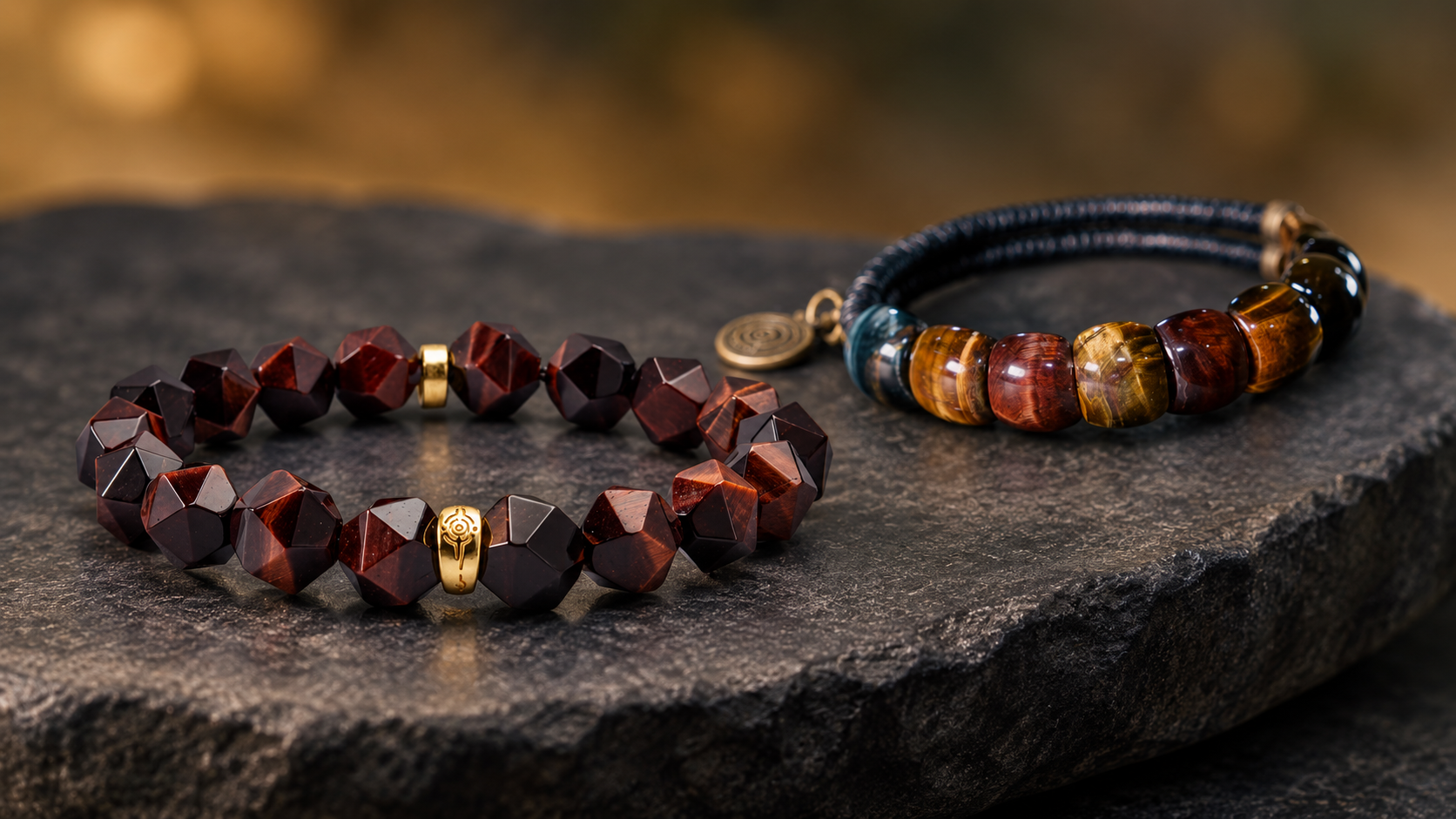
Tiger eye is immediately recognizable when light crosses a polished bead: a bright band appears to travel over warm brown, gold, red, or blue-black layers. That moving reflection gives the material its watchful name and supplies much of the symbolism found in tiger eye bracelets.
Yet tiger eye bracelet meaning is not one ancient rule or a list of guaranteed benefits. It grows from several distinct sources: the stone’s fibrous structure and optical effect, the broader symbolism of the tiger, Chinese cosmological images such as the White Tiger, modern gemstone traditions, and the actual composition of a bracelet. Understanding those layers makes the design more meaningful without presenting belief as mineral science.
What Is Tiger Eye?
Tiger eye is a chatoyant gem material in the quartz family, usually displaying golden-yellow to reddish-brown bands and a silky luster. It consists of closely aligned quartz and altered amphibole-related fibers, with iron oxides contributing much of the familiar warm color. Polishing the material across its parallel structure reveals the moving line of light.
Tiger eye is commonly placed around 6.5–7 on the Mohs hardness scale. That makes it suitable for beads and everyday jewelry, but hardness only describes resistance to scratching. A bead can still chip or fracture under impact, while elastic, cord, silver, copper, brass, wood, and companion stones may be more vulnerable than the tiger eye itself.
For the wider distinction between crystalline quartz, microcrystalline quartz, glass, rocks, and mixed jewelry materials, begin with our gemstone and crystal bracelet guide.
How Tiger Eye Forms
A simplified explanation often says that quartz replaces pre-existing crocidolite fibers and preserves their shape. That model remains common in gem descriptions, but research has shown that the story is more complicated. In a 2003 paper in Geology, Peter Heaney and Donald Fisher examined South African material and argued that its structure developed through a crack-seal process in which quartz and fibrous amphibole grew during repeated fracture opening and mineral deposition, rather than through simple one-for-one replacement of an earlier fiber mass.
This repeated growth created organized, parallel textures. Later alteration and oxidation changed the fibers and helped develop the golden-brown colors associated with tiger eye. Blue-gray material preserves a different stage or degree of alteration and is commonly sold as hawk’s eye or blue tiger eye.
The geological detail matters because the stone’s most famous visual feature is structural. Its shimmer is not painted onto the surface. The aligned internal texture directs reflected light, while the orientation and polish of each bead determine how strongly the effect appears.
Chatoyancy: The Moving Band of Light
The optical effect in tiger eye is called chatoyancy, from a French expression meaning “cat’s eye.” Under directional light, a bright band seems to glide across a rounded bead as the bracelet or viewer moves. The band is produced by reflection from the material’s parallel fibrous structure.
Cutting orientation is essential. A bead polished across the fibers can show a concentrated moving line; a poorly oriented or flat-looking piece may display only weak banding. Because bracelets curve around the wrist, several beads can catch light at different angles and create a sequence of shifting highlights.
This eye-like movement offers a direct visual foundation for meanings such as awareness, vigilance, focus, and watchfulness. Those meanings arise through observation and metaphor. They do not demonstrate that the stone can medically improve concentration, treat anxiety, or prevent physical harm.
Tiger Eye Types, Colors, and Appearance
Golden-Brown Tiger Eye
The classic variety combines dark brown layers with honey, gold, or bronze bands. Its warm palette works naturally with wood, copper, brass, black cord, and earth-toned stones. Strong specimens show a clear band that travels as the bead turns, though natural variation means no two beads need to match perfectly.
Red Tiger Eye
Red tiger eye ranges from copper-red to deep reddish brown. Heating is commonly used in the trade to strengthen red coloration, so vivid red beads should not automatically be described as untreated. Their darker palette often gives a bracelet a more concentrated and forceful visual character than golden-brown tiger eye.
Hawk’s Eye or Blue Tiger Eye
Hawk’s eye is a related chatoyant quartz material with blue-gray, blue-black, or greenish tones. Sellers frequently use “blue tiger eye” as a trade description. It shares the moving silky band but creates a cooler, quieter appearance. Exact terminology may vary, so color alone is not enough to establish treatment, origin, or identity.
Tiger Iron and Multicolor Designs
Tiger iron is a banded rock that combines tiger eye with red jasper and dark hematite. It should not be treated as another color of pure tiger eye. A multicolor tiger eye bracelet, meanwhile, may arrange golden, red, brown, and blue-black chatoyant beads together. Those beads can differ in alteration or treatment history even when they belong to one coordinated design.
Unnaturally uniform color, molded seams, or a light band that looks identical from every angle may suggest imitation material, including fiber-optic glass. Photographs can help compare patterns, but only qualified gemological testing can confirm identity and treatment with confidence.
Tiger Symbolism in Chinese Culture
The tiger has a long Chinese cultural history as an image of authority, courage, military strength, vigilance, and protection. That history helps explain why a stone named for a tiger’s eye can support guardian symbolism in modern jewelry. It does not prove that tiger eye mineral beads themselves served one fixed role throughout ancient Chinese or Taoist practice.
The White Tiger, the West, and Metal
In Chinese cosmology, the White Tiger is one of the four directional animals. It corresponds to the west and is associated with autumn and the Metal phase. A seventh-century Chinese bronze mirror in the Metropolitan Museum of Art depicts the green dragon of the east, white tiger of the west, red bird of the south, and the black tortoise-and-snake of the north. The museum notes that these cardinal associations emerged around the third century BCE and became firmly established afterward.
This is a history of the tiger image and cosmological system, not evidence that golden tiger eye was the historical material of the White Tiger. The connection in a modern bracelet is interpretive: the stone’s name, watchful band, warm colors, and chosen motifs can evoke the guardian tiger.
Readers can explore the underlying correspondences in the Five Elements theory and the White Tiger’s celestial region in our guide to the Twenty-Eight Mansions.
The White Tiger and the Zodiac Tiger Are Not the Same
The White Tiger belongs to the four-direction cosmological system. The Tiger of the twelve-animal zodiac belongs to the cyclical calendar and is traditionally associated with qualities such as boldness, initiative, and independence. Modern jewelry may draw from either framework, but responsible descriptions should identify which one a design uses.
For the zodiac framework and the Tiger’s position within it, see the twelve Chinese zodiac animals.
Tiger Eye Bracelet Meaning in Modern Design
Watchfulness and focus come from the moving “eye” that remains visually active as the wrist turns. The bracelet can serve as a reminder to observe before acting and to keep attention on the task at hand.
Courage with restraint combines the tiger’s strength with tiger eye’s grounded brown and gold palette. Rather than uncontrolled aggression, the design can suggest steady action and confidence under pressure.
Protection and boundaries draw on the guardian role of the tiger in Chinese imagery. Worn as jewelry, this is symbolic language—a reminder to protect one’s time, judgment, or principles—not proof of an invisible physical shield.
Movement within stability is created by the contrast between a solid stone and a band of light that never appears completely still. In Taoist-inspired design, that contrast can suggest responsiveness: staying centered while conditions and perspectives change.
Tiger Eye in Taoist World Bracelet Designs
Fu Mo Yun Lei: Multicolor Tiger Eye and the Cloud-Thunder Spiral
The Fu Mo Yun Lei Multicolor Tiger Eye Bracelet combines natural yellow, red, brown, and blue-black tiger eye with black cord, wooden spacers, and a vintage brass spiral charm inspired by cloud-and-thunder patterns. The changing bead colors emphasize variation and movement; the spiral adds a visual theme of transformation and connection between heaven and earth.
Red Tiger’s Eye and Silver: Seven Watchful Stones
The Tiger’s Eye Bracelet centers on seven Red Tiger’s Eye stones set with pure-silver details. Compared with the multicolor Fu Mo Yun Lei design, its restricted red-brown palette and repeated seven-stone arrangement create a focused, compact expression of watchfulness, courage, and grounded decision-making.
Double Light: Layered Tiger Eye and Handcrafted Copper
The Double Light Bracelet uses multiple tiger eye strands with handcrafted copper accents. Repetition across the layered construction amplifies the moving bands of light, while copper introduces warmth and visible handwork. Its meaning comes as much from scale, rhythm, and construction as from the stone itself.
A separate zodiac interpretation appears in the Chinese Zodiac Tiger Bracelet, where Tiger’s Eye is paired with Yellow Tower Quartz in a golden composition designed around the Tiger sign rather than the White Tiger of the west. More material combinations are available in the Gemstone & Crystal Bracelets collection.
A Short Practical Guide: Choosing, Wearing, and Caring
Choose by light, structure, and complete materials. Compare the strength and movement of the chatoyant band, natural variation among beads, color or treatment disclosures, bead size, wrist fit, and construction. A single strand, layered copper design, silver setting, and corded bracelet will feel and age differently.
Wear it on the wrist that is comfortable. There is no scientifically established or universal Taoist rule requiring tiger eye on the left or right wrist. Modern “receiving hand” and “projecting hand” explanations belong to particular belief systems. Comfort, dominant-hand activity, stacking, and the location of metal details are more practical considerations.
Care for the most sensitive component. Wipe the bracelet with a soft cloth after wear and remove it before swimming, bathing, cleaning, sport, or impact-heavy work. Avoid prolonged soaking, harsh chemicals, sudden temperature changes, and pulling elastic from a single bead. Silver may tarnish, copper and brass may develop patina, and wood or cord should remain dry. Store the bracelet separately to reduce scratching and tangling.
Frequently Asked Questions
What does a tiger eye bracelet symbolize?
Modern tiger eye bracelets commonly symbolize watchfulness, courage, focus, confidence, protection, and grounded action. The exact meaning changes with the color, construction, motifs, companion materials, and the wearer’s personal intention.
Why does the light seem to move across tiger eye?
Parallel internal structures reflect light as the stone or viewer moves. On a rounded, correctly oriented bead, this creates chatoyancy: a bright line resembling a cat’s eye that appears to travel over the surface.
Is tiger eye an ancient Taoist stone?
Tiger eye is a natural gem material used internationally. The tiger and White Tiger have important places in Chinese and Taoist-related cosmology, but that does not make every tiger eye bead an ancient Taoist object. A bracelet becomes Taoist-inspired through its verified motifs, composition, interpretation, and intended practice.
Is red tiger eye natural?
Natural reddish material exists, but heat treatment is also commonly used to deepen red color. Appearance alone cannot reliably establish treatment status. Check the seller’s disclosure or request appropriate gemological documentation when this distinction matters.
Which hand should wear a tiger eye bracelet?
Either wrist is acceptable. Choose according to fit, comfort, work habits, and how the bracelet interacts with a watch or other jewelry. Left-receiving and right-projecting rules are modern symbolic preferences rather than universal requirements.
Conclusion
Tiger eye is compelling because its appearance already contains a story: a stable mineral surface crossed by light that shifts with every movement. Its fibrous structure explains the cat’s-eye effect, while golden, red, blue-black, layered, and multicolor designs offer distinct visual identities.
Chinese tiger symbolism adds cultural depth when used carefully. The White Tiger, zodiac Tiger, and a modern tiger eye bracelet are related through imagery, but they are not interchangeable historical categories. Taoist World designs make those relationships visible through stone choice, metalwork, cord, motifs, and composition—turning the bracelet into a personal reminder of alertness and steady courage rather than a promise of supernatural or medical results.
Related Posts

What Are Gemstone and Crystal Bracelets? Materials, Meaning, and How to Choose
Explore gemstone and crystal bracelets, their materials, symbolism, design types, fit, care, and how to [...]
Sep

Quartz Bracelet Meaning: Types, Chinese Culture, and Taoist World Designs
Explore quartz formation, clear, phantom and rutilated varieties, Chinese cultural history, Taoist-inspired symbolism, and Taoist [...]
Sep

Obsidian Bracelets: Volcanic Glass, Chinese Symbolism, and Taoist World Designs
Explore obsidian bracelet meaning through volcanic-glass formation, black, snowflake and sheen types, cultural context, symbolism, [...]
Sep