

Introduction
An agarwood bracelet combines wearable wood, natural variation, and a material with a long aromatic and cultural history. Depending on the design, it may be made primarily from polished agarwood beads or combine agarwood with stone, shell, seeds, metal, and other organic materials.
That variety makes agarwood bracelet meaning more complex than a single claim about luck, protection, or “energy.” Agarwood has appeared in religious, aromatic, luxury, and contemplative contexts across several cultures. A modern bracelet may draw from that history, but its meaning also depends on the actual materials, construction, motifs, and intention of the wearer.
This guide begins with agarwood as a material—how resin forms, why fragrance matters, and how it entered Chinese incense culture—then connects those qualities to symbolism and specific Taoist World bracelet designs. Choosing, wearing, and care appear later as practical support rather than the article’s main frame.
What Is Agarwood?
Agarwood is resin-rich aromatic wood associated mainly with trees in the Aquilaria and Gyrinops genera. It does not describe every part of an ordinary tree in the same way. The valued material develops when the tree responds to injury and biological stress by producing and accumulating resin within the wood.
A peer-reviewed review in Economic Botany explains that resin-infused agarwood has been traded and used for centuries in incense, perfumery, spiritual practice, and luxury goods. It also notes that aroma varies with species, growing location, the part of the tree, resin development, harvesting, and processing.
Those variables matter in jewelry. Agarwood beads can differ in color, grain, weight, aroma, resin distribution, polishing, and finish. Darker color or a stronger smell alone does not prove a particular grade, origin, or natural resin content. Coatings, added fragrance, lighting, and commercial naming can affect what a buyer sees or smells.
Agarwood is also a conservation-sensitive trade material. The CITES species checklist includes agarwood-producing taxa under international trade controls. This does not make every agarwood object unlawful, but it makes transparent sourcing, accurate identification, and seller documentation more meaningful than dramatic “secret tests.”
For a broader comparison of mineral, wood, glass, and mixed-material jewelry, see our guide to gemstone and crystal bracelets.
Agarwood, Oud, and Aloeswood: Do the Names Mean the Same Thing?
Agarwood is known by many regional and historical names, including oud, aloeswood, gaharu, jinkoh, and chenxiang. These words developed in different languages and trade traditions. In broad English-language use, “agarwood” and “oud” often point to the same resinous aromatic material, although “oud” is especially common in perfumery and Middle Eastern contexts.
Product descriptions still require care. An “oud bracelet” might refer to beads made from agarwood, a bracelet scented with oud oil, or jewelry marketed through an oud-inspired fragrance story. The name alone cannot establish species, geographic origin, resin content, treatment, or authenticity. Read the complete material disclosure rather than relying only on the title.
Agarwood in Chinese Incense Culture and Historical Practice
In Chinese, agarwood is commonly called chenxiang (沉香), often translated as “sinking fragrance.” The name points to the density of resin-rich wood and to fragrance as the material’s defining quality. Agarwood was valued not simply as decorative timber, but as an aromatic material encountered through incense, connoisseurship, collecting, and crafted objects.
The National Palace Museum has presented agarwood within the history of incense culture, including its high status in later imperial China. Historical use was not confined to one belief system: agarwood appears in Buddhist and Daoist ritual settings, courtly and literati culture, traditional materia medica, and domestic fragrance practices. These contexts overlap, but they should not be treated as identical.
That history helps explain why an agarwood bracelet can carry meanings of refinement, composure, reverence, and inward attention. The symbolism comes from the material’s slow resin formation, layered aroma, rarity, and long cultural use—not from a universal promise that every bracelet produces the same spiritual or physical effect.
In contemporary jewelry, the cultural story is expressed through bead grain, scent, hand feel, spacing, companion materials, and symbolic motifs. A responsible product description should therefore identify what the bracelet is made from and how the design interprets that heritage.
What Does an Agarwood Bracelet Mean?
There is no single universal agarwood bracelet meaning. Its symbolism has grown from several overlapping qualities: rarity, fragrance, transformation within wood, long-distance trade, religious use, craftsmanship, and the tactile experience of handling beads.
Reflection and composure. Aromatic wood and bead handling have long appeared in contemplative settings. In a modern bracelet, agarwood may serve as a sensory reminder to pause, breathe, or return attention to the present. That is a personal practice, not proof that the wood treats anxiety or another medical condition.
Transformation through time. Agarwood becomes valued because resin develops within stressed or wounded wood. This unusual formation process can symbolize adaptation, patience, and the possibility that experience leaves meaningful traces. The symbolism comes from the material story; it does not promise that wearing a bracelet will change external events.
Rarity and refinement. Agarwood has circulated historically as an aromatic luxury material. Polished beads can therefore suggest discernment, craftsmanship, and appreciation of subtle natural variation rather than conspicuous brilliance.
Spiritual association. Agarwood has been used in multiple religious and cultural traditions, but those traditions are not interchangeable. A bracelet may support an individual prayer, counting, or meditation routine, yet a modern decorative strand should not automatically be described as an ancient Taoist, Buddhist, Hindu, or Islamic ritual object without specific evidence.
Personal continuity. Wood changes gradually with touch, air, and wear. For some people, that developing surface becomes a record of daily use and gives the bracelet meaning over time.
Traditional Associations and Modern Boundaries
Traditional and modern discussions often associate agarwood with calm, reflection, protection, prosperity, or the clearing of unwanted influences. These ideas belong to cultural interpretation, personal testimony, and spiritual practice; they should not be converted into guaranteed medical or material outcomes.
The practical qualities are more modest and verifiable. Wood beads are generally lighter than similarly sized stone beads. A genuine aromatic piece may have a subtle natural scent, although intensity varies and can change with temperature, humidity, finishing, storage, and wear. Smooth beads can also provide a tactile object for counting or personal reflection.
Traditional associations with purification, spiritual attention, peace, auspiciousness, or status can still be meaningful when clearly described as cultural symbolism. A responsible article separates those associations from claims that a bracelet diagnoses, prevents, or treats a health condition.
Solid Agarwood Beads vs. Herbal Incense Beads
A bracelet made with agarwood as a listed material is not necessarily the same as a botanical fragrance bracelet whose compressed blend includes agarwood among several ingredients. Both can be wearable aromatic objects, but their construction, texture, scent profile, and care needs may differ.
Solid wood beads should be evaluated through material disclosure, grain, workmanship, finish, provenance, and treatment information. Herbal incense beads should be evaluated through the actual ingredient list and the stability of the complete formula. They are wearable beads and should not be described as loose incense intended for burning.
Our comparison of woody herbal bracelets examines Wuzhen and E Li Zhang Zhong Xiang as formulated botanical blends. That article complements this material guide but answers a different search question.
Agarwood Materials, Cultural Meaning, and Taoist World Designs
Agarwood is not exclusively Taoist. Its role in Taoist-inspired jewelry depends on the complete design: the relationship between natural materials, named motifs, auspicious color, sound, craftsmanship, and the balance between restrained wood and brighter accents.
The Xuanli Wealth Bead combines Agarwood with Ebony, Liuli, Tagua Nut, a bell, and a Phoenix Nine motif. Here the dark wood creates a grounded base while red glass-like color, pale organic material, metalwork, and sound produce a layered symbolic composition.
The Golden Agarwood Bracelet pairs Agarwood with Southern Red Agate and shell. Its warm wood, deep red stone, and gold-toned accents create a more luminous expression centered on contrast and auspicious color.
The Fuling Wishing Beads uses Agarwood alongside Bodhi Root, Vajra Bodhi, Magnesite, Camel Bone, and Deer Antler. Because the design mixes wood, seeds, mineral, and animal-derived materials, its meaning and care must be based on the complete bracelet rather than agarwood alone.
The Dalai Square Ingot Bracelet combines Agarwood, Southern Red Agate, Copper, and a material currently listed on the product as Beeswax. Since commercial translations can be ambiguous, this guide does not reinterpret that material as amber without independent confirmation.
Readers comparing all current designs can explore the Gemstone & Crystal Bracelets collection.

Practical Guidance: Choosing, Wearing, and Caring for Agarwood Bracelets
How to Choose an Agarwood Bracelet
Start with a complete material list. Determine whether the bracelet is mainly agarwood or a mixed design. Stone, shell, metal, elastic, cord, seeds, and organic components change its weight, feel, symbolism, and care requirements.
Ask what “agarwood” means in that listing. Look for species information when available, country or region claims, whether the wood is cultivated or wild sourced, and whether oil, fragrance, dye, coating, or stabilizer has been added. Do not assume a claimed origin or grade from a photograph.
Use several signals rather than one home test. Grain, aroma, density, color, surface finish, price, and water behavior can all be misunderstood or manipulated. No single “sink test,” smell test, or color rule proves authenticity across every piece.
Inspect workmanship and fit. Beads should feel smooth, drill holes should not have sharp edges, and the elastic or cord should suit the weight of the complete bracelet. Measure your wrist and compare it with the stated size rather than relying on labels such as small or large.
Prefer traceability over dramatic promises. Clear material disclosure, close photographs, treatment information, sizing, return terms, and responsive seller communication are more useful than claims of guaranteed luck, healing, or supernatural protection.
How to Wear an Agarwood Bracelet
An agarwood bracelet can be worn on either wrist. Statements that the left wrist universally “receives” energy and the right wrist “releases” it belong to particular modern belief systems, not a scientific rule or a universal Taoist requirement.
Choose the side that is comfortable and less exposed to water, desk impact, tools, or repeated friction. A looser fit can reduce pressure on wood and mixed beads, but the bracelet should not slide off the hand. Avoid stacking it beside sharp metal jewelry that may scratch the finish or damage the cord.
If the bracelet is used as a reminder during breathing, prayer, or meditation, let the practice be simple and personal. The object can support attention without being treated as a substitute for medical care or as a guarantee of a particular result.
How to Care for an Agarwood Bracelet
Keep it dry. Remove the bracelet before bathing, swimming, washing dishes, or prolonged exercise. Water can affect wood, elastic, cord, metal fittings, compressed botanical beads, and surface finishes.
Avoid perfume and household chemicals. Alcohol, detergent, sanitizer, cosmetics, essential oils, and added fragrance can alter the surface or mask the bracelet’s natural aroma. Apply personal-care products first and allow them to dry before wearing the bracelet.
Wipe gently after wear. Use a clean, soft, dry cloth. Do not soak the beads or scrub them with an abrasive brush. If the seller provides treatment-specific instructions, follow those for the exact piece.
Store away from heat, sunlight, moisture, and strong odors. Keep the bracelet in a clean, dry container or soft pouch. Do not seal it while damp, and do not store it beside strongly scented products that can overwhelm its own aroma.
Inspect the whole bracelet. Check elastic, knots, metal edges, pendants, and connectors regularly. In a mixed-material design, care for the most sensitive component rather than assuming every bead can be treated like wood.
Conclusion
Agarwood bracelet meaning grows from the material’s aromatic history, gradual resin formation, cultural use, craftsmanship, and the personal experience of wearing natural beads. Reflection, transformation, refinement, and continuity are useful symbolic themes, but they should not be turned into guaranteed medical, financial, or supernatural outcomes.
The best choice begins with accurate material disclosure. Compare the complete bracelet, ask about treatment and sourcing, examine workmanship and fit, and care for every component conservatively. That approach respects both the cultural significance of agarwood and the practical reality of wearable jewelry.
Frequently Asked Questions
Is agarwood the same as oud?
In broad usage, yes: oud commonly refers to the aromatic resinous material known in English as agarwood. However, an “oud bracelet” may also be scented or oud-inspired, so the product’s material disclosure still matters.
Should an agarwood bracelet have a strong smell?
Not necessarily. Aroma varies with the individual wood, resin distribution, processing, finish, temperature, humidity, storage, and wear. An extremely strong scent may come from added fragrance, while a subtle scent does not automatically mean the bracelet is fake.
How can I tell whether an agarwood bracelet is authentic?
No single home test can prove authenticity in every case. Assess several factors together: seller traceability, treatment disclosure, material details, grain, aroma, workmanship, close photographs, documentation, and return terms. Laboratory analysis may be needed for high-value verification.
Which wrist should I wear an agarwood bracelet on?
Either wrist is acceptable. Choose the side that feels comfortable and reduces exposure to water, impact, and friction. Left-versus-right “energy” rules are belief-based rather than universal requirements.
Can an agarwood bracelet get wet?
Brief accidental contact may not ruin every bracelet, but prolonged soaking should be avoided. Water can affect wood, finishes, elastic, cord, metal, and other organic components. Remove the bracelet before bathing or swimming.
Does an agarwood bracelet have proven health benefits?
A wearable agarwood bracelet should not be presented as a treatment for anxiety, sleep problems, pain, circulation, or other health conditions. Its aroma, light weight, tactile feel, cultural associations, and use as a personal reminder may be meaningful, but those qualities are not a substitute for medical care.
Related Posts
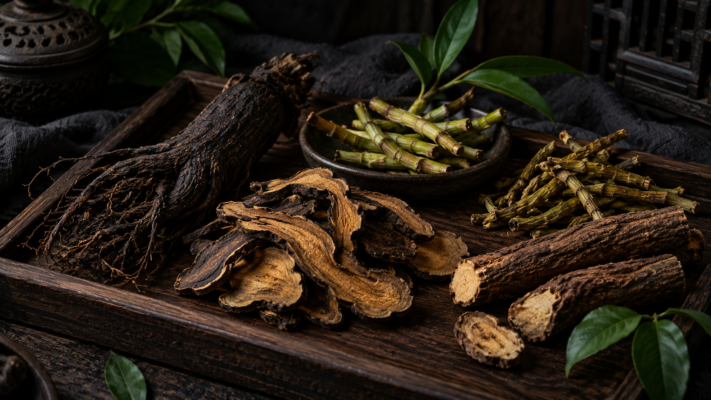
Hei Long Xian Bracelet: Dark Stones, Woody Fragrance, and Symbolic Meaning
Explore the Hei Long Xian bracelet, its dark stones, botanical formula, protective symbolism, material facts, [...]
Sep
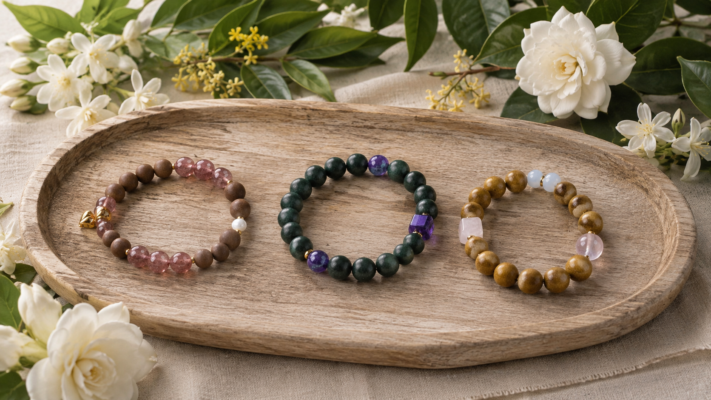
Jasmine, Gardenia, and Osmanthus Herbal Bracelets: Exploring Three Floral Blends
Introduction Choosing a floral bracelet sounds simple until you discover how differently a flower can [...]
Sep

What Are Chinese Herbal Bracelets? A Guide to Botanical Blends, Fragrance, and Meaning
Chinese herbal bracelets combine aromatic botanical incense beads with wearable jewelry materials such as crystals, [...]
Sep