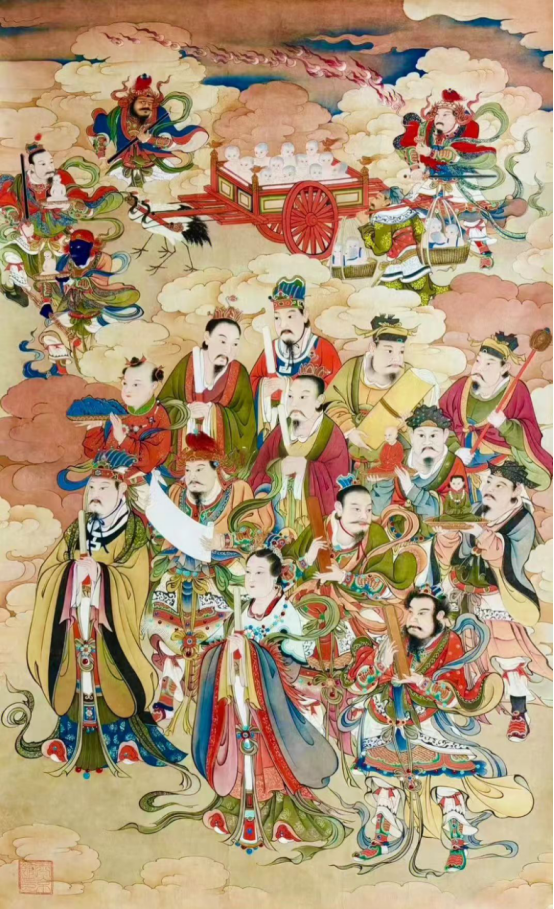
The Nine Heavens Creator of Spirits is a divine system composed of nine celestial emperors in ancient Chinese Taoist belief. This sacred system originated from Taoist classics such as The Great Law of the Upper Clearness and The Golden Book of the Instruction and Salvation of the Divine Essence.
According to Taoist cosmology, the Nine Heavenly Deities emerged from the differentiation of the three primordial energies: Tao, Yuan, and Sheng. The first three emperors originated from Sheng qi, the middle three from Yuan qi, and the final three from Tao qi, forming a complete celestial hierarchy connected with the structure of the universe.
Origin of the Nine Heavenly Deities
Ancient Taoist teachings describe the universe as being divided into nine heavenly layers, each governed by a supreme celestial ruler. These rulers became known collectively as the Nine Heavens Creator of Spirits.
This cosmological concept reflects the Taoist understanding that Heaven, qi, and divine order are interconnected. Similar ideas of layered celestial governance can also be found in traditions associated with the Four Heavenly Masters in Taoism, where heavenly authority and spiritual administration play central roles.
The Nine Heavenly Emperors symbolize the highest manifestations of cosmic power, wisdom, and spiritual transformation.
The Nine Celestial Emperors
The Nine Heavenly Deities are traditionally listed as:
Yudan Wumian Heavenly Emperor
Associated with the earliest manifestation of sacred celestial qi and the beginning of divine order.
Shangshang Chanshan Wumian Shengnian Heavenly Emperor
Represents the continuation of heavenly vitality and spiritual purity.
Banjian Xuanyan Heavenly Emperor
Connected with mystical transformation and cosmic balance.
Ziru Duoshi Heavenly Emperor
Associated with spiritual teaching and heavenly governance.
Boloni Min Jiaojue Heavenly Emperor
Represents enlightenment and transcendence within Taoist cosmology.
Dongyuan Huaxing Heavenly Emperor
Closely related to cosmic evolution and celestial movement.
Linghua Banfu Heavenly Emperor
Associated with sacred spiritual blessings and heavenly protection.
Gaoxu Qingtian Heavenly Emperor
Represents the purity and clarity of the higher heavens.
Wuxiang Wuxie Wuai Heavenly Emperor
Symbolizes the ultimate formless and unobstructed state of the Tao.
Cosmological Meaning in Taoism
The Nine Heavens system reflects one of the highest expressions of Taoist cosmology. Ancient Taoists believed that the universe operated through layers of heavenly qi governed by divine rulers.
This structure influenced many later Taoist ritual traditions, including celestial bureaucracy systems, scripture traditions, and thunder ritual theology. Some cosmological ideas connected to heavenly administration later influenced traditions related to the Twenty-Four Dharma-Protecting Heavenly Lords.
The concept also reflects the Taoist belief that humanity and Heaven are deeply connected through qi and spiritual transformation.
The Concept of “Receiving the Qi of Nine Heavens”
A traditional Taoist saying states that “a person acquires the qi of nine heavens to become a deity.” According to this belief, a fetus receives heavenly qi month by month while in the womb, and after nine months the spiritual energies become complete.
This teaching symbolizes the relationship between cosmic qi and human life. Similar concepts of spiritual transformation and celestial energy also appear within the traditions of Dian Mu (Lightning Mother) in Taoism, where heavenly forces directly influence the mortal world.
Cultural Significance of the Nine Heavens Creator of Spirits
The Nine Heavenly Emperors represent the Taoist understanding of universal order, divine hierarchy, and cosmic creation. They symbolize the origin of heavenly power and the spiritual structure of the cosmos itself.
In Taoist philosophy, the Nine Heavens are not merely physical realms, but spiritual dimensions connected to destiny, immortality, and the movement of primordial qi. Their influence appears throughout Taoist scripture, ritual practice, and celestial mythology.
Related Posts
The Nine Chen Lords of the Divine Firmament
The Nine Chen Lords of the Divine Firmament in Chinese is 神霄九宸大帝(shén xiāo jiǔ chén [...]
Dec
The Jade Emperor in Taoism: Supreme Ruler of Heaven and Cosmic Order
The Jade Emperor, whose full honorific title is “The Supreme Sovereign of the Heavenly Golden [...]
Dec
The Thirty-Six Heavenly Generals in Taoism: Guardians of Thunder, Exorcism, and Celestial Justice
The Thirty-Six Heavenly Generals are one of the most important groups of martial guardian deities [...]
Dec