
Introduction
When people first learn their Chinese zodiac animal, it is often treated as a fun fact — something to mention alongside a Western star sign. But the Chinese zodiac is much more than a personality system. It is part of a traditional framework for understanding time, personality, compatibility, and the recurring cycles of Chinese astrology.
The Chinese zodiac, or Shengxiao (生肖), assigns one of twelve animals to each year in a repeating cycle. Unlike Western astrology, which divides the zodiac into twelve signs based on the position of the Sun during the year, the Chinese zodiac traditionally connects a person’s animal sign with their year of birth.
The twelve animals are the Rat, Ox, Tiger, Rabbit, Dragon, Snake, Horse, Goat, Monkey, Rooster, Dog, and Pig. Each animal has its own traditional characteristics and symbolic associations, but these interpretations are better understood as cultural archetypes rather than fixed descriptions of personality.
The zodiac also connects with the Five Elements, the 60-year cycle, and the annual Tai Sui system. Understanding these relationships provides the foundation for more specific topics such as yearly zodiac forecasts, Tai Sui conflicts, and traditional protective practices.
This guide explores the Chinese zodiac by examining:
- the traditional legend behind the twelve animals
- the historical development of the zodiac system
- the traditional meanings associated with each animal
- how the twelve animals interact with the Five Elements
- how to determine your own Chinese zodiac sign
- how zodiac animals connect with Tai Sui and yearly astrology
The Legend of the Great Race
The most widely known explanation for the order of the twelve zodiac animals is the legend of the Great Race.
According to Britannica’s overview of the Chinese zodiac, the Jade Emperor called upon the animals of the world to compete in a race, promising positions in the zodiac to the first twelve animals to arrive.
The clever Rat, unable to compete with stronger animals in a swimming race, reportedly persuaded the Ox to carry it across the river. Just before reaching the finish line, the Rat jumped ahead and claimed first place.
The Ox came second, followed by the Tiger and Rabbit. The Dragon, despite being capable of flying, arrived later because the legend says it stopped to help people by bringing rain.
The Snake secretly traveled with the Horse and then emerged unexpectedly, taking sixth place. The Goat, Monkey, and Rooster arrived together, while the Dog was delayed after stopping to play in the water. The Pig arrived last after taking time to eat and rest.
The story explains the familiar order:
Rat → Ox → Tiger → Rabbit → Dragon → Snake → Horse → Goat → Monkey → Rooster → Dog → Pig
Although the Great Race is a popular explanation for the order, it should be understood as a folk legend rather than a documented historical account of how the zodiac system was created.
Where Does the Chinese Zodiac Actually Come From?
The legend of the Great Race is memorable, but the historical development of the Chinese zodiac is considerably more complicated.
According to Britannica (Chinese Zodiac), scholars have proposed different dates for the development of the twelve-animal system, including periods associated with the Warring States, Qin, and Han dynasties.
By the later Han period, however, the twelve-animal system had become firmly established.
This distinction is important because the zodiac was not necessarily created in a single moment by a single individual. Like many traditional systems, it appears to have developed gradually through the interaction of astronomy, calendrical practices, folklore, symbolism, and Chinese philosophical traditions.
The twelve animals were also connected with the older system of the Twelve Earthly Branches, which played an important role in traditional Chinese calendrical calculations.
In other words, the animals are not simply twelve personality symbols. They are part of a much larger system for organizing cycles of time.
The 12 Chinese Zodiac Animals and Their Meanings
Each zodiac animal is traditionally associated with a collection of personality characteristics and symbolic meanings.
These descriptions should not be treated as scientific personality assessments. Instead, they represent traditional cultural interpretations that have been passed down and adapted over generations.
Complete Guide
| Order | Animal | Chinese | Earthly Branch | Traditional Traits |
|---|---|---|---|---|
| 1 | Rat | 鼠 | Zi 子 | Clever, resourceful, adaptable |
| 2 | Ox | 牛 | Chou 丑 | Patient, dependable, hardworking |
| 3 | Tiger | 虎 | Yin 寅 | Brave, confident, ambitious |
| 4 | Rabbit | 兔 | Mao 卯 | Gentle, diplomatic, sensitive |
| 5 | Dragon | 龙 | Chen 辰 | Charismatic, ambitious, powerful |
| 6 | Snake | 蛇 | Si 巳 | Intuitive, strategic, thoughtful |
| 7 | Horse | 马 | Wu 午 | Energetic, independent, adventurous |
| 8 | Goat | 羊 | Wei 未 | Gentle, creative, compassionate |
| 9 | Monkey | 猴 | Shen 申 | Clever, curious, inventive |
| 10 | Rooster | 鸡 | You 酉 | Observant, confident, disciplined |
| 11 | Dog | 狗 | Xu 戌 | Loyal, honest, protective |
| 12 | Pig | 猪 | Hai 亥 | Generous, sincere, easygoing |
1. Rat — Intelligence and Resourcefulness
The Rat occupies the first position in the zodiac cycle.
It is traditionally associated with cleverness, adaptability, resourcefulness, and social intelligence. The Great Race itself reinforces this image: the Rat succeeds not through physical strength, but through strategy.
People born in Rat years are therefore traditionally described as observant, practical, and quick-thinking.
For a detailed example of how the Rat is interpreted in yearly Chinese astrology, see our guide to 2026 Rat Horoscope.
2. Ox — Patience and Determination
The Ox represents diligence, patience, reliability, and perseverance.
Unlike the clever Rat, the Ox’s strength comes from its willingness to work steadily toward a goal. It is traditionally associated with people who value responsibility and consistency.
The Ox therefore represents a different kind of strength: quiet endurance rather than quick adaptation.
3. Tiger — Courage and Confidence
The Tiger is associated with courage, confidence, independence, and determination.
As one of the most powerful animals in the zodiac, the Tiger traditionally represents people who are willing to take risks and confront challenges directly.
Its energy is often associated with ambition and strong personal will.
4. Rabbit — Gentleness and Diplomacy
The Rabbit traditionally represents gentleness, sensitivity, diplomacy, and peace-seeking behavior.
Rather than confronting problems directly, the Rabbit is often associated with tact and careful observation.
In traditional interpretations, this makes the Rabbit particularly connected with harmony and social awareness.
5. Dragon — Power and Ambition
The Dragon is unique among the twelve animals because it is the only mythical creature in the Chinese zodiac.
It is traditionally associated with power, ambition, confidence, success, and charisma.
Unlike many Western dragon traditions, the Chinese Dragon has historically been associated with auspicious power, imperial authority, rain, and prosperity.
6. Snake — Wisdom and Strategy
The Snake is traditionally associated with intelligence, intuition, reflection, and strategic thinking.
Its symbolism often emphasizes observation and patience rather than direct confrontation.
People born under the Snake are traditionally described as thoughtful and perceptive.
7. Horse — Freedom and Movement
The Horse represents energy, independence, movement, and freedom.
Its symbolism is strongly connected with action and forward momentum. This makes Horse years particularly important in traditional Chinese astrology because the Horse represents a dynamic form of Yang energy.
The significance of the Horse becomes especially visible in 2026, the Yang Fire Horse year.
8. Goat — Creativity and Compassion
The Goat is traditionally associated with creativity, kindness, sensitivity, and empathy.
It represents a softer and more nurturing form of energy within the zodiac cycle.
Traditional interpretations often connect Goat-born individuals with artistic interests and strong emotional sensitivity.
9. Monkey — Intelligence and Adaptability
The Monkey represents cleverness, curiosity, flexibility, and inventiveness.
Like the Rat, the Monkey is traditionally associated with intelligence and problem-solving, but its symbolism tends to emphasize experimentation and adaptability.
10. Rooster — Confidence and Precision
The Rooster is traditionally associated with observation, confidence, discipline, and directness.
Its connection with dawn also gives it symbolic associations with awakening, punctuality, and awareness.
11. Dog — Loyalty and Protection
The Dog represents loyalty, honesty, responsibility, and protection.
Its symbolism is strongly connected with trust and guardianship, making the Dog one of the zodiac’s most strongly protective archetypes.
12. Pig — Generosity and Contentment
The Pig occupies the final position in the zodiac cycle.
It is traditionally associated with generosity, sincerity, contentment, and diligence.
Despite finishing last in the Great Race, the Pig’s symbolism is generally positive and is often connected with abundance and enjoyment of life’s material blessings.
How the 12 Animals Connect With the Five Elements
The twelve-animal cycle does not operate independently.
It interacts with the Five Elements — Wood, Fire, Earth, Metal, and Water — creating a much larger calendrical system.
This same Five Elements framework appears throughout Taoist philosophy, traditional Chinese cosmology, medicine, and other traditional practices.
Each zodiac animal is paired with an element through the larger cycle of Heavenly Stems and Earthly Branches.
Because each of the five elements occurs in both Yin and Yang forms, the complete combination of the ten Heavenly Stems with the twelve Earthly Branches produces a 60-year cycle.
This is why a person’s zodiac sign is technically more specific than simply saying “I am a Horse” or “I am a Rat.”
For example, 2026 is not simply the Year of the Horse. It is traditionally identified as a Yang Fire Horse year.
The animal provides one layer of information, while the elemental and calendrical framework provides another.
The 60-Year Cycle and the Zodiac
The interaction between animals and elements creates the traditional 60-year sexagenary cycle.
A particular animal-element combination therefore returns only once every 60 years.
For example:
- 2026 — Yang Fire Horse
- 1966 — Yang Fire Horse
- 1906 — Yang Fire Horse
This 60-year cycle is particularly important when examining traditional Chinese astrology because people born under the same animal sign can have different elemental combinations depending on their birth year.
This is also part of the broader calendrical structure behind the 60 Tai Sui generals, with each Tai Sui traditionally associated with a specific year in the 60-year cycle.
How to Find Your Chinese Zodiac Animal
Determining your zodiac animal is usually straightforward — but there is one important complication.
The Chinese zodiac does not simply begin on January 1.
Chinese New Year follows the traditional lunisolar calendar and generally falls between late January and mid-February in the Gregorian calendar.
Therefore, someone born in January or early February may belong to the previous zodiac year rather than the animal associated with the Gregorian calendar year shown on their birth certificate.
For example, someone born in early February 2026 should not automatically assume they are a Horse. The exact date of Chinese New Year in that year needs to be checked first.
For an accurate result, use the Chinese New Year date for your specific birth year rather than simply matching the four-digit year to an animal.
Your Zodiac Animal and Tai Sui
Knowing your zodiac animal becomes particularly useful when studying Tai Sui, the annual deity associated with the year’s ruling branch.
Our guide to What Is Tai Sui? explains the broader role of Tai Sui in Chinese religious and astrological traditions.
Each year, the ruling zodiac branch interacts differently with the other eleven branches.
Some zodiac signs may have a harmonious relationship with the year’s branch, while others may experience one of the traditional forms of conflict, including:
- Direct Clash (Chong)
- Harm (Hai)
- Punishment (Xing)
- Break (Po)
These relationships form part of the traditional framework used to interpret whether someone is considered to be offending Tai Sui (Fan Tai Sui) in a particular year.
For example, the Rat and Horse occupy opposite positions in the twelve Earthly Branches. As a result, Rat-born individuals experience a direct branch clash during a Horse year.
This is why our 2026 Rat Horoscope focuses specifically on navigating the direct clash between Rat and Horse in the Yang Fire Horse year.
Why the Chinese Zodiac Still Matters Today
The Chinese zodiac remains deeply embedded in Chinese and East Asian culture, even though people interpret it in very different ways.
For some people, it functions primarily as a cultural tradition — something associated with festivals, family customs, greetings, and birth-year symbolism.
For others, it remains part of a living system of Chinese astrology, divination, and traditional religious practice.
The zodiac can also be understood as a framework for thinking about cyclical time.
Instead of viewing every year as completely independent, the system places each year within a repeating pattern of animals, elements, branches, and relationships.
This cyclical perspective helps explain why zodiac traditions remain relevant even in modern contexts.
Zodiac Guidance at Taoist World
The twelve Chinese zodiac animals provide the foundation for exploring a much broader network of Chinese metaphysical traditions.
At Taoist World, we approach the zodiac as a cultural and traditional system rather than presenting its interpretations as scientifically established predictions.
Understanding the twelve animals is only the beginning. From there, you can explore the Five Elements, Tai Sui, yearly zodiac forecasts, traditional protective practices, and the wider cosmological framework connecting them.
Explore more zodiac and Tai Sui guidance:→ Tai Sui & Chinese Zodiac Collection
Conclusion
The twelve Chinese zodiac animals are much more than a collection of personality archetypes.
The Rat, Ox, Tiger, Rabbit, Dragon, Snake, Horse, Goat, Monkey, Rooster, Dog, and Pig form the animal layer of a much larger traditional system connected with the Earthly Branches, Five Elements, calendrical cycles, and Tai Sui.
The famous Great Race provides a memorable explanation for their order, but the historical development of the zodiac is considerably more complex, emerging gradually through Chinese calendrical and cultural traditions.
Understanding your zodiac animal is therefore only the first step.
Once the animal is combined with the Five Elements and the 60-year cycle, a much more detailed picture emerges — one that helps explain why the same zodiac sign can be interpreted differently across different years.
And when that system is combined with Tai Sui, the zodiac becomes part of an even broader framework for understanding annual cycles and traditional Chinese astrology.
For anyone beginning to explore Chinese metaphysics, learning the twelve zodiac animals is one of the best places to start.
FAQ
The twelve animals are Rat, Ox, Tiger, Rabbit, Dragon, Snake, Horse, Goat, Monkey, Rooster, Dog, and Pig.
Shengxiao (生肖) translates roughly to “birth likeness,” referring to the Chinese zodiac system that assigns an animal to each year in a repeating twelve-year cycle.
The twelve animals correspond to the Twelve Earthly Branches, an ancient Chinese calendrical system used to organize time.
The traditional order is Rat, Ox, Tiger, Rabbit, Dragon, Snake, Horse, Goat, Monkey, Rooster, Dog, and Pig.
Each zodiac animal pairs with one of the Five Elements across a 60-year cycle, meaning the same animal sign appears five times per full cycle, each time with a different element.
Check the exact date Chinese New Year fell on in your birth year — if you were born before that date, you likely belong to the previous year’s zodiac animal.
Related Posts

Complete Analysis of the 2026 丙午(Bing wu) Horse Year Tai Sui Folk Customs: Deity Positions, Zodiac Conflicts, and Rational Inheritance
Introduction The year 2026 marks the Bing Wu (丙午) Year of the Horse, a combination [...]
Mar
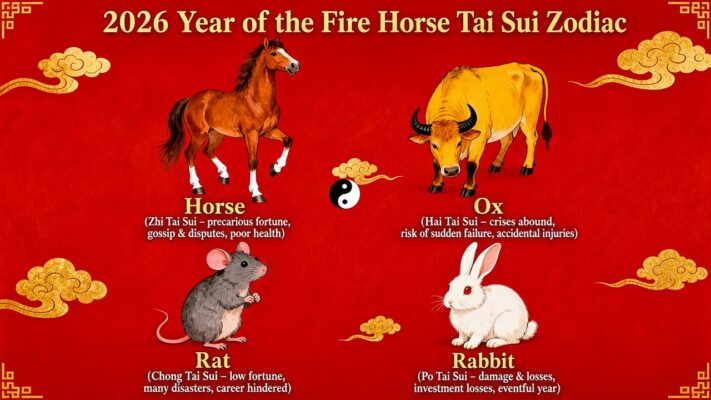
2026 Tai Sui Guide: What the Fire Horse Year Means for Your Zodiac
Introduction When people first hear that a new year brings a new “Tai Sui,” they [...]
Mar

What Is Tai Sui? Understanding the Chinese Zodiac’s Guardian Deities and Why They Matter
Tai Sui (太歲) is a traditional Chinese calendrical and religious concept connected historically with Jupiter, [...]
Aug