Introduction
The Tortoise and Serpent Generals are powerful guardian deities in the Taoist pantheon and the closest attendants of the True Martial Emperor. Also known as the Water and Fire Generals, they protect the northern heavens, guard celestial gates, and maintain the cosmic balance of yin and yang.
Their images originate from the ancient symbol of Xuanwu, the sacred Black Tortoise of the North, traditionally depicted as a tortoise entwined with a serpent. Over time, Taoism transformed this celestial symbol into two independent guardian generals serving beneath the True Martial Emperor. Today, they are among the most recognizable protectors in Taoist temples and martial deity traditions.
Origins of the Tortoise and Serpent Generals
Transformation from Xuanwu
In early Chinese cosmology, Xuanwu represented the northern constellations and was symbolized by a combined tortoise-and-snake form. As the worship of the True Martial Emperor evolved, the tortoise and serpent gradually became personified as divine guardians.
This transformation marked the evolution from an astronomical symbol into active celestial protectors within Taoist theology.
The Organ Transformation Legend
One famous Taoist legend states that during his cultivation, the True Martial Emperor removed his stomach and intestines to purify himself from mortal impurities. After he attained immortality, these discarded organs absorbed spiritual qi and transformed into a tortoise and serpent.
Initially wild and destructive, they were eventually subdued by the emperor and recruited as his loyal generals.
This story reflects Taoist themes of purification, transformation, and the conversion of chaotic forces into spiritual guardians.
Appearance and Symbolism
The Tortoise and Serpent Generals embody both stillness and movement, softness and strength.
The Tortoise General
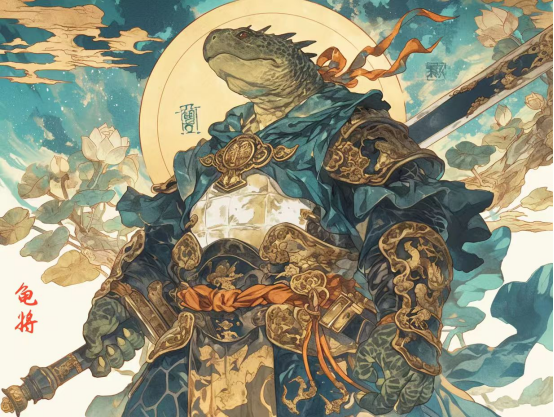
The Tortoise General is associated with water, stability, endurance, and the yin principle.
He is commonly portrayed as:
- A giant black tortoise carrying Bagua symbols
- A warrior in dark robes holding a water banner
- A calm and immovable guardian representing the “Earth Axis”
His symbolism includes longevity, grounding, protection, and defensive strength.
The Serpent General
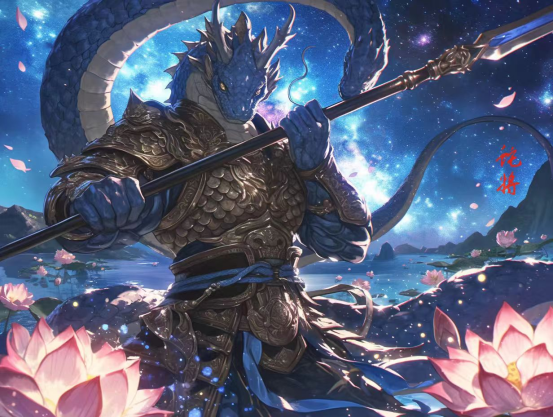
The Serpent General governs fire, transformation, speed, and yang energy.
He is often depicted as:
- A flying spiritual serpent surrounded by flames
- A red-faced celestial warrior wielding a flaming sword
- A dynamic guardian symbolizing the “Heaven Gate”
His role emphasizes movement, adaptability, spiritual power, and offensive protection.
Their duality perfectly represents the Taoist philosophy of balance between opposing cosmic forces.
Core Functions of the Tortoise and Serpent Generals
Guardians of the Heavenly Gates
The two generals serve as celestial gatekeepers beneath the command of the True Martial Emperor. They defend the northern heavens against demons, evil spirits, and chaotic energies.
Their protective role resembles the martial functions seen in The Thirty-Six Heavenly Generals and The Four Great Marshals.
Controllers of Water and Fire
As Water and Fire Generals, they regulate the elemental balance of nature.
They are believed to:
- Prevent floods and droughts
- Stabilize rivers and waterways
- Protect travelers from accidents
- Neutralize harmful spiritual influences
- Resolve curses and negative energies
Because of these powers, their worship became especially widespread in regions surrounding major rivers such as the Yangtze Basin.
Protectors of Spiritual Cultivation
For Taoist practitioners, the Tortoise and Serpent symbolize the internal alchemical harmony of water and fire.
Meditating upon them helps cultivate:
- Yin-yang balance
- Spiritual stability
- Internal energy circulation
- The Taoist state of “Kan and Li Union”
This internal symbolism connects them closely to Taoist meditation and immortality practices.
Philosophical Meaning in Taoism
The Tortoise and Serpent Generals are not simply martial protectors. They also embody deep Taoist cosmology.
Yin and Yang Harmony
The tortoise represents yin while the serpent represents yang. Together they symbolize the eternal balance of complementary forces.
Water and Fire Union
Water and fire normally oppose one another, yet Taoism teaches that true harmony comes from balancing these energies rather than suppressing them.
This idea reflects the Taoist ideal of achieving inner equilibrium.
Stillness and Movement
The tortoise symbolizes stability and endurance, while the serpent symbolizes motion and transformation.
Together they express the Taoist principle that stillness contains movement, and movement contains stillness.
Religious Influence and Temple Worship
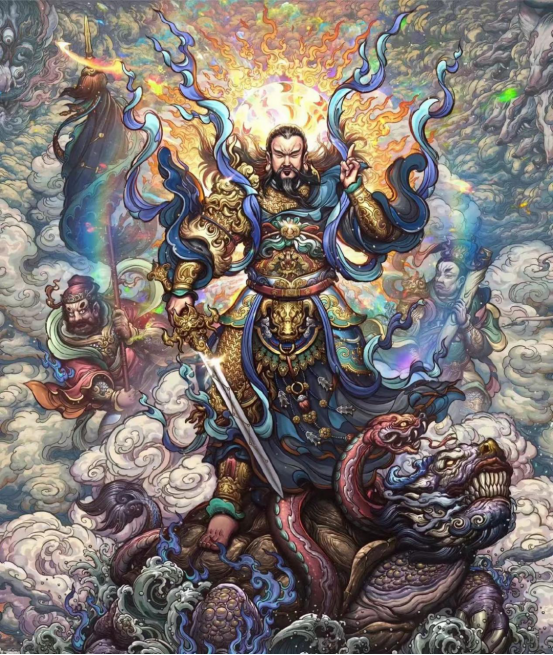
The Tortoise and Serpent Generals are almost always depicted beneath the feet of the True Martial Emperor in Taoist temples.
Famous sacred sites such as Wudang Mountain preserve ancient bronze and iron statues of these guardians, some dating back hundreds of years.
In folk belief, they are widely worshipped for:
- Household peace
- Safe travel
- Disaster prevention
- Water protection
- Spiritual safety
During the birthday celebrations of the True Martial Emperor on the third day of the third lunar month, Taoist temples conduct ceremonies invoking the blessings of the Tortoise and Serpent Generals.
Their imagery also appears frequently alongside protective deities such as Divine Officer Wang and the Five Marshals of the Thunder Ministry in Taoism.
Cultural Legacy
Beyond religion, the Tortoise and Serpent Generals became important symbols in Chinese art, sculpture, opera, martial culture, and Taoist-inspired jewelry design.
Their combined symbolism of:
- Yin-yang harmony
- Water-fire balance
- Spiritual protection
- Longevity and peace
continues to influence modern Taoist cultural products and spiritual aesthetics.
Conclusion
The Tortoise and Serpent Generals are among the most meaningful guardian figures in Taoism. As protectors of the True Martial Emperor and living symbols of Xuanwu, they represent far more than martial strength.
They embody the Taoist understanding that true protection comes through balance — the balance of yin and yang, stillness and movement, water and fire, heaven and earth.
Their enduring presence in Taoist temples and spiritual traditions reflects humanity’s timeless pursuit of harmony, stability, and inner peace.
Related Posts
The Four Sage True Lords in Taoism | Supreme Northern Guardian Generals
The Supreme Martial Guardians of the Northern Heavens The Four Sage True Lords are among [...]
Dec
The Thirty-Six Heavenly Generals in Taoism: Guardians of Thunder, Exorcism, and Celestial Justice
The Thirty-Six Heavenly Generals are one of the most important groups of martial guardian deities [...]
Dec
The Seventy-Two Earth Fiends in Taoist Mythology and Magic Arts
The Seventy-Two Earth Fiends are one of the most mysterious and multifaceted groups of deities [...]
Dec