
Obsidian Is Volcanic Glass, Not a Crystal
Obsidian bracelets are often grouped with crystal jewelry, yet the material is not a crystal or a mineral in the strict geological sense. Obsidian is natural volcanic glass: silica-rich lava cools rapidly enough that atoms do not organize into a regular crystal structure. That glassy origin explains its deep luster, occasional translucence, and clean conchoidal fracture.
This distinction gives the phrase obsidian bracelet meaning a useful starting point. Before protection, grounding, or other modern associations are discussed, the material itself deserves attention. Its identity begins with volcanism, rapid cooling, and human skill in turning a brittle glass into polished beads.
The Encyclopaedia Britannica overview of obsidian describes it as volcanic glass formed by the rapid cooling of viscous lava and notes its long use for tools, weapons, ornaments, and mirrors. That history is real; claims that a bracelet treats illness or guarantees wealth are not established material facts.
How Obsidian Forms and Why It Looks Glassy
Most obsidian develops from rhyolitic or similarly silica-rich lava. High silica makes the melt viscous, slowing atomic movement. If that melt loses heat quickly at a lava-flow margin, dome, or contact zone, extensive crystal growth is suppressed and a glassy rock forms instead.
Obsidian is therefore amorphous rather than crystalline. It may contain tiny crystals, bubbles, mineral particles, or flow bands, but its continuous groundmass remains glass. The material is commonly black because microscopic inclusions and iron-bearing components absorb and scatter light, even though thin edges can appear brownish, gray, or translucent.
Fresh obsidian breaks with curved, shell-like surfaces and can create exceptionally sharp edges. This conchoidal fracture made it valuable to toolmakers in many ancient societies. In a bracelet, every bead should be fully rounded and polished; chips and sharp rims are quality and safety issues, not signs of stronger “energy.”
Obsidian Types and Their Visible Features
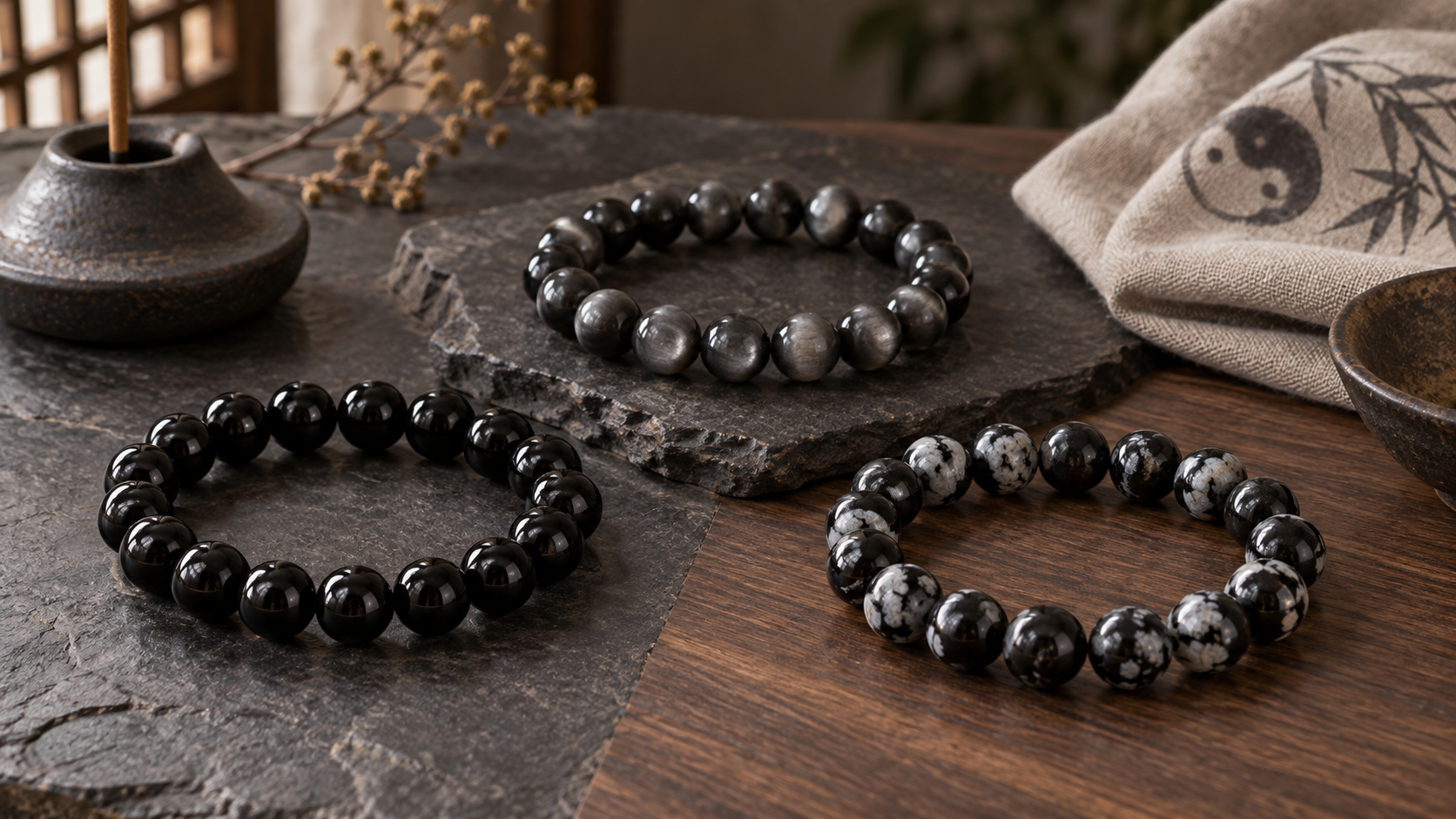
Names such as black, snowflake, rainbow, gold-sheen, and silver-sheen describe appearance rather than separate mineral species. Cut direction, bead thickness, polish, and lighting can change what a customer sees, so a type name should be checked against photographs and the full material description.
Black Obsidian
Black obsidian has the most uniform ink-dark appearance. Well-polished beads show a vitreous shine, while transmitted light may reveal brown or smoky edges. It creates a visually quiet base for carved metalwork, silver, brass, or contrasting stones.
Snowflake Obsidian
Snowflake obsidian contains pale rounded or radiating patches called spherulites, commonly formed as the glass begins to devitrify and tiny crystals grow. The USGS explains that spherulites are radiating crystalline masses produced during devitrification. Their natural distribution is irregular, so no two beads need match exactly.
Silver-, Gold-, and Rainbow-Sheen Obsidian
Sheen obsidian reveals reflective fields, bands, or color flashes when light reaches internal bubbles, layers, or inclusions at the right angle. Silver and gold are optical descriptions, not metallic content. Rainbow obsidian can show muted green, violet, gold, or reddish bands, often most visible under a directional lamp rather than diffuse room light.
Mahogany and Other Trade Names
Mahogany obsidian combines black with reddish-brown areas associated with iron-rich material. “Ice,” “white,” “blue,” and other market labels are less standardized and may cover natural-looking material, treated glass, or entirely man-made glass. A poetic color name is not proof of composition, source, or treatment.
From Ancient Cutting Material to Modern Bracelet Beads
Long before elastic bracelets, people valued obsidian because controlled flaking could produce sharp cutting edges. Archaeologists also use chemical signatures to connect artifacts with particular volcanic sources, revealing long-distance exchange networks. Obsidian objects therefore preserve evidence of technology, mobility, and trade—not a single universal spiritual doctrine.
Its historical meanings differed by place. In parts of Mesoamerica it was used for tools, ritual objects, and mirrors; elsewhere it became blades, points, or ornaments. Modern bead bracelets inherit the material’s dramatic appearance, but they are a contemporary form. It is misleading to treat every current claim about an obsidian bracelet as an unbroken ancient tradition.
Chinese material culture provides another reason for precision. Jade, hardstone, bronze, wood, and later glass each developed their own histories and symbolic vocabularies. Obsidian may be discussed within the broader human history of worked stone and glass, but it should not be substituted for jade or presented as a universally documented classical Chinese talisman.
Obsidian Meaning in Chinese and Taoist-Inspired Design
Obsidian itself has no single fixed Taoist doctrinal meaning. In contemporary Taoist-inspired jewelry, meaning usually comes from a relationship among material, color, name, number, emblem, and composition. This approach respects both the geology and the design instead of claiming that black volcanic glass automatically carried one message throughout Chinese history.
Black, Xuan, and the Language of Depth
The Chinese term xuan (玄) can evoke darkness, mystery, subtlety, or profound depth in philosophical and literary contexts. A black obsidian design may draw on that vocabulary through an ink-dark surface and restrained silhouette. This is a modern aesthetic and philosophical association, not a claim that the stone itself is named or prescribed in early Taoist texts.
Yin–Yang Contrast
Black-and-white bead arrangements can visualize complementarity: neither side exists as a self-sufficient absolute, and each gains meaning through relation. Our guide to qi and yin–yang in Taoist philosophy explains why this is more subtle than equating black with bad and white with good.
North, Water, and Xuanwu—A Design Association
In the Chinese Four Symbols system, the Black Tortoise or Xuanwu is associated with the north and winter; later Taoist traditions developed related divine and guardian figures. A black bracelet may reference this visual field, but the correspondence belongs to the symbol system, not to obsidian geology. Readers can compare the historical framework in our article on the Four Symbols in Taoist and Chinese culture.
Modern descriptions often connect black obsidian with protection, grounding, reflection, or boundaries. These can be meaningful personal metaphors: volcanic heat becoming cool glass, darkness reflecting light, or a smooth bead serving as a tactile reminder to pause. They are symbolic interpretations, not demonstrated medical treatment or guaranteed supernatural outcomes.
Taoist World Obsidian Designs
Taoist World uses obsidian differently across designs, so the complete bracelet—not the stone name alone—determines its visual and symbolic character. The following pieces show three distinct approaches: metal contrast, philosophical restraint, and changing light.
Fu Mo Xuan Tong: Black Obsidian and Textured Brass
The Fu Mo Xuan Tong Black Obsidian and Brass Bracelet pairs approximately 10 mm polished black obsidian beads with antiqued, hand-textured brass. The glassy black spheres and evolving metal patina create a deliberate contrast between smooth and rugged surfaces. Its symbolism centers on composure, resolve, and connection, while its construction gives it a bolder streetwear character.
Xuan Ying: Mystery, Shadow, and Restraint
The Xuan Ying (Mystic Shadow) Bracelet keeps the palette dark and understated. Its name invokes xuan as mystery and depth, allowing the polished obsidian surface to support a quiet, inward-looking design rather than an ornate narrative.
Yue Hua: Silver Sheen and Moonlight
The Yue Hua (Moonlight) Silver Obsidian Bracelet uses plaque-shaped beads and shifting silver reflections. As the wrist moves, the sheen appears and recedes like light across dark water. Here the design meaning comes from an optical effect joined to a moonlight metaphor—not from silver metal inside the stone.
Mixed Materials and Layered Meaning
Obsidian can also work as one voice in a larger composition. The Heilong Xian Herbal Incense Obsidian Bracelet combines it with hawk’s eye, botanical incense beads, and sterling silver. Our separate Hei Long Xian design guide explains how stone, fragrance, and metal change both symbolism and care.
For comparison across related materials, the gemstone and crystal bracelet guide separates mineral identity, traditional association, and personal intention. You can also browse the Gemstone & Crystal Bracelets collection to compare bead sizes, mixed materials, and design themes.

A Short Guide to Choosing, Wearing, and Caring
Choose by Material and Construction
Start with the full material list. Decide whether you want uniform black, visible silver or rainbow sheen, contrasting beads, or a mixed-material piece. Compare wrist size, bead diameter, elastic or cord construction, metal sensitivity, and the prominence of any symbol. Photographs under several lighting conditions are especially important for sheen obsidian.
Visual checks can identify chips, rough drill holes, poor polish, or inconsistent construction, but photographs cannot certify geological origin. Price alone does not prove authenticity, and a perfectly black bead is not automatically natural obsidian. If treatment, origin, or exact composition matters, request specific disclosure or an independent gemological report.
Wear It Without Invented Rules
There is no geological rule assigning obsidian to the left or right wrist. Choose the side that fits your movement, watch, and other jewelry. If you adopt a personal or family tradition about wrist placement, describe it as that tradition rather than a universal fact. Remove the bracelet for impact-heavy work, exercise equipment, or situations where it may catch.
Care for Glass and the Whole Bracelet
Wipe polished beads with a soft, slightly damp cloth and dry them promptly. Avoid hard drops, ultrasonic cleaners, harsh chemicals, prolonged soaking, and contact with harder jewelry. Store the bracelet separately in a soft pouch. Follow the most delicate component: elastic can weaken, brass develops patina, silver tarnishes, and botanical beads should generally remain dry.
Frequently Asked Questions
What does an obsidian bracelet mean?
In modern jewelry, it is commonly associated with protection, grounding, reflection, and personal boundaries. Those are symbolic or traditional interpretations. A specific bracelet’s fuller meaning comes from its colors, name, emblems, accompanying materials, and the wearer’s intention.
Is obsidian a crystal?
No in the strict mineralogical sense. Obsidian is amorphous volcanic glass and lacks the ordered internal structure of a crystal. “Crystal bracelet” is a broad retail category, not a precise classification for this material.
Are silver and gold obsidian made of metal?
Not necessarily. The words usually describe optical sheen against a dark glass body. Check the product specification separately for actual silver, gold, brass, or other metal components.
Does obsidian have a fixed Taoist meaning?
No. Obsidian is not a universal Taoist ritual material with one fixed doctrine. Contemporary Taoist-inspired designs may connect its black color and reflective surface with ideas such as xuan, yin–yang contrast, stillness, or guardian imagery, but the association belongs to the complete design.
Can an obsidian bracelet treat anxiety or physical illness?
There is no good scientific evidence that wearing obsidian treats medical or mental-health conditions. It may function as meaningful jewelry or a personal reminder, but it should not replace qualified care.
Conclusion
An obsidian bracelet begins with a remarkable material: silica-rich lava cooled into natural glass. Black, snowflake, and sheen varieties reveal different textures and optical effects; ancient tools demonstrate the material’s practical history; and modern bracelets translate its darkness, reflection, and volcanic origin into personal symbolism.
The most responsible interpretation keeps those layers distinct. Geology explains the glass. History explains how people worked and exchanged it. Chinese and Taoist-inspired design explains how color, contrast, names, and symbols create meaning today. Choosing a bracelet with that clarity makes the object more interesting—not less.
Related Posts
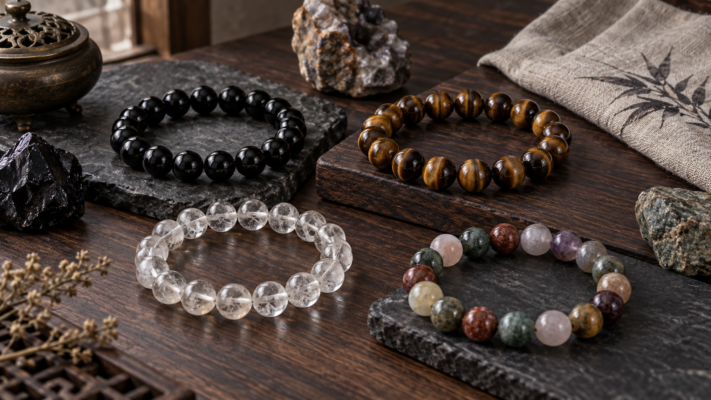
What Are Gemstone and Crystal Bracelets? Materials, Meaning, and How to Choose
Explore gemstone and crystal bracelets, their materials, symbolism, design types, fit, care, and how to [...]
Sep
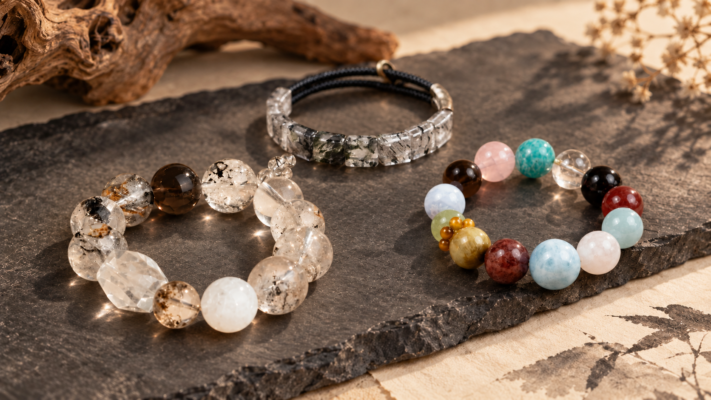
Quartz Bracelet Meaning: Types, Chinese Culture, and Taoist World Designs
Explore quartz formation, clear, phantom and rutilated varieties, Chinese cultural history, Taoist-inspired symbolism, and Taoist [...]
Sep
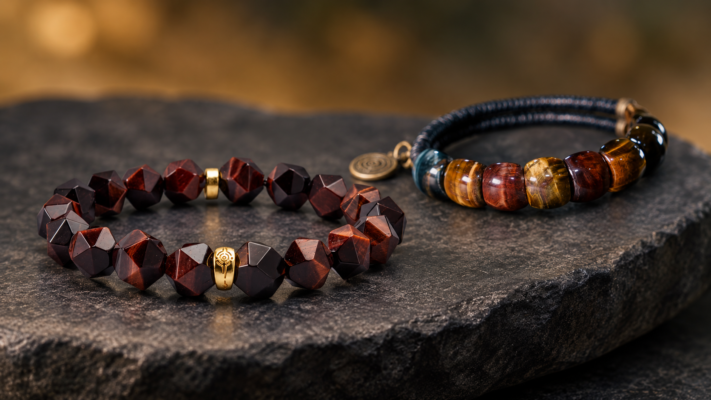
Tiger Eye Bracelet Meaning: Chatoyancy, Chinese Symbolism, and Taoist World Designs
Explore tiger eye formation, chatoyancy, golden, red and blue varieties, Chinese tiger symbolism, and Taoist [...]
Sep