

Introduction
When people first encounter the terms Qi and Yin-Yang, they often treat them as separate ideas — Qi as a kind of mystical energy, Yin-Yang as a symbol of balance. In practice, the two concepts are inseparable, describing the same underlying reality from two different angles.
Qi and Yin-Yang are among the most important concepts in Taoist philosophy and traditional Chinese cosmology. Together, they form the foundation of Taoist views on the universe, life, human health, and spiritual cultivation, closely connected to how Taoist philosophy understands the human body.
Although they are distinct ideas, Qi and Yin-Yang are deeply interconnected. Taoism teaches that all things in existence emerge through the movement and transformation of Qi under the balance of Yin and Yang. The changes of Yin, Yang, and Qi all abide by the fundamental law that Tao Follows Nature.
This guide explores Qi and Yin-Yang by examining three key areas:
- what Qi represents as the fundamental life force in Taoist thought
- how Yin and Yang function as complementary, ever-transforming forces
- how the two concepts work together within Taoist cultivation and Chinese culture more broadly
What Is Qi in Taoism?
In Taoist thought, Qi is the fundamental life force or vital energy that fills the universe. Everything in existence is believed to originate from Qi and eventually return to it. According to Britannica’s entry on Qi, early Daoist philosophers and alchemists regarded Qi as a vital force inhering in the breath and bodily fluids, developing techniques to alter and control its movement within the body in pursuit of physical longevity and spiritual power.
The Tao Te Ching states: “The Tao gives birth to One, One gives birth to Two, Two gives birth to Three, and Three gives birth to all things.” In Taoist interpretation, the “One” is often understood as primordial Qi — the original energy from which all existence emerges.
Qi exists in both the cosmos and the human body. Taoism classifies Qi into different forms, including primordial Qi inherited at birth, nutritional Qi derived from food, protective Qi that guards the body, and spiritual Qi connected to consciousness and vitality.
The Meaning of Yin and Yang
Yin and Yang describe the dual yet complementary forces that govern the universe. Rather than opposing enemies, Yin and Yang are interdependent energies that constantly transform into one another. Examples include Heaven and Earth, Day and Night, Movement and Stillness, Fire and Water, and Activity and Rest.
Taoism teaches four key characteristics of Yin and Yang:
Opposition and Balance — Yin and Yang restrain and balance each other. Excessive dominance of one side leads to disharmony.
Mutual Dependence — Neither Yin nor Yang can exist independently. Yin contains the seed of Yang, and Yang contains the seed of Yin.
Cyclical Transformation — Yin transforms into Yang, and Yang transforms into Yin, just as night becomes day and winter becomes spring.
Dynamic Harmony — The universe remains stable through the continuous movement and balancing of these two forces.
This classic quote from Xici Shang of The I Ching illustrates the origin and evolution of Yin-Yang and Qi movement in Taoism: “Therefore in the Changes there is the Supreme Ultimate, which generates the Two Modes.” The “Two Modes” refer directly to Yin and Yang emerging from the Supreme Ultimate (Taiji).
The Relationship Between Qi and Yin-Yang
Qi and Yin-Yang cannot be separated. Qi is the substance or energy of existence, while Yin and Yang are the patterns and qualities through which Qi operates.
According to Britannica’s entry on Yinyang, the two forces are said to proceed from the Great Ultimate (Taiji), with their continuous interplay — one increasing as the other decreases — describing the actual process of the universe and everything within it.
In Taoist cosmology, Yang Qi is light, active, and ascending, while Yin Qi is heavy, receptive, and descending. The interaction between Yin Qi and Yang Qi produces all natural phenomena, including the changing seasons, wind and rain, day and night, and birth and transformation.
At the human level, the body also contains Yin and Yang Qi: defensive Qi is considered Yang, nourishing Qi is considered Yin, the heart belongs to Yang, and the kidneys belong to Yin. Health depends on maintaining harmony between these forces.
Qi, Yin-Yang, and the Five Elements
Yin-Yang and Qi interact closely with The Five Elements Theory to form the core cosmic operating rules.
The Five Elements — Wood, Fire, Earth, Metal, and Water — describe how Qi changes and circulates throughout nature and the human body. Yin and Yang determine the energetic qualities of these transformations. Together, Qi, Yin-Yang, and the Five Elements became the core framework for Taoist cultivation, traditional Chinese medicine, Feng Shui, martial arts, and Chinese astrology.
Qi and Yin-Yang in Taoist Cultivation
Taoist spiritual practice focuses heavily on refining Qi and balancing Yin and Yang within the body. Practices include meditation, breathing exercises, internal alchemy, Qigong, and dietary cultivation.
The goal is to harmonize body, breath, and spirit so that acquired Qi gradually returns to primordial Qi. Taoism believes that when Qi becomes abundant and Yin-Yang return to balance, the practitioner can achieve physical health, mental clarity, spiritual tranquility, longevity, and unity with the Dao.
The Cultural Influence of Qi and Yin-Yang
The ideas of Qi and Yin-Yang extend far beyond Taoism and deeply influence Chinese civilization. Traditional Chinese medicine diagnoses illness through Qi circulation and Yin-Yang balance. Martial arts train practitioners to regulate internal Qi. Feng Shui analyzes the movement of Qi within environments.
These concepts became one of the central philosophical systems of Chinese culture and continue to shape views on health, spirituality, and harmony today.
Qi and Balance at Taoist World
Understanding Qi and Yin-Yang offers a foundational lens for appreciating nearly every other dimension of Taoist thought — from the Five Elements to practices like meditation and internal cultivation.
At Taoist World, this same principle of dynamic balance — never static, always in relationship — shapes the philosophy behind the handcrafted objects and guidance we offer.
Explore more Taoist philosophy and wisdom: → Taoist Philosophy & Wisdom Collection
Conclusion
Qi and Yin-Yang together form the conceptual backbone of Taoist cosmology — Qi as the vital energy underlying all existence, and Yin-Yang as the complementary forces that shape how that energy moves, transforms, and balances itself.
Neither concept fully makes sense without the other. Qi provides the substance; Yin-Yang provides the pattern. Understanding both offers a foundation not only for Taoist philosophy, but for the wider framework of Chinese medicine, cultivation practice, and cosmology that continues to shape millions of lives today.
FAQ
Qi is the fundamental life force or vital energy believed to fill the universe and flow through all living things, including the human body.
Not exactly — they are complementary and interdependent rather than opposing. Each contains the seed of the other and continuously transforms into it.
Qi is the substance or energy of existence, while Yin and Yang describe the patterns and qualities through which that energy operates and transforms.
Taoism identifies several forms, including primordial Qi (inherited at birth), nutritional Qi (from food), protective Qi (guarding the body), and spiritual Qi (linked to consciousness).
Chinese medicine diagnoses and treats illness based on Qi circulation and Yin-Yang balance within the body, viewing health as a state of harmony between these forces.
Related Posts
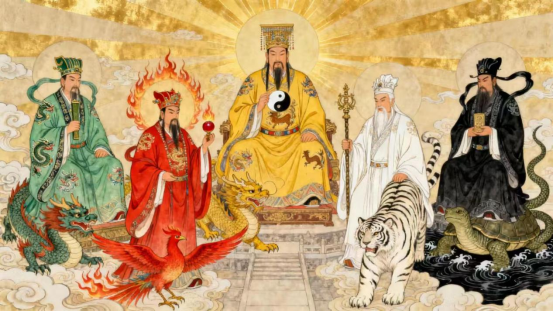
The Five Elders of the Five Directions in Taoism
The Five Elders of the Five Directions are among the highest celestial deities in the [...]
Dec

Tao Follows Nature: The Core Principle of Taoist Philosophy and Natural Harmony
Introduction When people first encounter the phrase “Tao follows nature,” they often assume it is [...]
Dec

How Taoist Philosophy Understands the Human Body
Introduction When we think about the human body today, we often imagine a collection of [...]
Jul