

Tai Sui (太歲) is a traditional Chinese calendrical and religious concept connected historically with Jupiter, the sixty-year sexagenary cycle, and the deity believed to preside over each year. In modern Taoist and Chinese folk practice, people commonly speak of sixty Tai Sui guardian generals who rotate through the cycle.
The phrase Fan Tai Sui (犯太歲), often translated as “offending Tai Sui,” refers to certain traditional conflicts between a person’s zodiac or Earthly Branch and the year’s ruling sign. This guide explains what Tai Sui means, where the idea came from, how the sixty guardians relate to the zodiac, and why worship or appeasement practices developed around the tradition.
What Is Tai Sui?
Tai Sui (太歲) is a name rooted in ancient Chinese astronomy, referring to a hypothetical counter-orbit position tracking the planet Jupiter. According to the historical overview on Wikipedia’s entry on Tai Sui, the star position opposite Jupiter in its roughly 12-year orbital cycle was personified as a heavenly general believed to assist the Jade Emperor in overseeing the mortal world.
By the Warring States period, Tai Sui had become an established figure in popular astrology, though the earliest written records of Tai Sui worship date to the Han dynasty. Over time, this astronomical concept absorbed layers of Taoist religious meaning, evolving from a tracked celestial position into a system of revered guardian deities.
Today, Tai Sui is generally understood as the Guardian God of the Year — a rotating position of divine authority believed to govern the fortunes of everyone living through that particular year.
The 60 Tai Sui Generals and the Sexagenary Cycle
Rather than a single deity, Tai Sui refers to sixty individual generals, each taking a turn to govern one year within a repeating 60-year cycle known as the sexagenary cycle. For a dedicated overview of the full pantheon, see our guide to the Sixty Jiazi Gods and Tai Sui Guardian Generals.
Each of the 60 Tai Sui generals is traditionally believed to have been a real historical figure who served with distinction and was later deified for their contributions. The general presiding over the current year is respectfully referred to as “Liu Nian Tai Sui.”
This 60-year structure is closely tied to the 12-year Jupiter orbital cycle that originally inspired the concept — combined with the 5 traditional elements (Wood, Fire, Earth, Metal, and Water), the system produces 60 unique year-combinations before repeating. This is the same underlying framework discussed in our guide to The Five Elements Theory in Taoism and Chinese Philosophy, which explores how these elemental cycles shape much of Taoist cosmology.
Fan Tai Sui: What It Means to “Offend” Tai Sui
The term most commonly associated with Tai Sui in everyday conversation is Fan Tai Sui (犯太歲) — to “offend” or come into conflict with the Tai Sui of a given year.
Whether a person offends Tai Sui in a given year depends on the relationship between their birth zodiac sign and the zodiac sign governing that year. There are generally four recognized types of conflict:
- Zhi Chong (Direct Clash): Your zodiac sign is directly opposite the year’s ruling sign — traditionally considered the most significant conflict.
- Xing (Punishment): Your sign is in a punishing relationship with the year’s sign, based on traditional Chinese astrological pairings.
- Hai (Harm): A more subtle conflict, generally considered milder in effect.
- Po (Break): Another secondary conflict type, typically regarded as less severe than a direct clash.
People experiencing Fan Tai Sui in a given year are traditionally advised to take extra care in health, finances, and major life decisions, though the severity and specific advice can vary between different schools of practice.
How Tai Sui Connects to the Chinese Zodiac
Because the Tai Sui cycle is built on the same underlying framework as the 12-year zodiac cycle, every person’s birth zodiac sign has a direct relationship to Tai Sui in any given year — not only in years when their own sign is “in power.”
This connection is explored in more detail in our 2026 Tai Sui Guide: What the Fire Horse Year Means for Your Zodiac, which breaks down exactly how each of the twelve zodiac signs is affected during a specific Tai Sui year, including which signs face direct clashes and which face milder forms of conflict.
Beyond personal fortune, Tai Sui’s influence is also traditionally applied to physical spaces — including which directions are considered inauspicious to build or renovate toward during a given year, a principle we cover further in our guide to feng shui and pet placement during the 2026 Yang Fire Horse year.
Traditional Ways to Appease Tai Sui
For those affected by Fan Tai Sui in a given year, several traditional practices are believed to help ease potential difficulties. Our separate guide to worshipping and appeasing Tai Sui covers the ritual side in greater detail:
- Temple visits: Many practitioners visit temples dedicated to Tai Sui to pray for protection and offer respect to the year’s ruling general.
- Wearing red: Red is traditionally considered protective and is often worn — sometimes in the form of a red string bracelet — throughout a person’s Fan Tai Sui year.
- Amulets and talismans: Protective objects, often blessed or consecrated, are commonly carried or worn as a form of ongoing protection.
- Avoiding major decisions: Some practitioners choose to delay major life events, such as marriage or relocating, during a year of significant conflict with Tai Sui.
None of these practices are considered guarantees against misfortune. Rather, they are traditionally understood as ways to approach a challenging year with greater care and awareness.
Tai Sui in 2026 and Beyond
2026 is a Yang Fire Horse year — a combination that carries its own specific elemental dynamics, discussed in depth in our Complete Analysis of the 2026 Bing Wu Horse Year Tai Sui Folk Customs.
Because the Tai Sui system operates on a 60-year cycle, each year brings a distinct combination of zodiac sign and element, meaning no two years carry identical energy. Understanding the specific dynamics of the current year — not just the general concept of Tai Sui — is what allows the tradition to remain practically relevant year after year.
Understanding Tai Sui at Taoist World
Understanding Tai Sui begins with recognizing that it is not a single superstition, but a tradition shaped by centuries of astronomy, Taoist religious practice, and cultural belief working together.
At Taoist World, we believe that engaging with traditions like Tai Sui is most meaningful when approached with genuine understanding — not fear, and not blind ritual, but informed awareness of what these beliefs represent and where they come from.
Whether you are exploring Tai Sui out of curiosity, preparing for a challenging zodiac year, or simply deepening your understanding of Chinese tradition, we hope this guide offers a clear starting point.
Explore more Tai Sui and Feng Shui guidance: → Feng Shui Consultation Collection

Conclusion
Tai Sui is ultimately a tradition about cycles — the orbit of a planet, the rotation of sixty guardian generals, and the recurring patterns that shape how Chinese astrology understands time itself.
Rather than a fixed warning to fear, Tai Sui is better understood as an invitation to pay closer attention during certain years — to approach decisions with more care, and to draw on traditional practices that have offered people a sense of agency and protection for centuries.
Whether or not your zodiac sign is in conflict with Tai Sui this year, understanding the tradition behind the concept offers a deeper appreciation for how astronomy, mythology, and Taoist belief have shaped Chinese culture across thousands of years.
FAQ
Tai Sui refers to sixty different generals who each take a turn governing one year within a repeating 60-year cycle, rather than a single fixed deity.
Offending Tai Sui, or Fan Tai Sui, happens when your zodiac sign is in a clashing, punishing, harming, or breaking relationship with the sign governing the current year.
Compare your birth year’s zodiac sign to the zodiac sign ruling the current year. Direct clashes (opposite signs) are considered the most significant form of conflict.
No — only zodiac signs with a clashing, punishing, harming, or breaking relationship to the year’s ruling sign are affected in a given year.
Wearing red, visiting a Tai Sui temple, and carrying a blessed amulet are among the most widely practiced traditional remedies.
Related Posts
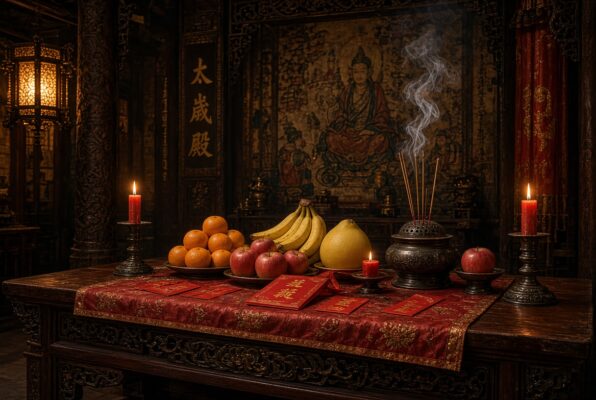
How to Worship and Appease Tai Sui: Rituals, Offerings, and Remedies
Introduction When people first learn that they may be “offending Tai Sui” in a particular [...]
Aug
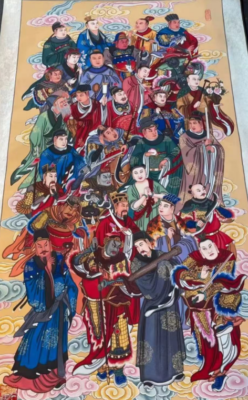
Sixty Jiazi Gods in Taoism | The Sixty Tai Sui Guardian Generals
The Sixty Jiazi Gods, also known as the Sixty Tai Sui Generals, are one of [...]
Dec

Complete Analysis of the 2026 丙午(Bing wu) Horse Year Tai Sui Folk Customs: Deity Positions, Zodiac Conflicts, and Rational Inheritance
Introduction The year 2026 marks the Bing Wu (丙午) Year of the Horse, a combination [...]
Mar