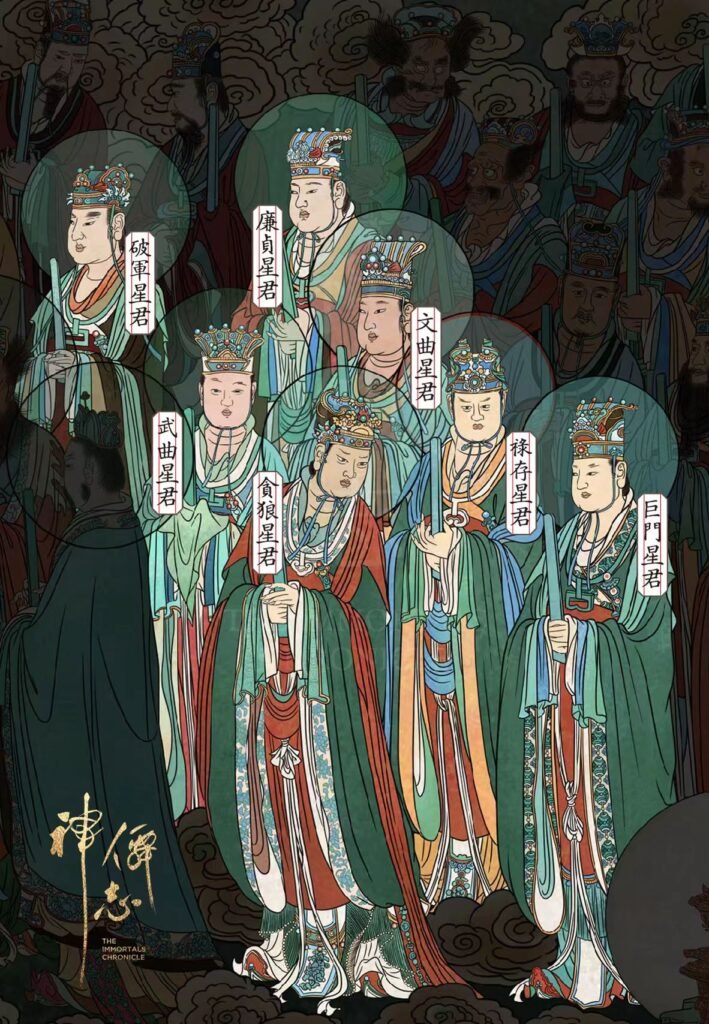
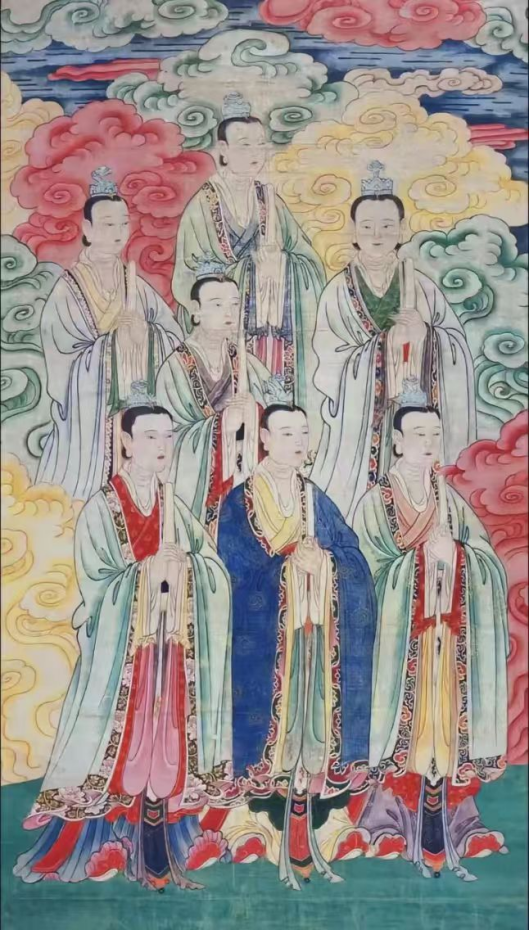
The Seven True Lords of the Big Dipper are among the most important astral deities in Taoism, corresponding to the seven stars of the Big Dipper constellation: Tian Shu (Dubhe), Tian Xuan (Merak), Tian Ji (Phecda), Tian Quan (Megrez), Yu Heng (Alioth), Kai Yang (Mizar), and Yao Guang (Alkaid). Under the command of the Jade Emperor, they govern human destiny, longevity, fortune, karmic transformation, and spiritual protection. Together, they form one of the central celestial systems within Taoist cosmology and star worship traditions.
In Taoist belief, the Big Dipper is regarded as the cosmic axis of heaven. The movement of its stars influences the circulation of yin and yang, seasonal transformation, human fate, and the balance of spiritual energies. Because of this sacred role, the Seven Lords are revered as powerful protectors capable of extending life, removing disasters, and guiding mortals toward peace and prosperity.
Origin of the Big Dipper Star Lords
The worship of the Big Dipper originated from ancient Chinese astronomy and the philosophy of harmony between heaven and humanity. Ancient observers believed that the Big Dipper regulated celestial order and reflected the destiny of the human world.
Over time, Taoism transformed the seven stars into divine beings with personalities, official titles, and spiritual duties. These deities became central figures in Taoist rituals involving longevity prayers, disaster relief, spiritual purification, and destiny transformation.
The Seven Lords are also deeply connected to Doumu Yuanshun, the Mother of the Stars, who is regarded as the celestial mother of the Dipper Lords and the supreme goddess of astral power. Together with the Six Lords of the Southern Dipper and the Five Dippers Lords in Taoism, they form a complete cosmic administration governing birth, death, fortune, and reincarnation.
The Seven Lords and Their Divine Functions
Lord Tian Shu – Tan Lang Star Lord
The first star of the Big Dipper is Lord Tian Shu, also called Lord Tan Lang (Greedy Wolf). Associated with the Wood element and the virtue of benevolence, he governs fortune, blessings, social harmony, and prosperous relationships.
Believers pray to him for financial luck, harmonious connections, and the removal of obstacles that block success and opportunity.
Lord Tian Xuan – Ju Men Star Lord
Lord Tian Xuan, the second star, is known as Lord Ju Men (Giant Gate). Connected with the Earth element, he oversees family harmony, stability, and conflict resolution.
He protects households from disputes and negative influences while strengthening personal security and emotional balance.
Lord Tian Ji – Lu Cun Star Lord
The third star, Lord Tian Ji, is called Lord Lu Cun (Prosperity Preserver). Affiliated with the Metal element, he governs official careers, social advancement, and long-term prosperity.
Students, officials, and businesspeople often pray to him for career success, promotion, and lasting achievements.
Lord Tian Quan – Wen Qu Star Lord
Lord Tian Quan is the fourth star and is known as Lord Wen Qu, the Literary Star. Associated with the Water element and wisdom, he governs scholarship, examinations, intelligence, and spiritual insight.
He is especially revered by students and scholars seeking academic excellence and clarity of mind.
Lord Yu Heng – Lian Zhen Star Lord
The fifth star, Lord Yu Heng, is known as Lord Lian Zhen (Integrity Star). Connected with the Fire element, he purifies harmful influences and protects against sudden disasters and accidents.
His role emphasizes moral discipline, spiritual purification, and righteous conduct.
Lord Kai Yang – Wu Qu Star Lord
Lord Kai Yang, the sixth star, is called Lord Wu Qu (Martial Star). Associated with courage, authority, and breakthrough power, he governs professional success, leadership, and martial fortune.
Believers pray to him for strength, determination, and the ability to overcome major obstacles in life and career.
Lord Yao Guang – Po Jun Star Lord
The seventh star, Lord Yao Guang, is known as Lord Po Jun (Destructive Army). He governs transformation, endings, renewal, and the power to reverse declining fortune.
His divine function is especially important during periods of hardship, helping believers break through limitations and begin new stages of life.
Religious Meaning of the Big Dipper Lords
The core belief surrounding the Seven True Lords centers on the idea that celestial stars influence human destiny. Taoism teaches that the seven stars correspond to the seven spiritual essences within the human body. By worshipping the Dipper Lords, believers can harmonize their spiritual energy, dispel misfortune, and strengthen their connection with cosmic order.
In Taoist rituals, prayers to the Big Dipper are commonly performed for:
- Longevity and health
- Protection from disasters
- Spiritual purification
- Career advancement
- Wisdom and academic success
- Fortune enhancement
- Removal of karmic obstacles
The famous saying, “The Big Dipper governs death, while the Southern Dipper governs life,” reflects the complementary relationship between the Northern and Southern celestial systems. Together, they maintain the balance of birth, death, destiny, and reincarnation.
Symbolism and Cultural Influence
The Seven Lords of the Big Dipper became deeply integrated into Chinese religion, astrology, feng shui, literature, and folk customs. Their star imagery frequently appears in Taoist talismans, temple murals, ritual banners, and sacred diagrams.
In Taoist ceremonies, priests often perform Dipper Worship Rituals to invoke the protection of the Seven Lords and transform negative destiny patterns. Their symbolism also appears in martial arts traditions, spiritual cultivation practices, and Chinese metaphysical systems.
As one of the most enduring forms of Chinese star worship, the Seven Lords represent humanity’s desire to align personal destiny with the sacred order of the cosmos. Their belief system embodies the Taoist pursuit of harmony, longevity, wisdom, and spiritual transcendence.
Related Posts

Doumu Yuanshun: Mother of the Stars in Taoism
The Supreme Mother of the Stars Doumu Yuanshun, also known as Doulao Yuanshun, is one [...]
Dec
The Five True Lords of the Eastern Dipper in Taoism
Guardians of Destiny in the Eastern Heavens The Five True Lords of the Eastern Dipper [...]
Dec
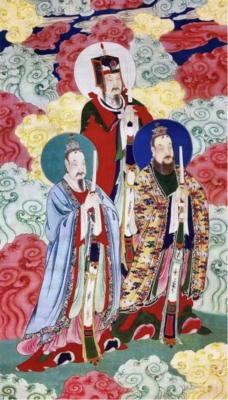
Three Terraces Lords of Taoism: Guardians of Life, Fortune, and Longevity
Introduction The Three Terraces Lords (San Tai Xingjun) are highly important celestial deities within the [...]
Dec