
Tianlong and Diya are the paired attendants of Wenchang, a deity associated with literature and examinations in Chinese religious traditions. Their names are 天聾 / 天聋 (tiān lóng, “Heaven-deaf”) and 地啞 / 地哑 (dì yǎ, “Earth-mute”). Textual references, museum records, and temple descriptions document the pair; explanations of their symbolism belong to particular religious traditions rather than established causes of academic outcomes.
Names and the documented pair
Tianlong: Heaven-deaf
Tianlong is the attendant named 天聾, literally referring to heaven and deafness. “Tian Long” is a spaced romanization of the same name. The characters distinguish this attendant from unrelated figures also romanized Tianlong. His identity is best explained alongside Diya, rather than as an independently documented thunder-born deity.
Diya: Earth-mute
Diya is 地啞, rendered here as “Earth-mute”; “Di Ya” is another spacing of the name. Taiwan’s Ministry of Education dictionary entry for the pair identifies them as Wenchang’s attendants and records their pronunciation. Taiwan’s Ministry of Interior also identifies both attendants in its Wenchang shrine description. These references establish a paired relationship, not a fixed hierarchy of offices.
Historical witnesses and their limits
The Ministry of Education entry cites the Qing writer Chu Renhuo’s Jianhu Baji, volume 4. That is a documented textual witness; it does not by itself establish when the attendants first originated or when every interpretation developed.
The Princeton University Art Museum catalogue describes Wenchang with attendants in a rubbing of an image carved on stone in 1854. It names Tianlong and Diya and discusses their attributes. The dated carving provides an identifiable historical example, rather than proof of a universal or unchanged arrangement.
Temple imagery and varying attributes
In the Mengjia Qingshuiyan temple’s description, Tianlong holds a book and Diya holds a sword. This preserves a distinctive book-bearing depiction of Tianlong, but the attributes belong to that named installation.
Princeton’s catalogue presents a different example: Diya is depicted with a qin, while a separate attendant, Baite, bears a seal box. Its discussion associates Diya with a register of scholars’ destinies. Such curatorial interpretation should not be converted into a universal seal-and-register workflow shared by all temples.
Consequently, a prop, costume, age, or left/right position in one depiction should not be treated as a compulsory identifying feature everywhere. The pair’s names and relationship to Wenchang are firmer points of identification than a single visual formula.
Symbolism in identified traditions
Some temple explanations interpret deafness and muteness through restraint in hearing or speaking about heavenly affairs. The Taichung Tianhou Temple’s Wenchang hall description, for example, connects the paired attendants with secrecy and humility. This is attributed religious symbolism, not evidence that the attendants literally prevent information from escaping.
The names can also invite reflection on discretion and careful speech. That reflective reading should be distinguished from historical documentation and from a promise of supernatural protection, examination success, or promotion.
Wenchang worship and religious context
Tianlong and Diya are best understood within Wenchang worship. This page explains their documented pairing and selected historical and temple examples; the broader biography and worship of Wenchang belong to the linked Wenchang overview. Prayers and interpretations express religious belief and practice and do not guarantee changes in a person’s studies or career.
Sources
The linked sources above serve different purposes: the Ministry of Education supplies terminology and a textual citation; the Ministry of Interior corroborates shrine pairing; Princeton supplies a dated artwork and curatorial interpretation; Mengjia Qingshuiyan and Taichung Tianhou supply locally attributed imagery and symbolism. None is used here to establish an unsupported birth legend, a universal administrative duty, or guaranteed efficacy.
Related Posts
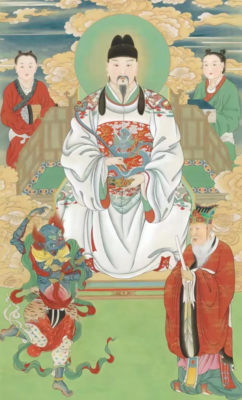
Lord Wenchang | Taoist God of Literature and Scholarly Success
Lord Wenchang, also known as Emperor Wenchang, is the supreme Taoist deity governing literature, examinations, [...]
Dec
Wind Lord Fengbo (风伯): Taoist God of Wind and Weather
Fengbo, also known as Fengshi, Feilian, or Ji Bo, was an ancient wind god in [...]
Dec
Folk Deities in Taoism and Chinese Folk Religion
Folk deities are one of the most widespread parts of Chinese religious culture. Unlike the [...]
Dec