The Thunder Patriarch (雷祖, Leizu), formally known as Jiutian Yingyuan Leisheng Puhua Tianzun (九天应元雷声普化天尊), is the supreme deity of the Taoist Thunder Department (Lei Bu) and the highest authority governing divine thunder. Often referred to simply as Leisheng Tianzun or Thunder Ancestor, he embodies heavenly justice, cosmic discipline, and universal salvation.
In Taoist belief, thunder is far more than a natural force—it is the manifestation of celestial law. As the highest thunder deity, Leizu commands the entire thunder hierarchy, including the Five Directional Thunder Kings in Taoism, who serve as elite commanders carrying out divine thunder judgments throughout the cosmos.
Divine Authority and Sacred Title
The full title Jiutian Yingyuan Leisheng Puhua Tianzun reflects his supreme cosmic role:
- Jiutian (Nine Heavens): symbolizes the highest celestial authority
- Yingyuan: acting in accordance with heavenly principles
- Leisheng: representing thunder’s voice as divine warning and judgment
- Puhua: universal transformation, salvation, and compassion
Together, these meanings present Leizu as both an enforcer of heavenly justice and a compassionate protector who resolves suffering and restores balance.
Supreme Ruler of the Thunder Department
As the highest deity of the Thunder Ministry, Thunder Patriarch governs:
- The Thirty-Six Thunder Generals
- Leigong and Dianmu (Thunder God and Lightning Mother)
- The Five Thunder Messengers
- Countless celestial officials responsible for weather, judgment, and spiritual purification
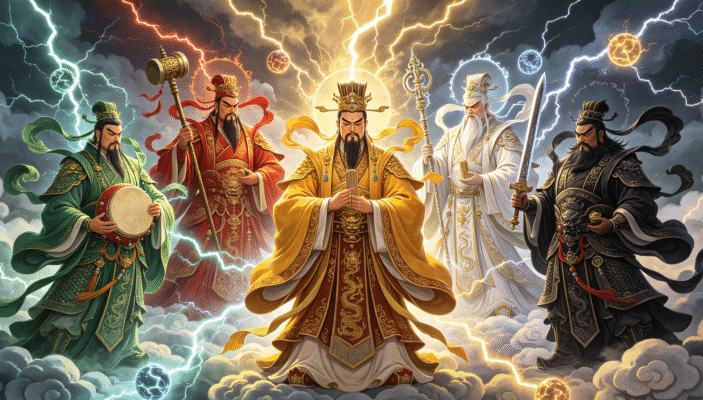
Beneath his divine command, the Five Directional Thunder Emperors regulate elemental thunder across the east, south, west, north, and center, ensuring harmony between heaven and earth.
Leizu’s divine responsibilities include:
- Punishing evil and rewarding virtue
- Expelling demons and malevolent spirits
- Breaking karmic obstacles and grievances
- Protecting believers from disasters
- Maintaining cosmic and moral order
Appearance and Divine Manifestation

Traditional Taoist scriptures describe Leizu as a majestic celestial ruler:
- Wearing a Nine-Heaven Crown
- Dressed in radiant heavenly robes
- Holding a golden whip or thunder command tablet
- Accompanied by attendants such as the Thunder God, Lightning Mother, Wind Spirit, and Rain Spirit
Some Taoist teachings also state that his true form transcends physical appearance, manifesting invisibly through thunder and lightning itself—his divine voice echoing throughout the universe.
Thunder Rituals and Taoist Practice
Leizu is the central deity of Taoist Thunder Magic (Leifa) traditions. Major Taoist schools—including Zhengyi, Shangqing, Lingbao, Maoshan, and Qingcheng—all revere him as the highest thunder god.
Before practicing thunder rites, Taoist priests traditionally receive a sacred Thunder Command (Lei Ling), symbolizing permission to invoke his authority.
His name frequently appears in:
- Thunder talismans and sacred seals
- Ritual thunder decrees
- Exorcism ceremonies
- Protection and disaster-removal rites
Taoists believe invoking Leizu grants the power to summon thunder generals, dispel evil, and restore spiritual clarity.
Scriptures and Religious Importance
Many important Daoist canonical texts center on Thunder Patriarch, including:
- Thunder Jade Scripture
- The Jade Scripture of Jiutian Yingyuan Leisheng Puhua Tianzun
- The Great Law of Three-Five Destroying Evil
- Supreme Nine-Heaven Thunder Jade Scripture
These texts portray Leizu as the ultimate wielder of celestial thunder—an enforcer of divine law who protects nations, saves beings, and resolves karmic entanglements.
Conclusion
The Thunder Patriarch (Leizu) stands at the summit of Taoism’s thunder hierarchy, embodying both heavenly justice and universal compassion. As commander of the Thunder Department, he governs divine punishment, spiritual purification, and cosmic order.
For Taoist practitioners, he is the sacred teacher of thunder rituals. For ordinary believers, he is the great protector who brings peace, justice, and clarity through the voice of thunder.

Related Posts
Five Directional Thunder Emperors: Supreme Taoist Gods of the Five Thunder Directions
The Five Directional Thunder Emperors (五方雷帝, Wufang Leidi) are among the highest-ranking deities in the [...]
Dec
Left Attendant General Qing Lei: The Taoist Thunder Deity of Vitality and Divine Justice
The Left Attendant General Qing Lei (左侍将青雷将军), formally known as General Qinglei of the Left [...]
Dec
Wind Lord Fengbo (风伯): Taoist God of Wind and Weather
Fengbo, also known as Fengshi, Feilian, or Ji Bo, was an ancient wind god in [...]
Dec