

Introduction
When people first ask how Taoism began, they often expect a simple answer — a founder, a date, and perhaps a single moment when the religion came into existence.
The traditional story is much more subtle.
It begins with an elderly scholar, an aging court official, a journey toward the western frontier, and a gatekeeper who refused to let a mysterious traveler pass without first recording his wisdom.
Yet the traditional story of Taoism’s beginnings should not be confused with the complete historical development of Taoism. Taoism did not emerge as an organized religion from a single event. Its philosophical ideas, religious practices, and institutions developed gradually over centuries, as explored in The Origin and Development of Taoism.
Instead, this article focuses on one of the most influential stories associated with Taoism’s beginnings: the legend of Laozi, his journey westward, his encounter with Yin Xi, and the creation of the Tao Te Ching.
Unlike many religious founding stories, the tale of Laozi is remarkably quiet. There is no dramatic revelation from heaven or spectacular miracle. Instead, there is an old man leaving the world behind, a final conversation at a distant frontier gate, and a short philosophical text that would eventually influence generations of readers across East Asia and beyond.
This guide explores the legend behind Taoism’s beginnings by examining three key questions:
- Who was Laozi according to the earliest surviving traditions?
- What happened at Hangu Pass between Laozi and the gatekeeper Yin Xi?
- How much of the story can historians actually establish?
Who Was Laozi?
Laozi occupies a unique position in the history of Chinese philosophy and religion.
According to Britannica’s entry on Laozi, Laozi is traditionally described as having flourished during the 6th century BCE and as having served as a curator or keeper of the imperial archives of the Zhou dynasty.
This traditional description is significant because such a position would have placed Laozi close to the intellectual and ritual traditions of his time. An archivist would have had access to historical records, court customs, ritual knowledge, and older writings — all subjects that later became important in accounts of his wisdom.
However, the historical evidence surrounding Laozi is complicated.
The earliest surviving references to him do not provide a conventional biography. Instead, later texts gradually developed a portrait of Laozi as a figure of unusual wisdom.
The Zhuangzi, one of the foundational texts associated with early Taoist thought, presents Laozi as an important contemporary of Confucius. Some passages even portray Confucius as seeking Laozi’s advice on ritual and its deeper meaning.
These accounts should be understood as part of an evolving literary and philosophical tradition rather than as straightforward historical biographies.
By the time the historian Sima Qian compiled the Records of the Grand Historian around the 1st century BCE, the story had become considerably more developed: Laozi was portrayed as an aging Zhou official who became increasingly dissatisfied with the decline of his political world and eventually decided to leave civilization behind.
This is where history and legend begin to merge.
Laozi’s Journey West
According to the traditional story, Laozi eventually left his position and traveled toward the western frontier.
He is often depicted riding an ox as he departed from the Zhou realm, heading toward the distant border and leaving behind the political world in which he had spent much of his life.
The image is particularly striking because it reflects an important theme found throughout Taoist thought: withdrawal from excessive worldly ambition.
Rather than seeking political power, recognition, or status, Laozi supposedly chose to disappear.
But according to the legend, he did not disappear immediately.
At the western frontier stood Hangu Pass, a strategically important gateway through which travelers passed between the central Chinese states and the lands farther west.
There, Laozi encountered a gatekeeper named Yin Xi.
The Legend of Yin Xi and the Purple Qi
The story becomes even more legendary at this point.
According to later tradition, Yin Xi observed an unusual manifestation of purple qi (紫气) appearing in the eastern sky before Laozi’s arrival.
This became associated with the famous Chinese expression Ziqi Donglai (紫气东来), literally meaning that “purple qi comes from the east.”
Purple qi was interpreted as an auspicious sign associated with the arrival of an extraordinary person or sage.
When Yin Xi realized that a remarkable figure was approaching, he reportedly understood that the traveler was not an ordinary man.
When Laozi arrived at Hangu Pass, Yin Xi refused to allow him to simply continue his journey.
Instead, he asked Laozi to leave behind a record of his teachings before disappearing from the world.
This request supposedly changed the course of Chinese intellectual history.
The Birth of the Tao Te Ching
According to the traditional account, Laozi agreed to Yin Xi’s request.
He then composed a short philosophical work traditionally said to contain around 5,000 Chinese characters.
The text eventually became known as the Tao Te Ching (道德經), commonly translated as The Classic of the Way and Its Virtue.
The work explores some of the central ideas that later became fundamental to Taoist philosophy, including:
- the Tao (道) as the underlying Way or order of reality
- Wu Wei (無為), often translated as non-action or effortless action
- simplicity and moderation
- humility
- the limits of force and ambition
- living in accordance with the natural order
According to the legend, once Laozi completed the text, he handed it to Yin Xi and continued through the frontier gate.
He then disappeared from the historical record.
Whether this final journey actually occurred is impossible to establish with certainty. But as a cultural narrative, it became one of the most enduring stories associated with Laozi and the origins of Taoist thought.
The Tao Te Ching itself would eventually become one of the most influential philosophical texts in Chinese history.
Its ideas would later interact with many different strands of Taoist thought, as well as broader Chinese philosophical traditions, including concepts such as those discussed in The Five Elements Theory in Taoism and Chinese Philosophy.
Did Laozi Really Exist?
The story of Laozi is enormously influential, but that does not mean every part of the traditional biography can be treated as established history.
The historical existence of Laozi has been debated by scholars for more than a century.
According to Britannica’s entry on the Tao-te Ching, the traditional belief that Laozi personally authored the entire text was seriously challenged during the 19th century.
Some scholars even questioned whether Laozi represented a single historical individual at all.
One major difficulty is that the Tao Te Ching itself provides very little historical information. It does not offer a conventional biography of its supposed author, nor does it provide enough specific references to people, places, or events to establish a clear date of composition.
As a result, scholars have proposed a wide range of possibilities concerning when and how the text developed.
Some interpretations maintain that a historical thinker named Laozi existed and that his teachings formed the foundation of the text.
Others suggest that “Laozi” may represent a composite figure whose identity gradually absorbed teachings from multiple thinkers and oral traditions.
A third possibility occupies the middle ground: a historical teacher may have existed, while the text attributed to him was subsequently expanded, edited, and transmitted by later generations.
This uncertainty does not make the Tao Te Ching less important.
Instead, it helps distinguish two different questions:
Did the legendary Laozi exist exactly as later traditions describe him?
And:
Did the ideas associated with Laozi profoundly influence Chinese philosophy and religion?
The historical evidence for the first question remains uncertain.
The answer to the second is much clearer.
Why the Legend Still Matters

The importance of the Laozi story does not depend entirely on whether every detail can be verified historically.
The legend itself communicates a number of ideas that became deeply associated with Taoist thought.
Laozi does not seek political authority.
He does not establish a kingdom.
He does not demand recognition.
Instead, he leaves.
Yet before disappearing, he agrees to share a concise record of his understanding of the Way.
This creates an interesting paradox: the man who supposedly wanted to withdraw from worldly recognition became one of the most influential figures in Chinese intellectual history.
The story therefore functions as more than a biography.
It can also be read as a philosophical narrative about humility, withdrawal, simplicity, and the limitations of worldly ambition.
For many readers and practitioners, whether Laozi personally wrote every line of the Tao Te Ching is less important than the fact that the text became a central vehicle through which ideas associated with early Taoist philosophy were transmitted.
The legend survives because it expresses something about the philosophy itself.
Rather than forcing itself upon the world, wisdom is portrayed as something quietly preserved and passed forward.
From Laozi’s Legend to the Development of Taoism
It is important, however, not to confuse the Laozi legend with the complete origin of Taoism.
The story of Laozi and the Tao Te Ching represents an important philosophical foundation, but Taoism as a religious and institutional tradition developed over a much longer period.
Later Taoist movements introduced organized communities, ritual systems, priesthoods, meditation practices, talismans, cosmological theories, and formal religious institutions.
Figures such as Zhang Daoling, associated with the Celestial Masters tradition, played an important role in the development of organized religious Taoism centuries after the period traditionally associated with Laozi.
This means that asking “When did Taoism begin?” requires more than one answer.
If we are talking about the philosophical tradition associated with the Tao Te Ching and other early texts, we are looking at the intellectual world of ancient China.
If we are talking about Taoism as an organized religion, its development occurred much later through a gradual process of institutional and ritual formation.
That distinction is essential for understanding Taoism accurately.
Explore Taoist Tradition at Taoist World
Understanding how Taoism began is ultimately about understanding the difference between legend, philosophy, and history.
The story of Laozi provides a powerful introduction to Taoist thought, while the historical development of Taoism reveals a much broader tradition shaped by philosophers, religious communities, ritual specialists, and practitioners across many centuries.
At Taoist World, we believe Taoist culture is best understood as a living tradition rather than as a collection of isolated historical facts.
Through stories such as the legend of Laozi, philosophical texts such as the Tao Te Ching, and the material culture surrounding Taoist practice, it becomes possible to see how ideas were transmitted from one generation to another.
Explore more Taoist culture and philosophy: → Taoist Basics & Culture
Conclusion
The beginning of Taoism cannot be reduced to a single historical moment.
The story of Laozi provides a powerful traditional explanation for how Taoist philosophy came to be associated with the Tao Te Ching, but the broader tradition emerged through a much longer process of intellectual, religious, and cultural development.
What makes the Laozi story particularly enduring is the uncertainty surrounding it. History cannot fully confirm the legendary journey to Hangu Pass, nor can it establish with certainty exactly how the Tao Te Ching was composed. Yet the ideas preserved under Laozi’s name have remained influential for more than two millennia.
Perhaps that is the most fitting way to approach the legend: not as a perfectly documented biography, but as a story through which generations have continued to encounter the questions at the heart of Taoist thought — how should we live, how should we relate to the world, and what does it mean to follow the Way?
FAQ
Laozi is traditionally regarded as one of the foundational figures of Taoism and is traditionally associated with the authorship of the Tao Te Ching. However, the historical details of his life and authorship remain subjects of scholarly debate.
According to tradition, Yin Xi, the gatekeeper of Hangu Pass, encountered Laozi as he was leaving the Zhou realm. Yin Xi asked him to record his teachings before continuing his journey, resulting in the text traditionally identified as the Tao Te Ching.
Ziqi Donglai (紫气东来) literally refers to “purple qi coming from the east.” In Chinese tradition, it is associated with an auspicious sign indicating the arrival of a sage or extraordinary person. It became connected with the legend of Laozi’s journey toward Hangu Pass.
Historians remain divided. Some believe Laozi was a historical figure associated with the Zhou court, while others argue that the name may represent a composite figure formed from multiple philosophical traditions.
There is no universally accepted date. Scholarly interpretations place its development across a broad period of ancient Chinese history, and many scholars believe the text was compiled and transmitted over time rather than necessarily written by a single author at one moment.
Yes. Tao Te Ching and Dao De Jing refer to the same classical Chinese text, 道德經. “Dao De Jing” follows modern Mandarin pinyin, while “Tao Te Ching” reflects an older romanization that remains widely used in English
Related Posts

The Origin and Development of Taoism
Introduction When people first ask how Taoism began, they often expect a simple answer — [...]
Dec
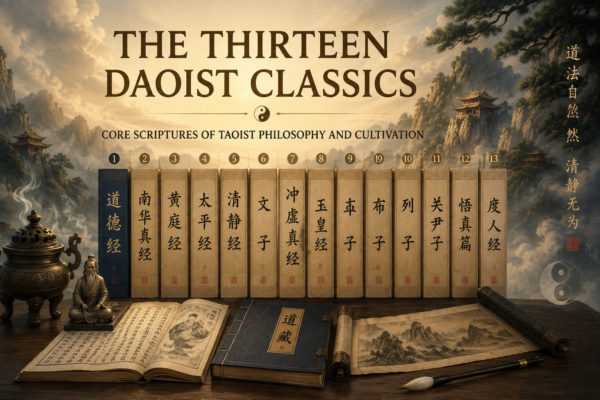
The Thirteen Daoist Classics: Core Scriptures of Taoist Philosophy and Cultivation
Introduction When people first encounter Taoist scripture, they often assume the Tao Te Ching stands [...]
Dec
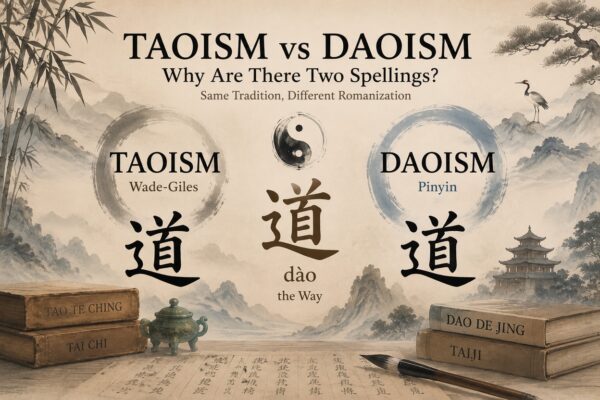
Is Taoism the Same as Daoism? Understanding Why There Are Two Spellings
Introduction When people first start reading about Chinese philosophy, they often encounter both “Taoism” and [...]
Aug