
Introduction
When people first encounter Taoist scripture, they often assume the Tao Te Ching stands alone as the tradition’s defining text. In reality, that single work is only the entry point into a much larger canon — one that spans philosophy, alchemy, ritual, and governance across more than a thousand years of Chinese intellectual history.
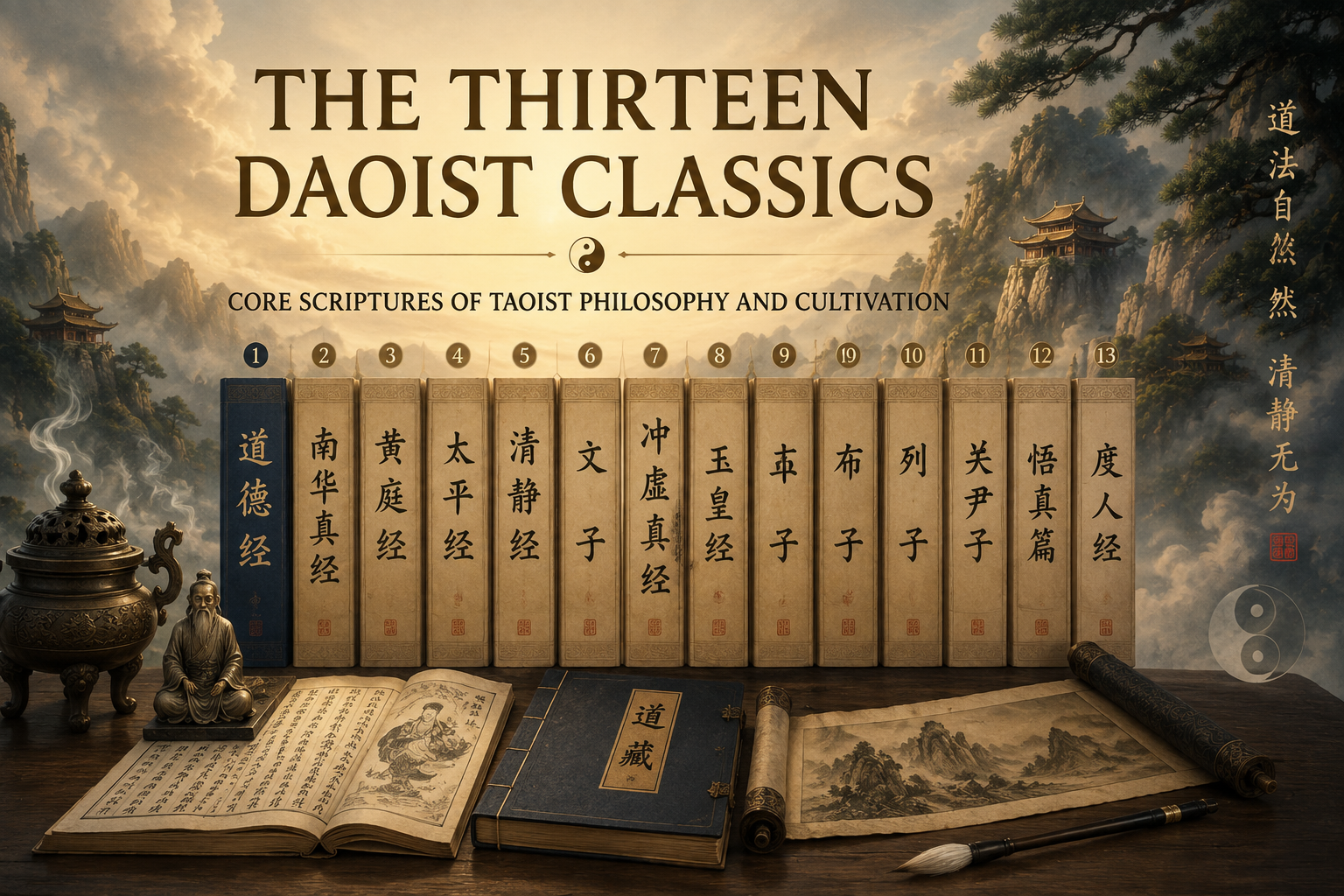
The Thirteen Daoist Classics are a collection of thirteen foundational scriptures that form the doctrinal core of Taoism. These texts cover Taoist philosophy, spiritual cultivation, ritual systems, ethics, internal alchemy, governance, and religious practice. They are regarded as the essential canon for Taoist priests, scholars, and believers studying traditional Taoist culture.
The mainstream version of the Thirteen Daoist Classics was largely standardized during the Qing Dynasty through the compilation of the Daozang, or Daoist Canon — an imperially sponsored collection of Daoist writings, the largest repository of Daoist literature ever compiled. Together, these scriptures shaped the intellectual and spiritual framework of Taoism for centuries.
This guide explores the Thirteen Daoist Classics by examining three key areas:
- what these thirteen scriptures are collectively, and where they came from
- a closer look at each individual text and its distinct contribution to Taoist thought
- how these classics continue to shape Taoist ritual, ethics, and cultivation today
What Are the Thirteen Daoist Classics?
The Thirteen Daoist Classics refer to the most influential and authoritative scriptures in traditional Taoism. They serve as the doctrinal foundation for Taoist philosophy, cultivation systems, temple rituals, and religious ceremonies.
The classics include philosophical writings from Laozi and Zhuangzi, early Taoist religious texts, scriptures on immortality cultivation, ritual manuals, and internal alchemy teachings.
The doctrinal foundations behind many traditional practices, including Taoist sacrificial rituals, are rooted in these canonical texts, which provide the core doctrinal basis for standard Taoist ceremonial practice.
Believers also study these scriptures to understand morality, spiritual discipline, and the correct methods to pray for blessings. In addition, the theories and ceremonial rules behind consecration ceremonies can be traced back to these ancient scriptures.
Tao Te Ching (Dao De Jing)
The Fundamental Scripture of Taoism
The Tao Te Ching, also called Laozi, is traditionally attributed to Laozi and is considered the most important scripture in Taoism.
The text revolves around the concept of the “Dao” (Tao), explaining the origin of the universe, the principle that Dao gives birth to all things, non-action governance, simplicity and humility, and harmony between humans and nature.
It established the philosophical foundation of Taoism and deeply influenced Chinese culture, politics, and spirituality.
Nanhua Jing (Zhuangzi)
The Scripture of Spiritual Freedom
The Nanhua Jing, commonly known as Zhuangzi, was written by Zhuangzi and his followers during the Warring States period.
This scripture expands Taoist philosophy through allegories and imaginative stories. Its central themes include spiritual freedom, equality of all things, following nature, and transcending worldly limitations.
The text had a profound influence on Taoist cultivation theory, immortality beliefs, and internal alchemy practices.
Chongxu Zhenjing (Liezi)
The Taoist Philosophy of Naturalness
The Liezi is traditionally attributed to Lie Yukou. The scripture mainly uses philosophical fables and stories to explain Taoist principles.
Its teachings emphasize following natural law, non-contention, spiritual liberation, and simplicity and spontaneity. The Liezi complements the teachings of Laozi and Zhuangzi and became one of the important philosophical classics of Taoism.
🖼️ [产品卡片占位]:建议插入一款与道德经/经典文化相关的商品,配图+价格+”Shop Now”按钮。
Tongxuan Zhenjing (Wenzi)
Integrating Taoism with Governance
The Wenzi is said to have been written by Wenzi, a disciple of Laozi.
The scripture interprets the teachings of the Tao Te Ching while incorporating ideas from Confucianism and Legalism. It discusses the essence of the Dao, self-cultivation, state governance, and moral order.
This work significantly influenced Taoist political ethics and governance philosophy.
Taiping Zhenjing Shengjun Mishi
Taoist Teachings on Preserving Vital Essence
This Taoist scripture is believed to contain teachings on preserving vitality and cultivating internal essence.
Although the authorship remains uncertain, later scholars believe it was compiled during the Tang Dynasty using materials from the Taiping Jing.
Its teachings mainly focus on protecting life essence, health preservation, spiritual cultivation, and longevity methods.
Taiping Jing
One of the Earliest Taoist Religious Scriptures
The Taiping Jing is an important scripture from the Eastern Han Dynasty and served as the foundational text of the Taiping Dao movement.
Its content covers Heaven and earth, Yin and Yang, the Five Elements, health preservation, and ethics and governance. The scripture advocates peaceful governance, moral behavior, and harmony between humanity and the cosmos. It played a crucial role in the formation of early Taoism.
Dongling Zhenjing (Kangcangzi)
Taoist Political and Philosophical Teachings
Compiled during the Tang Dynasty, the Dongling Zhenjing contains philosophical discussions on Taoist governance and morality.
It became recognized as one of the important Taoist “True Scriptures” during the Tang imperial era.
Wenshi Zhenjing (Guanyinzi)
Inner Enlightenment and Unity with the Dao
The Guanyinzi explores the mysterious and subtle nature of the Dao.
Its teachings focus on inner enlightenment, spiritual awakening, returning to one’s true nature, and unity with the Dao. The scripture strongly influenced later Taoist meditation and internal cultivation traditions.
Baopuzi Neipian
The Classic of Taoist Immortality and Alchemy
Written by Ge Hong during the Eastern Jin Dynasty, the Baopuzi Neipian is one of the most important texts of Taoist alchemy. According to Britannica’s entry on the Baopuzi, the work is divided into “Inner Chapters,” which focus on alchemical studies and the pursuit of physical immortality — including recipes for elixirs and recommendations on diet, breathing, and meditation — and “Outer Chapters,” which reflect Ge Hong’s Confucian perspective on ethics and social harmony.
The book systematically discusses immortality beliefs, external alchemy, talismans and magic arts, longevity practices, and health preservation. It remains a key historical source for understanding medieval Taoism.
Du Ren Jing
The Core Scripture of the Lingbao Tradition
The Du Ren Jing is one of the most influential scriptures of the Lingbao school of Taoism.
Its central teaching is universal salvation. The text emphasizes ritual merit, salvation of souls, ceremonial practice, and compassionate redemption. This scripture became one of the major foundations for Taoist ritual ceremonies and salvation rites.
Yuangong Zhenjing
Scripture of Yuangong the Great Emperor
Popular after the Song Dynasty, this scripture centers on the miracles and teachings of Yuangong the Great Emperor.
It combines loyalty and filial piety, moral cultivation, ritual merit, and internal alchemy concepts. The text became influential within Taoist devotional practices and deity worship traditions.
Qingjing Jing
The Scripture of Clarity and Stillness
The Qingjing Jing is especially important within the Quanzhen tradition of Taoism.
Though short in length, it teaches profound spiritual principles: purifying the mind, eliminating desires, maintaining inner clarity, and returning to tranquility. It remains one of the most frequently recited Taoist scriptures today.
Xin Yin Zhenjing
Internal Alchemy and Spiritual Transformation
The Xin Yin Zhenjing is a concise but highly influential scripture on Taoist internal alchemy.
Its teachings focus on the classic stages of inner cultivation: transforming essence into Qi, transforming Qi into spirit, and returning spirit to emptiness. The text summarizes the core principles of Taoist spiritual refinement and immortality cultivation.
Cultural Importance of the Thirteen Daoist Classics
The Thirteen Daoist Classics are not merely religious texts. They collectively shaped Taoist philosophy, Chinese spiritual traditions, internal alchemy systems, ritual culture, traditional medicine, and ethics and governance.
These scriptures continue to influence Taoist temples, practitioners, scholars, and believers throughout the modern world. For Taoism, they represent both the intellectual source of philosophical wisdom and the sacred foundation of religious cultivation.
Studying the Classics at Taoist World
The Thirteen Daoist Classics represent centuries of accumulated wisdom — from Laozi’s foundational philosophy to Ge Hong’s alchemical studies and the ritual scriptures that continue to shape temple practice today.
At Taoist World, we believe understanding the depth and range of this canon offers essential context for appreciating Taoist tradition as a living, evolving body of knowledge, not a single fixed text.
Explore more Taoist philosophy and wisdom: → Taoist Philosophy & Wisdom Collection
Conclusion
The Thirteen Daoist Classics represent far more than a reading list — they are the accumulated intellectual and spiritual inheritance of Taoism, spanning philosophy, alchemy, governance, and ritual across more than a thousand years.
From the Tao Te Ching’s foundational simplicity to the Baopuzi’s detailed alchemical studies and the Qingjing Jing’s teachings on stillness, each text contributes a distinct thread to the larger fabric of Taoist thought. Together, they remain the sacred foundation on which Taoist temples, priesthood, and practice continue to stand today.
FAQ
✓ Is the Tao Te Ching the only important Taoist scripture? No — while it’s the most well-known, the Tao Te Ching is one of thirteen classics covering philosophy, alchemy, ritual, and governance, each contributing something distinct to Taoist tradition.
✓ What is the Daozang? The Daozang, or Daoist Canon, is the large, imperially sponsored collection of Daoist writings that preserves the Thirteen Classics along with a much broader body of Taoist literature.
✓ Which classic focuses specifically on alchemy and immortality? The Baopuzi Neipian, written by Ge Hong, is the most significant text focused on external alchemy, immortality beliefs, and longevity practices.
✓ Which text is most important to the Quanzhen school specifically? The Qingjing Jing holds particular importance within Quanzhen Taoism, valued for its concise teachings on purifying the mind and returning to stillness.
✓ Do modern Taoist priests still study these classics? Yes — the Thirteen Daoist Classics remain part of the core scripture Taoist priests study today, alongside daily practices like chanting and meditation.
Related Posts

Why Taoist Ritual Implements Are Made from Precious Metals ?
Introduction For many people encountering Taoist ritual implements for the first time, one question naturally [...]
Aug
Introduction to the Procedure of the Dharma Assembly
Taoist dharma assemblies are among the most important ceremonial traditions in Taoism, combining scripture chanting, [...]
Dec

Tao Follows Nature: The Core Principle of Taoist Philosophy and Natural Harmony
Introduction When people first encounter the phrase “Tao follows nature,” they often assume it is [...]
Dec