
Introduction
When people first ask how Taoism began, they often expect a simple answer — a single founder, a founding date, one clear moment of creation. What they usually find instead is something more layered: a tradition that took shape gradually, over more than a thousand years, through the fusion of several distinct streams of belief.
Taoism is the earliest indigenous religion in China and one of the most influential spiritual traditions in East Asian culture. Long before the formal establishment of organized Taoism, its philosophical concepts, ritual systems, and cosmological worldview had already taken root within ancient Chinese civilization.
The origin of Taoism was not formed overnight by a single founder. Instead, it gradually emerged through the fusion of ancient shamanic beliefs, Taoist philosophy, immortality practices, and yin-yang cosmology — each contributing a distinct layer to what would eventually become a fully organized religious tradition.
This guide traces that development by examining three key phases:
- the ancient shamanic and philosophical roots that preceded organized Taoism
- how Taoism formally became an organized religion during the Han dynasty
- the major schools and dynastic developments that shaped Taoism into its modern form
Origin of Taoism
Taoism did not emerge as a single, unified system from its earliest days. Rather, it developed through the gradual convergence of several older traditions, each contributing beliefs, practices, or philosophical concepts that would later be absorbed into a coherent religious framework.
Spirits and Witchcraft: The Earliest Religious Foundation
In ancient China, people believed that all things possessed spiritual power. Mountains, rivers, stars, ancestors, and natural phenomena were all viewed as sacred beings capable of influencing human destiny.
The earliest spiritual practitioners were shamans and ritual specialists who communicated with spirits, healed illnesses, expelled evil forces, and conducted sacrificial ceremonies. Their ritual dances, incantations, divination methods, and healing techniques later became the foundation of Taoist ritual culture.
Many later Taoist ceremonies, talismans, and purification practices evolved directly from these ancient traditions. In many ways, Taoist priests transformed primitive ritual practices into a complete religious and cosmological system.
Huang-Lao Thought: The Philosophical Backbone of Taoism
Without philosophy, Taoism might have remained only a collection of folk rituals and magical practices.
During the Spring and Autumn and Warring States periods, thinkers such as Laozi and Zhuangzi introduced the concept of the “Dao” — the invisible and eternal source that generates and governs all things in the universe. The legendary story behind how this philosophy first came to be written down is explored in more depth in our guide, How Did Taoism Start? The Legend of Laozi and the Birth of the Tao Te Ching.
This philosophical system became the highest spiritual core of Taoism.
The Huang-Lao School of the early Han Dynasty combined the worship of the Yellow Emperor and Laozi, promoting ideas such as:
- non-action governance
- harmony with nature
- simplicity and tranquility
- spiritual freedom
After Confucianism became the official ideology during the reign of Emperor Wu of Han, Huang-Lao philosophy gradually moved from imperial politics into folk society. There, it merged with immortality techniques and cultivation practices, eventually evolving into religious Taoism.
Laozi himself was gradually deified and later honored as Taishang Laojun, one of the supreme deities in Taoism.
Learning its origin and development helps you easily distinguish Taoist Philosophy vs. Taoist Religion.
Immortality Practices and the Pursuit of Transcendence
During the Qin and Han dynasties, legends about immortal beings and sacred mountains such as Penglai became extremely popular.
Many alchemists and magicians searched for methods to achieve immortality. Their practices developed into two major systems:
External Alchemy Practitioners attempted to create immortal elixirs by refining minerals and metals such as mercury and cinnabar.
Internal Alchemy Internal alchemy treated the human body as a spiritual furnace. Practitioners cultivated essence, qi, and spirit in order to achieve transcendence and enlightenment.
These practices later became central to Taoist cultivation traditions and the pursuit of immortality.
Yin-Yang and Five Elements: The Cosmic Framework
The theories of Yin-Yang and the Five Elements provided Taoism with a systematic explanation of the universe.
Everything in existence was believed to operate through:
- the balance of yin and yang
- the interaction of the five elements
- the cycles of growth and transformation
These theories became deeply integrated into Taoist medicine, alchemy, astrology, feng shui, ritual systems, and cultivation methods. They allowed Taoism to build a highly organized cosmological structure that connected nature, humanity, and spirituality.
The Birth of Organized Taoism
The Influence of Taiping Jing
By the late Eastern Han Dynasty, social unrest, natural disasters, and political corruption created a widespread desire for spiritual salvation.
During this period, the scripture Taiping Jing (“Scripture of Great Peace”) spread widely. It combined Taoist philosophy, yin-yang cosmology, morality, and religious salvation into a unified doctrine, promoting ideas such as cosmic harmony, moral responsibility, karmic consequences, and achieving peace through virtue.
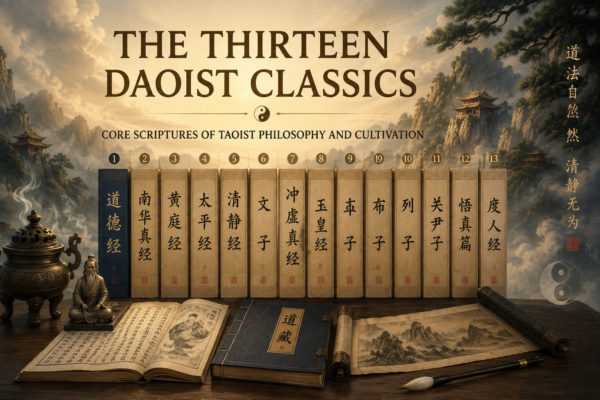
Many precious Taoist classics were gradually sorted out and passed down in the course of Taoist development, eventually becoming part of The Thirteen Daoist Classics.
Zhang Daoling and the Establishment of Tianshi Dao
Around the end of the Eastern Han Dynasty, Zhang Daoling founded the Way of the Celestial Masters (Tianshi Dao) in Sichuan. According to Britannica’s entry on Zhang Daoling, he settled in the Sichuan region during the reign of Emperor Shundi, claimed to have received a direct revelation from the deified Laozi, and began prophesying the coming of an age of Great Peace (Taiping).
This movement is widely recognized as the formal establishment of Taoism as an organized religion. Key features included worship of Laozi as the supreme deity, use of the Tao Te Ching as the central scripture, healing through talismans and rituals, confession of sins, and organized religious communities.
Believers were required to contribute five dou of rice, which is why the movement was also called the “Way of Five Pecks of Rice.” Zhang Daoling’s descendants later developed a structured religious organization with priests, rituals, scriptures, and sacred laws.
Taiping Dao and the Yellow Turban Rebellion
At roughly the same time, Zhang Jue founded Taiping Dao based on Taiping Jing teachings.
The movement attracted enormous numbers of followers and eventually launched the famous Yellow Turban Rebellion with the slogan: “The Blue Heaven is dead; the Yellow Heaven shall rise.”
Although the rebellion failed, it demonstrated the tremendous social influence and mobilizing power of Taoist religious ideology.
Development During the Wei, Jin, and Southern-Northern Dynasties
During this period, Taoism underwent major theological and institutional development.
Ge Hong and Baopuzi Ge Hong systematized Taoist alchemy, immortality theories, and cultivation methods in his famous work Baopuzi.
Kou Qianzhi’s Reforms Kou Qianzhi reformed Celestial Master Taoism by removing excessive folk witchcraft and introducing stricter religious regulations.
Tao Hongjing’s Contributions Tao Hongjing organized Taoist scriptures, developed Taoist theology, and refined cultivation systems, greatly strengthening southern Taoism.
The Golden Age of Taoism
Sui, Tang, and Song Dynasties
During the Tang Dynasty, the imperial family claimed descent from Laozi and strongly promoted Taoism. Laozi was officially honored as “Taishang Xuanyuan Emperor,” and Taoism enjoyed enormous political and cultural prestige.
During the Song Dynasty, emperors continued to support Taoism, leading to the expansion of Taoist temples, flourishing ritual culture, growth of Taoist literature, and advancement of internal alchemy practices.
Emergence of Major Taoist Schools
Quanzhen School
In the Southern Song and Jin-Yuan periods, Wang Chongyang founded the Quanzhen (“Complete Perfection”) School in 1163. According to Britannica’s entry on Quanzhen, Wang established a monastery in Shandong to propagate the Way of Perfect Realization as a deliberate synthesis of Confucianism, Taoism, and Chan (Zen) Buddhism — a sect that would go on to flourish under Mongol imperial patronage.
Quanzhen Taoism emphasized monastic cultivation, internal alchemy, moral discipline, and the integration of Confucianism, Buddhism, and Taoism.
Zhengyi School
The Zhengyi tradition preserved older Celestial Master practices, especially ritual ceremonies, talismans, and community religious services.
These two schools eventually became the two major branches of Taoism that continue to define the tradition today.
Taoism in the Ming and Qing Dynasties
Although Taoism gradually declined politically during the Ming and Qing periods, it remained deeply influential among the people.
Taoist beliefs continued to shape folk religion, festivals, funeral customs, health preservation, temple culture, and spiritual practices. Even today, Taoism continues to influence Chinese philosophy, traditional medicine, martial arts, and cultural identity.
Taoist History at Taoist World
Understanding the full arc of Taoism’s development — from ancient shamanic ritual to a fully organized religious tradition with distinct schools and lineages — offers essential context for appreciating Taoist culture as it is practiced and expressed today.
At Taoist World, we draw on this deep historical foundation in the craftsmanship and symbolism behind everything we create, believing that genuine appreciation for Taoist tradition begins with understanding where it came from.
Explore more Taoist history and culture: → Taoist Basics & Culture Collection
Conclusion
The origin and development of Taoism represent a remarkable historical journey from primitive spiritual beliefs to a complete religious and philosophical system.
It absorbed ancient shamanic rituals, Taoist philosophy, immortality techniques, yin-yang cosmology, and folk religious traditions — gradually forming one of the most profound spiritual traditions in Chinese civilization.
From the Eastern Han Dynasty onward, Taoism continued evolving through philosophy, ritual practice, scripture compilation, and institutional organization. Its wisdom shaped Chinese culture for thousands of years and continues to influence modern spiritual thought today.
FAQ
Zhang Daoling is widely credited with formally establishing Taoism as an organized religion when he founded the Way of the Celestial Masters (Tianshi Dao) in the 2nd century CE.
Taoist philosophy refers to the ideas found in texts like the Tao Te Ching, while Taoist religion refers to the organized institution with temples, priests, and rituals that developed later, absorbing that philosophy as its core.
The Quanzhen (“Complete Perfection”) school, which emphasizes monastic cultivation, and the Zhengyi school, which preserves older ritual and community-based practices, are the two major branches practiced today.
These cosmological theories predate organized Taoism but were gradually absorbed into its framework, becoming central to Taoist medicine, alchemy, feng shui, and ritual practice.
Yes. Despite periods of political decline, Taoism remains deeply influential in Chinese folk religion, festivals, health practices, and cultural identity, both in China and among Taoist communities worldwide.
Related Posts
The Thirteen Daoist Classics: Core Scriptures of Taoist Philosophy and Cultivation
Introduction When people first encounter Taoist scripture, they often assume the Tao Te Ching stands [...]
Dec
How Did Taoism Start? The Legend of Laozi and the Birth of the Tao Te Ching
Introduction When people first ask how Taoism began, they often expect a simple answer — [...]
Aug
Basic Knowledge of Taoist Temples and Taoist Priests: Structure, Duties & Taoist Traditions
Introduction When people first visit a Taoist temple, they often notice the architecture, the incense, [...]
Dec