

Introduction
The Five Elements herbal bracelet turns one of the most influential frameworks in Chinese thought into a wearable composition. Its design joins five botanical ingredients, clear quartz, and a five-color theme associated with Wood, Fire, Earth, Metal, and Water.
Understanding the bracelet requires one important distinction: Wu Xing is not simply a list of five physical substances. It is a model of relationship, sequence, and transformation. The bracelet does not contain or control cosmic forces; instead, it uses materials and colors to express the cultural idea of balance among changing phases.
This article examines one design in detail. For the broader category—how botanical beads are made, how fragrance behaves, and how cultural meaning differs from a medical claim—start with What Are Chinese Herbal Bracelets?
For a second application of the same cultural framework, read The Taoist Five-Element Diet, which explains how the five phases have also shaped traditional ways of organizing foods, seasons, and qualities.
What Is the Wuxing Tianzi Herbal Bracelet?
The Wuxing Tianzi design combines clear quartz with botanical incense beads made from sophora flower, aged tangerine peel, poria, licorice root, and atractylodes. Five colors—green, red, yellow, white, and black—provide the visual vocabulary of the Five Elements.
The formula and color arrangement work on different levels. The botanical materials create the fragrance and tactile identity of the incense beads. The colors communicate the Five Elements theme. Clear quartz gives the design a transparent, unifying accent.
Wu Xing: Five Dynamic Phases
Wu Xing is commonly translated as the Five Elements, but “Five Phases” or “Five Processes” better conveys its dynamic character. Our foundational article, The Five Elements Theory in Taoism and Chinese Philosophy, explains the wider system beyond this bracelet design. The Internet Encyclopedia of Philosophy describes Wood, Fire, Earth, Metal, and Water as interdependent modes within an ongoing universe, rather than fixed building blocks.
The familiar generating sequence is Wood, Fire, Earth, Metal, and Water, returning again to Wood. A second regulating sequence describes how one phase checks another. These cycles express a broader principle: harmony does not require every part to be identical or equally dominant at every moment. The same relational idea appears in our discussion of how Taoist philosophy understands the human body, where the framework is treated as traditional philosophy rather than modern diagnosis. Balance emerges through relationship and adjustment.
The Five Colors in the Bracelet
Green and Wood
Green is associated with Wood, growth, spring, and outward development. In a bracelet, it can visually suggest renewal and movement.
Red and Fire
Red corresponds with Fire, warmth, visibility, and summer. It introduces the most energetic color note in the five-part palette.
Yellow and Earth
Yellow is associated with Earth, centrality, support, and transition. It acts as a visual anchor among brighter and darker tones.
White and Metal
White corresponds with Metal, refinement, structure, and autumn. Beside clear quartz, it reinforces a clean and lucid appearance.
Black and Water
Black is associated with Water, depth, storage, and winter. It gives the palette a grounding endpoint before the cycle turns toward growth again.
Understanding the Five-Ingredient Formula
Sophora flower introduces a light floral-botanical component. Aged tangerine peel contributes a dry citrus-peel impression. Poria has a subtle earthy identity, while licorice root and atractylodes deepen the root-and-rhizome character of the blend.
It is tempting to assign one ingredient mechanically to each element, but the product information does not establish a one-to-one mapping. This caution also matters when reading other systems influenced by the five phases, such as Chinese face reading and its traditional Five Elements correspondences. A more accurate interpretation is that five ingredients echo the fivefold structure collectively, while the five colors communicate the elemental correspondences directly.
These materials are used in the incense bead formula, not offered here as medicine. Traditional uses associated with individual botanicals should not be converted into health promises for a wearable product.
Why Clear Quartz Is Used
Clear quartz provides a visually neutral center. Its transparency allows the five colors to remain distinct without adding a sixth dominant hue. In modern crystal symbolism, clear quartz is often connected with clarity, purification, and balance; these are cultural associations and personal meanings rather than guaranteed properties.
From a design perspective, the material performs a clear function regardless of belief: it reflects light, breaks up opaque botanical beads, and helps the five-color structure read as one composition.
How to Wear the Bracelet as a Personal Reminder
A Five Elements bracelet can be used as a reminder to notice imbalance in ordinary life: effort and rest, expression and reflection, expansion and boundaries. This does not require selecting a single “lucky” element or treating the bracelet as a diagnostic tool.
Some wearers may focus on the complete cycle rather than one color. Others may choose the bracelet because the palette coordinates easily with clothing. Both approaches are valid—the cultural framework gives the design depth, while everyday wear gives it personal meaning.
Care and Storage
Keep the botanical beads away from water, steam, prolonged direct sunlight, and perfume. Wipe the bracelet gently with a dry, soft cloth and store it separately so clear quartz does not rub against softer jewelry materials.
Natural fragrance will usually become subtler over time. That is normal. Avoid adding essential oils unless the seller specifically confirms compatibility, because oils can discolor beads, affect elastic cord, and replace the original balanced aroma.
View the Five Elements Tianzi Fragrance Bracelet product page for the current bead arrangement, materials, sizing, and availability.
Conclusion
The Wuxing Tianzi bracelet expresses the Five Elements through a coordinated five-color design, a five-ingredient botanical formula, and clear quartz. Its strongest meaning is not a promise of perfect balance, but a visible reminder that balance is dynamic, relational, and continually renewed.
To compare this design with other formulas, gemstones, and fragrance profiles, explore the Chinese Herbal & Botanical Bracelets collection.

Frequently Asked Questions
What are the five ingredients in the Wuxing Tianzi bracelet?
The listed formula contains sophora flower, aged tangerine peel, poria, licorice root, and atractylodes.
Which colors represent the Five Elements?
The design uses green for Wood, red for Fire, yellow for Earth, white for Metal, and black for Water.
Does each botanical ingredient correspond to one element?
The current product description does not specify a one-to-one correspondence. The five ingredients collectively support the theme, while the color mapping is explicit.
Is Wu Xing the same as five physical elements?
Not exactly. Wu Xing is more accurately understood as five dynamic phases or processes used to describe relationships and change.
Can the bracelet determine which element I need?
No. It is a symbolic jewelry design, not a diagnostic instrument or substitute for a qualified cultural, medical, or metaphysical consultation.
Related Posts

Jiang Zhen Xiang Bracelet: Aromatic Materials and Protective Symbolism
Explore the Jiang Zhen Xiang bracelet, its woody botanical formula, cinnabar, White Phantom quartz, protective [...]
Sep
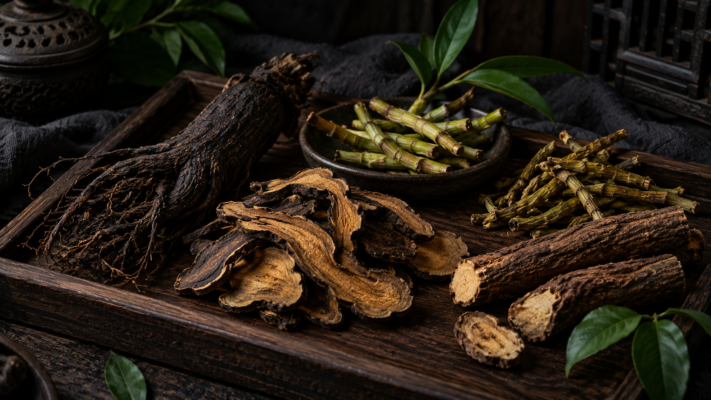
Hei Long Xian Bracelet: Dark Stones, Woody Fragrance, and Symbolic Meaning
Explore the Hei Long Xian bracelet, its dark stones, botanical formula, protective symbolism, material facts, [...]
Sep
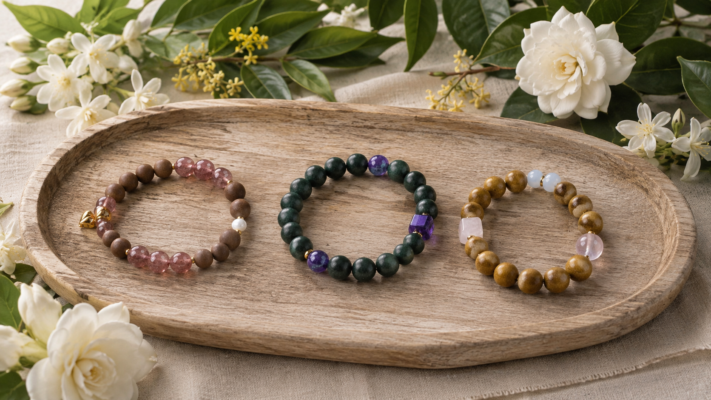
Jasmine, Gardenia, and Osmanthus Herbal Bracelets: Exploring Three Floral Blends
Introduction Choosing a floral bracelet sounds simple until you discover how differently a flower can [...]
Sep