When we think about the human body today, we often imagine a collection of separate systems. The heart pumps blood, the lungs bring in oxygen, the stomach digests food, and the brain coordinates everything else. Modern medicine has achieved remarkable advances by studying each organ individually, helping us better understand how the body functions and how diseases develop.
Taoist philosophy offers a different way of looking at the body. Rather than viewing our organs as isolated parts, Taoism sees the human body as an interconnected whole that constantly interacts with nature. Physical health, emotions, seasonal changes, and the flow of Qi are all understood as part of the same living system.
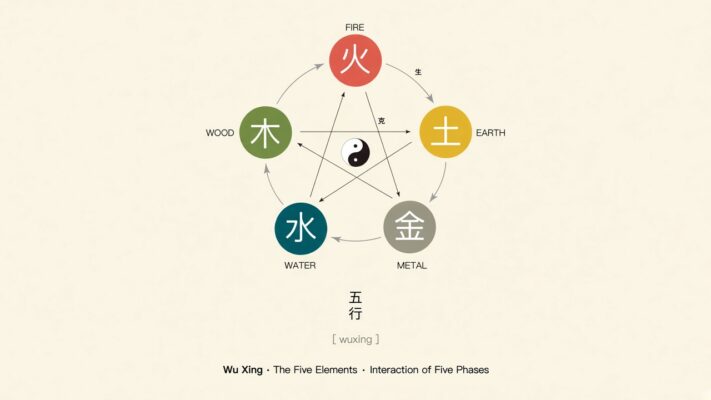
One of the most important frameworks for understanding this relationship is the Five Elements (Wu Xing). Rather than describing five physical substances, the Five Elements explain patterns of change and balance found throughout nature—including within the human body. If you’re new to this concept, we recommend reading our guide,“The Five Elements Theory,”before continuing with this article.
In this guide, we’ll explore how Taoist philosophy understands the Five Organs through the lens of the Five Elements, and why maintaining harmony between them has long been considered an essential part of cultivating health, balance, and well-being.
The Human Body Is Nature Itself
One of the most fundamental ideas in Taoist philosophy is that human beings are not separate from nature—we are nature itself.
The same rhythms that shape the changing seasons, the movement of water, the growth of trees, and the warmth of the sun are also reflected within the human body. From a Taoist perspective, there is no clear boundary between the natural world and ourselves. We are simply another expression of the Tao.
This understanding is reflected in one of the best-known passages of the Tao Te Ching:
“Man follows the Earth. Earth follows Heaven. Heaven follows the Tao. The Tao follows what is natural.” Chapter 25 of the 《Tao Te Ching》
Because human beings are part of nature, Taoist thinkers developed the concept of Wu Xing (The Five Elements) as a way of understanding the relationships and patterns that exist both in the natural world and within ourselves.
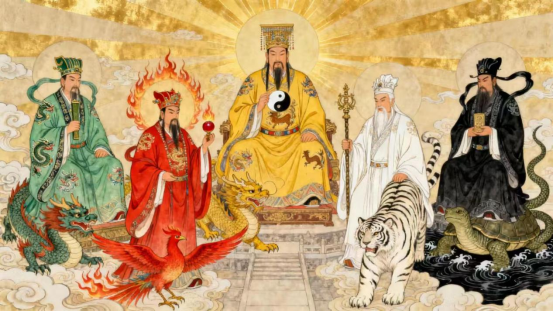
Although the Five Elements are often represented by Wood, Fire, Earth, Metal, and Water, they should not be understood merely as five physical substances. These names are symbolic. They describe different patterns of movement, transformation, and interaction found throughout nature.
For example, Fire does not only refer to flames. Depending on the context, it may represent warmth, upward movement, transformation, or the release of energy. Likewise, Water is more than a liquid—it represents nourishment, storage, adaptability, and the tendency to flow downward.
Seen in this way, the Five Elements become a language for describing how nature operates. Because the human body follows these same natural principles, Taoist philosophy uses Wu Xing to understand the relationships between the organs, emotions, seasons, and the continual process of maintaining balance.
The Five Organs Through the Lens of Wu Xing
In Taoist philosophy, the Five Organs—the Liver, Heart, Spleen, Lungs, and Kidneys—are understood through the framework of Wu Xing. Rather than viewing these organs as isolated structures with single functions, Taoism sees each one as expressing a particular pattern of nature.
This does not mean that an organ is literally made of an element. Instead, each organ shares qualities with one of the Five Elements, reflecting how it behaves, how it changes, and how it relates to the rest of the body.
For example, the Liver is associated with Wood because both represent growth, expansion, and upward movement. The Heart corresponds to Fire, symbolizing warmth, vitality, and outward expression. These relationships are symbolic and philosophical, helping us understand the body as a living system rather than a collection of independent parts.
From a Taoist perspective, no organ exists on its own. Just as the seasons influence one another and every element in nature is connected, the organs continuously interact to maintain harmony throughout the body.
The table below provides a simple overview of these traditional correspondences.
Organ
Wu Xing
Core Quality
Season
Emotion
Liver
Wood
Growth & Expansion
Spring
Anger
Heart
Fire
Warmth & Vitality
Summer
Joy
Spleen
Earth
Nourishment & Stability
Late Summer
Worry
Lungs
Metal
Purification & Letting Go
Autumn
Grief
Kidneys
Water
Storage & Renewal
Winter
Fear
1.Wood and the Liver: The Energy of Growth
Among the Five Organs, the Liver is associated with Wood, not because it resembles a tree, but because both express the same pattern of growth and expansion.
Think about spring. After a long winter, seeds begin to sprout, branches stretch toward the sky, and life starts moving outward once again. In Taoist philosophy, this upward and outward movement is the essential quality of Wood.
The Liver is understood in a similar way. Traditionally, it is associated with the smooth movement of Qi, allowing energy to circulate freely throughout the body. When this movement is balanced, people may feel motivated, adaptable, and emotionally steady. Just as a healthy tree grows without resistance, Taoism sees harmony as the result of energy flowing naturally rather than being forced.
For this reason, the Liver is also traditionally linked with the emotion of anger. This does not mean anger is “stored” in the liver or that the liver causes anger. Instead, Taoist philosophy uses anger as an example of energy that rises quickly and forcefully—much like a tree branch pushing upward in spring. When expressed with awareness, this energy can become determination and creativity. When excessive or suppressed, it may disturb the body’s natural sense of balance.
Rather than judging emotions as good or bad, Taoism encourages observing how they move through us. Like the seasons, emotions naturally arise and pass. Health comes not from eliminating them, but from allowing them to flow without becoming trapped.
Did You Know?
In Taoist philosophy, the Liver is associated with Wood, but this should be understood as a symbolic relationship rather than a medical one. These traditional correspondences describe patterns of nature and should not be interpreted as modern anatomical or clinical explanations.
2.Fire and the Heart: The Center of Spirit
In Taoist philosophy, the Heart is associated with Fire, representing warmth, vitality, and the ability to illuminate life from within. Just as fire provides light and heat, the Heart symbolizes the energy that brings awareness, enthusiasm, and emotional presence.
Unlike the modern anatomical view of the heart as primarily a pump, Taoist philosophy sees the Heart as the home of the Shen (Spirit). Shen refers to our consciousness, emotional awareness, and overall state of mind.
This idea can be found in traditional Chinese medical texts such as the Huangdi Neijing (Yellow Emperor’s Inner Classic), which states that:
In traditional Taoist and Chinese philosophical thought, this statement does not mean that the physical heart controls the mind in a modern medical sense. Instead, it expresses the belief that the Heart represents a person’s inner awareness, emotional balance, and spiritual state.
When the Heart is in harmony, the Shen is said to remain calm and settled, allowing a person to experience greater clarity, emotional balance, and restful sleep.
If you’re interested in applying these ideas before bedtime, you may also enjoy our guide to Taoist Sleep Meditation.
3.Earth and the Spleen: The Foundation of Nourishment
In Wu Xing, the Spleen is associated with Earth, representing stability, nourishment, and transformation.
Just as the Earth provides a foundation for plants to grow, Taoist philosophy views the Spleen as a symbol of the body’s ability to receive, transform, and make use of nourishment. This idea extends beyond physical food—it also includes how we process experiences, emotions, and the information we receive from the world around us.
“The Spleen is the root of acquired life and the source of transformation.” — Huangdi Neijing
Earth represents the center and the ability to create balance. When this energy is harmonious, a person is traditionally believed to feel grounded, stable, and capable of adapting to daily changes. Like fertile soil that supports life, a balanced Earth allows growth to happen naturally.
The Spleen is also traditionally associated with the emotion of worry or excessive thinking. This does not mean that thinking itself is negative. Reflection and awareness are essential parts of human life. However, Taoist philosophy observes that when the mind becomes trapped in endless analysis, concerns, and mental repetition, it can disturb the natural balance between the body and mind.
This is why Taoist practice often emphasizes returning from excessive thinking to direct awareness of the present moment. Through meditation, mindful breathing, and cultivating inner stillness, we learn not to eliminate thoughts, but to avoid becoming controlled by them.
In Wu Xing, the Lungs are associated with Metal, representing clarity, refinement, and the ability to release what is no longer needed.
To understand this relationship, we can observe the nature of Metal itself. Through refinement, raw materials are transformed into something pure and valuable. In the same way, Taoist philosophy views the Lung system as a symbol of purification—the process of taking in what nourishes life and letting go of what no longer serves us.
Breathing is one of the clearest expressions of this principle. With every breath, we naturally receive and release. We inhale what the body needs and exhale what it does not. This simple rhythm reflects a deeper Taoist understanding: life is maintained through a continuous balance between receiving and letting go.
The Lungs are also traditionally associated with the emotion of grief or sadness. This does not mean that sadness is harmful or should be avoided. Instead, Taoism recognizes that emotions are natural movements of life. Just as autumn arrives and leaves fall from trees, certain experiences require us to let go before new growth can begin.
When people hold onto past experiences, worries, or emotions for too long, they may lose the ability to move naturally with change. Taoist cultivation encourages learning from the qualities of Metal: clarity, acceptance, and release.
Through practices such as mindful breathing and meditation, we can gradually create more space within ourselves—not by rejecting emotions, but by allowing them to flow and transform naturally.
5.Water and the Kidneys: The Source of Renewal
In Wu Xing, the Kidneys are associated with Water, representing storage, depth, and the hidden potential that supports life.
Unlike flowing rivers and surface water, the deeper nature of Water is its ability to remain still, preserve, and provide support beneath the surface. In Taoist philosophy, this quality reflects the idea that not all growth comes from constant movement. Sometimes, restoration and renewal require periods of stillness.
The Kidneys are traditionally associated with the concept of Jing (Essence), which represents the fundamental vitality and life potential within a person. This idea does not refer to a measurable substance in modern biology, but rather to a traditional philosophical understanding of the resources that support growth, development, and endurance throughout life.
Water is also connected with winter, a season traditionally associated with conservation and inward reflection. Unlike spring and summer, which represent expansion and activity, winter teaches the importance of rest, preservation, and returning energy inward.
The emotion traditionally associated with the Kidneys is fear. From a Taoist perspective, fear is not simply a negative emotion—it is a signal related to survival and self-protection. However, when fear becomes overwhelming or prevents natural movement through life, it can disturb inner balance.
The wisdom of Water is learning when to move and when to rest. Through cultivating stillness, conserving energy, and maintaining harmony with natural rhythms, Taoist practice encourages us to reconnect with our deeper source of vitality.
This inward, restorative quality is also closely connected with Yin, which represents stillness, nourishment, and renewal in Taoist philosophy. To explore how these complementary forces shape the Taoist understanding of health and balance, read our guide to Qi and Yin-Yang in Taoist Philosophy.
After exploring each of the Five Organs individually, it is important to remember that Taoist philosophy never views them as separate systems.
Just as the Five Elements continuously generate, support, and regulate one another in nature, the organs are also understood as existing in a dynamic relationship. No organ functions in complete isolation, and no aspect of health can be understood on its own.
For this reason, Taoism places greater emphasis on balance than on perfection. Rather than asking whether one organ is “strong” or “weak,” Taoist practice asks whether the body’s natural relationships remain in harmony.
This perspective also explains why Taoist cultivation focuses on everyday habits rather than isolated solutions. Sleep, breathing, movement, emotional awareness, and living in harmony with the seasons are all viewed as different expressions of the same underlying balance.
In the end, the Five Organs are not simply parts of the body—they are reminders that health is created through relationship, not separation.
Taoism does not ask us to perfect one organ—it invites us to cultivate harmony within the whole person.
Final Thoughts
Rather than offering a checklist for improving health, Taoist philosophy invites us to see the human body from a different perspective.
The Five Organs are not viewed as isolated parts to be optimized individually. Instead, they represent different expressions of the same natural order that shapes the seasons, the landscape, and all living things. Health, from this perspective, is not achieved by pursuing perfection, but by cultivating balance.
This is the enduring value of Wu Xing. It is not simply a system for classifying organs or emotions, but a way of understanding the relationships that connect the body, the mind, and the natural world.
Whether through mindful breathing, restorative sleep, meditation, or simply learning to move with the rhythms of nature, Taoist cultivation reminds us that well-being is not something we force—it is something we gradually return to.
Perhaps the greatest lesson of Taoism is that we are not separate from nature. When we begin to understand the patterns of nature, we also begin to understand ourselves.
In Taoist philosophy, the Five Organs are the Liver, Heart, Spleen, Lungs, and Kidneys. Rather than being viewed solely as physical organs, they represent different patterns of nature expressed within the human body. Each organ is associated with one of the Wu Xing (Five Elements) and is connected to specific qualities, emotions, and seasonal rhythms.
No. Taoist philosophy does not replace modern anatomy or medicine. The Five Organs are part of a traditional philosophical framework used to understand the relationship between the body, mind, and nature. These symbolic associations should not be interpreted as modern medical explanations or diagnoses.
According to Taoist philosophy, human beings are part of nature and follow the same patterns of change found throughout the natural world. Wu Xing provides a framework for understanding these patterns, which is why each organ is traditionally associated with one of the Five Elements.
The goal is not to strengthen one organ individually, but to maintain harmony throughout the whole body. Taoism teaches that well-being arises from balance between the organs, emotions, daily habits, and the natural rhythms of life.
Traditional Taoist practices such as meditation, mindful breathing, regular sleep, and living in harmony with nature are intended to support overall well-being and inner balance. However, they should be viewed as complementary lifestyle practices rather than substitutes for professional medical care.
Medical Disclaimer
The information in this article is provided for educational purposes and reflects the traditional perspectives of Taoist philosophy and classical Chinese thought. Concepts such as Wu Xing (Five Elements), Qi, Shen, and Jing are presented as philosophical and cultural frameworks rather than modern medical theories.
This article is not intended to diagnose, treat, cure, or prevent any disease, nor should it replace professional medical advice. If you have concerns about your physical or mental health, please consult a qualified healthcare professional.