

Introduction
When people first hear that Taoist tradition connects food to the Five Elements, they often expect a rigid list of foods to eat and foods to avoid. What they usually find instead is something more flexible: a framework for noticing balance, not a strict set of dietary rules.
The Taoist approach to diet is rooted in the same Five Elements Theory that shapes Taoist cosmology, medicine, and Feng Shui more broadly. Rather than counting calories or macronutrients, this framework organizes food according to flavor — sour, bitter, sweet, pungent, and salty — each corresponding to one of the Five Elements and a specific organ system.
Unlike a fixed meal plan, the Five-Element diet is meant to be applied dynamically, adjusting to the seasons, your current state of health, and the natural rhythms of daily life — closely connected to the broader framework of Qi and Yin-Yang that underlies Taoist thought.
This guide explores the Taoist Five-Element diet by examining three key areas:
- how the five flavors connect to the Five Elements and specific organs
- what foods correspond to each element and what they’re traditionally believed to support
- how to apply this framework seasonally, without treating it as a rigid rulebook
The Five Flavors: Where Diet Meets the Five Elements
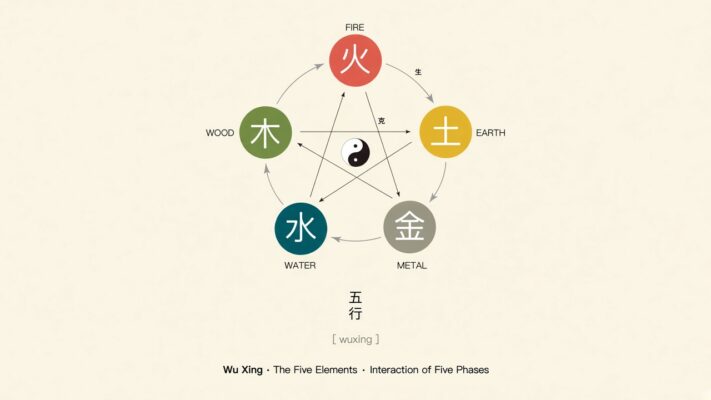
According to Britannica’s overview of traditional Chinese medicine, ancient healers identified five basic elements — Wood, Fire, Earth, Metal, and Water — and mapped a wide range of correspondences onto them, including specific organs, seasons, and the foods believed to support each one. This framework allows practitioners to build a healing or maintenance plan that includes food choices alongside other lifestyle adjustments.
Each of the five flavors is believed to have an affinity for a specific organ system( You can learn more in this Article How Taoist Philosophy Understands the Human Body), meaning foods within that flavor category are thought to support — or, in excess, burden — the corresponding organ.
Wood: Sour Foods and the Liver
Wood corresponds to the sour flavor and is associated with the liver and gallbladder, along with the season of spring.
Traditional sour foods include citrus fruits, vinegar, fermented foods, and leafy greens like sorrel. In moderate amounts, sour flavors are traditionally believed to support liver function and aid digestion; in excess, they are thought to create tension or rigidity, mirroring Wood’s association with growth that has become too forceful or unyielding.
Fire: Bitter Foods and the Heart
Fire corresponds to the bitter flavor and is associated with the heart and small intestine, along with the season of summer.
Traditional bitter foods include dark leafy greens, dandelion greens, bitter melon, and dark chocolate in moderation. Bitter flavors are traditionally believed to clear excess heat from the body and support circulation — fitting for an element associated with warmth, activity, and the peak of Yang energy.
Earth: Sweet Foods and the Spleen
Earth corresponds to the sweet flavor and is associated with the spleen and stomach, along with late summer.
It’s worth noting that “sweet” in this context does not primarily mean sugar or dessert. Traditional sweet foods include whole grains, root vegetables, squash, and legumes — naturally, mildly sweet foods that are believed to nourish and stabilize digestion, reflecting Earth’s role as the grounding center that supports all other elements.
Metal: Pungent Foods and the Lungs
Metal corresponds to the pungent (spicy) flavor and is associated with the lungs and large intestine, along with autumn.
Traditional pungent foods include ginger, garlic, onions, and warming spices. These foods are traditionally believed to disperse stagnation and support circulation, particularly useful in cooler months when the body benefits from added warmth — echoing Metal’s association with clarity, structure, and inward focus as the seasons turn colder.
Water: Salty Foods and the Kidneys
Water corresponds to the salty flavor and is associated with the kidneys and bladder, along with winter.
Traditional salty foods include seaweed, miso, and naturally salty ocean foods, used in modest amounts to support the kidneys — traditionally regarded as the body’s deepest reserve of vital energy. Water’s association with depth, stillness, and conserved potential is reflected in this element’s connection to winter, the season of rest and inward retreat.
Eating with the Seasons
Beyond matching flavors to organs, the Five-Element diet places significant emphasis on eating in alignment with the current season — a practical application of the Taoist principle that Tao Follows Nature.
In spring, lighter, sour-leaning foods are favored to support the Wood element’s associated growth and renewal. In summer, bitter and cooling foods help manage the Fire element’s peak heat. Late summer favors naturally sweet, grounding Earth foods. Autumn calls for warming, pungent Metal foods to prepare the body for colder months. And winter favors deeply nourishing, salty Water foods that support rest and conservation of energy.
This seasonal approach reflects a broader Taoist principle: that health comes not from following one fixed diet year-round, but from continuously adjusting to the natural cycles unfolding around you.
A Note on Balance, Not Restriction
It’s worth emphasizing that the Five-Element diet is not designed as a restrictive eating plan, nor does it ask practitioners to eliminate entire flavor categories.
The underlying goal is balance among all five flavors, adjusted according to season, individual constitution, and how your body actually feels — not the rigid avoidance of any single food group. Traditional guidance generally treats excess as more relevant than presence: too much of any one flavor, rather than the flavor itself, is what’s traditionally believed to create imbalance.
Wellness Wisdom at Taoist World
The Taoist Five-Element diet offers a practical, everyday application of the same cosmological framework that shapes so much of Taoist philosophy — a reminder that balance is found not through rigid rules, but through ongoing attention to the natural rhythms of body and season.
At Taoist World, we see this same principle reflected in much of what we do — believing that genuine wellness comes from understanding these traditional frameworks, not from following them mechanically.
Explore more Taoist wellness guidance: → Taoist Wellness & Self-Cultivation Collection
Conclusion
The Taoist Five-Element diet offers a way of thinking about food that goes beyond nutrients and calories — connecting flavor, season, and organ health into a single, interconnected framework rooted in centuries of Chinese medical and philosophical tradition.
Rather than a rigid meal plan, it functions as a lens: a way of noticing which flavors your body may be craving or avoiding, and adjusting gently in response, season by season. Approached this way, eating becomes less about following rules and more about paying closer attention — a small, daily practice of the same balance Taoist philosophy applies to life more broadly.
FAQ
Sour (Wood), bitter (Fire), sweet (Earth), pungent/spicy (Metal), and salty (Water) — each associated with a specific element and organ system.
No — in this framework, “sweet” refers to naturally mild, sweet foods like whole grains, root vegetables, and squash, not refined sugar or dessert.
Traditional guidance emphasizes balance among all five flavors rather than restriction, adjusted according to season and how your body feels, rather than a fixed daily formula.
Each season favors a different element and flavor — sour in spring, bitter in summer, sweet in late summer, pungent in autumn, and salty in winter.
It’s rooted in traditional Chinese medicine rather than modern nutritional science, though some of its principles — like seasonal, whole-food eating — align with general dietary wellness advice.
Related Posts
The Deities of the Five Directions in Taoism: The Five Elemental Gods of Wood, Fire, Metal, Water, and Earth
The Five Elemental Deities of Wood, Fire, Metal, Water, and Earth are central figures in [...]
Dec

How Taoist Philosophy Understands the Human Body
Introduction When we think about the human body today, we often imagine a collection of [...]
Jul
The Five Elements Theory in Taoism and Chinese Philosophy
Introduction When people first encounter the Five Elements in Chinese philosophy, they often assume Wood, [...]
Dec