

Introduction
When people think about Feng Shui in the home, they often focus on furniture, entrances, colors, directions, or symbolic objects. Yet there is another important part of the household environment that cannot be treated like furniture or decoration: the living beings who share the space with us.
Pets are constantly moving, breathing, resting, eating, and responding to their surroundings. From a traditional Taoist perspective, this makes them fundamentally different from inanimate objects. They participate in the changing flow of Qi within a home.
This becomes particularly interesting in 2026, a year traditionally associated with the Bing Wu (丙午) combination, commonly described as the Yang Fire Horse year. Fire is emphasized through both the heavenly stem and the earthly branch, creating a symbolic framework in which themes of activity, movement, warmth, and intensity become especially prominent.
But Feng Shui should not be reduced to a list of rules such as “one animal is lucky” or “another animal should face a certain direction.” Taoist thought is much more concerned with relationships, balance, and responding appropriately to changing circumstances.
This guide therefore approaches pets and Feng Shui from a broader Taoist perspective. Rather than treating animals as Feng Shui cures, we will explore how Qi, Yin and Yang, the Five Elements, and the natural behavior of animals can help us understand harmony within the home.
The Taoist View of the Home: A Living Environment
A home is more than a physical structure.
In Taoist thought, human beings exist within a continuous relationship with Heaven, Earth, and the natural world. The home is therefore not an isolated container. It is one part of a larger environment in which people, animals, objects, weather, light, movement, and space continuously interact.
This is one reason Feng Shui is traditionally concerned with the movement of Qi.
Qi should not be understood simply as an invisible substance that can be measured and placed like furniture. In traditional Chinese thought, Qi can also describe patterns of vitality, movement, transformation, and interaction.
A quiet room, an active household, a sleeping animal, an open window, sunlight entering a room, or stagnant air can all change the character of a space.
Pets participate naturally in these changes.
A dog moving through a living room creates a different environment from a dog sleeping quietly in a corner. A cat choosing a sunny windowsill creates a different pattern of movement from a cat hiding beneath furniture. A fish tank introduces a continuous visual and physical association with Water.
From this perspective, the important question is not simply:
“Which pet brings the best Feng Shui?”
A more useful question is:
“How does the presence and behavior of this living being interact with the environment of the home?”
The Context of 2026: The Yang Fire Horse Year
The year 2026 is traditionally associated with 丙午 (Bing Wu), commonly translated as the Fire Horse.
Both the heavenly stem 丙 and the earthly branch 午 are associated with Fire, which is why 2026 is often described as a year with particularly strong Fire symbolism.
Fire is traditionally associated with:
- activity;
- warmth;
- visibility;
- enthusiasm;
- movement;
- transformation.
These qualities can be constructive, but excessive Fire symbolism can also be interpreted as excessive stimulation, impatience, or instability.
For a broader look at the traditional beliefs and customs surrounding the year, see our 2026 Tai Sui Guide: What the Fire Horse Year Means for Your Zodiac and Complete Analysis of the 2026 丙午 (Bing Wu) Horse Year Tai Sui Folk Customs.
However, 2026 should not be understood as a year in which every household must follow the same set of Feng Shui rules. The more useful approach is to consider how the year’s symbolic qualities interact with the actual conditions of your home.
Pets as Living Qi
Traditional Feng Shui often distinguishes between environments that feel active and those that feel stagnant.
Pets naturally contribute movement to a household. Their breathing, movement, sounds, feeding patterns, and interaction with people introduce continual change into the living environment.
This can be understood through the relationship between Yin and Yang.
Yang is associated with activity, movement, warmth, and outward expression, while Yin is associated with stillness, quietness, inwardness, and rest. Neither is inherently better than the other. A healthy environment requires their relationship to remain balanced.
A highly energetic dog running constantly through a small apartment may create a very different atmosphere from a calm older dog resting beside its owner.
Likewise, a cat that spends most of the day sleeping contributes a different rhythm from one that is constantly active at night.
Therefore, it is more useful to consider a pet’s actual temperament and wellbeing than to assign a rigid Feng Shui label to the animal.
A Healthy Pet Comes Before Feng Shui
This principle should come before every other consideration.
A pet should never be adopted simply because someone believes that it will improve Feng Shui.
From an ethical and Taoist perspective, an animal is a living being rather than a decorative Feng Shui object. Its wellbeing should always take priority over symbolic considerations.
A stressed, frightened, sick, or neglected animal cannot reasonably be treated as a positive Feng Shui feature simply because its species is associated with a particular element.
Providing appropriate food, clean water, sufficient space, exercise, veterinary care, companionship, and a secure environment is therefore more important than any placement rule.
In this sense, caring properly for a pet is itself an expression of harmony.
Pets and the Five Elements

The Five Elements — Wood, Fire, Earth, Metal, and Water — provide another traditional framework for thinking about relationships within an environment.
It is important, however, not to treat the Five Elements as a rigid classification system in which every animal permanently belongs to one element.
Different Chinese traditions and Feng Shui schools may associate animals, directions, colors, seasons, and other phenomena with the Five Elements in different ways.
The Five Elements Theory in Taoism and Chinese Philosophy offers a broader introduction to how these relationships are understood within Taoist thought.
The more useful approach is to consider the qualities represented by each element and how they interact, rather than assigning every animal a fixed label.
Water: Stillness, Adaptation, and Flow
Water is associated with fluidity, depth, adaptability, and movement.
Aquatic animals such as fish naturally create a strong visual association with Water. A properly maintained aquarium can also introduce movement and reflection into an interior space.
But the symbolism of Water does not automatically make every aquarium beneficial.
The size of the tank, water quality, noise from filtration equipment, maintenance requirements, and the wellbeing of the animals are all more important than simply placing an aquarium in a supposedly “lucky” location.
A neglected aquarium filled with unhealthy water does not create harmony simply because Water is considered favorable.
Wood: Growth and Vitality
Wood represents growth, life, flexibility, and renewal.
Animals that interact closely with plants and natural environments can encourage people to reconnect with these qualities. Cats exploring a home filled with natural materials, for example, can become part of an environment that feels more connected to living nature.
The important principle is not that a cat is literally “a Wood animal” in every Taoist tradition.
Rather, its relationship with movement, growth, nature, and living space can be understood through the qualities traditionally associated with Wood.
Fire: Activity and Expression
Fire represents warmth, brightness, movement, transformation, and outward activity.
Highly active animals can sometimes contribute to this character of a household.
Birds, for example, are frequently associated with movement, sound, lightness, and upward motion. Their presence can create an energetic atmosphere, particularly in a busy household.
But an environment that is already noisy or highly stimulating may benefit from more quietness rather than additional activity.
This is the essence of Yin-Yang thinking: the same quality that supports one environment may overwhelm another.
Earth: Stability and Grounding
Earth is associated with stability, nourishment, reliability, and groundedness.
Dogs often occupy a particularly important social position within a household because they interact closely with people and frequently spend time in shared spaces.
Rather than claiming that every dog is inherently an Earth animal, we can understand the relationship symbolically: a calm companion who regularly occupies the center of family life can contribute to a feeling of stability and belonging.
Metal: Structure and Clarity
Metal is traditionally associated with structure, precision, clarity, and refinement.
Metal may be expressed in the home through architecture, objects, colors, sounds, and symbolic implements rather than through a particular pet species.
This is an important reminder that Feng Shui is not simply about assigning an element to an animal. The overall environment contains many interacting elemental qualities.
A household may already contain strong Fire through lighting, electronics, colors, and activity, while lacking the quiet and structure associated with other elements.
The goal is therefore not to maximize one element, but to understand the relationships among them.
How Taoism Understands Animals Within the Home
A deeper Taoist approach begins with observation.
Rather than asking which animal is “lucky,” we can observe how an animal naturally responds to its surroundings.
Where does it prefer to rest? Which areas make it anxious? Where does it seek sunlight? Where does it retreat when the household becomes noisy?
These behaviors provide practical information about the environment.
A cat repeatedly choosing a quiet corner may simply be responding to temperature, light, noise, or a sense of security. A dog staying near the entrance may be responding to its social role and awareness of movement outside the home.
There is no need to turn every behavior into a supernatural prediction.
Instead, observation itself becomes valuable because Taoist thought places great importance on understanding natural patterns rather than forcing them.
Creating Balance During the 2026 Fire Horse Year
The Fire symbolism associated with 2026 provides a useful opportunity to think about balance within the household.
If a home is already extremely active, brightly lit, noisy, and constantly occupied, introducing additional stimulation may not be helpful.
In such an environment, quiet spaces, natural materials, softer lighting, and clearly defined areas for rest can create a better balance.
Conversely, if a home feels dark, isolated, or stagnant, greater access to natural light, ventilation, movement, and living activity may help create a more comfortable environment.
The principle is adjustment rather than fear.
Feng Shui does not require every home to look the same. A balanced home is one that responds appropriately to the people and animals living within it.
Practical Feng Shui Considerations for Different Pets
Cats
Cats often seek warm, quiet, and elevated places where they can observe their surroundings.
Rather than forcing a cat into a supposedly auspicious location, allow it to choose among several safe resting areas.
Keep litter boxes clean and away from food preparation areas, sleeping spaces, and places where the animal may feel exposed.
From both a practical and symbolic perspective, cleanliness matters. A neglected litter area can create unpleasant odors and an unhealthy environment regardless of any Feng Shui theory.
Dogs
Dogs often spend significant time in shared family spaces, making their environment closely connected with the household’s daily rhythm.
A dog bed can be placed in a location where the animal can rest comfortably while still feeling connected to the family.
Avoid placing the bed in a high-traffic area where the animal is constantly disturbed.
Likewise, keeping pathways and entrances clear benefits both the dog and the general circulation of the home.
Fish
Fish can introduce a strong visual association with Water, making aquariums particularly interesting from a Five Elements perspective.
Traditional Feng Shui practices sometimes recommend specific numbers or directions for fish tanks. However, these recommendations vary among different schools and should not be treated as universal rules.
The practical requirements are much more consistent:
- maintain clean water;
- provide adequate tank space;
- use appropriate filtration;
- avoid excessive direct heat;
- provide species-appropriate care.
A healthy aquarium is far more harmonious than one placed in a theoretically favorable direction but poorly maintained.
Birds and Reptiles
Birds and reptiles require particular attention to temperature, light, ventilation, enclosure size, and species-specific environmental needs.
Their cages or enclosures should be positioned according to the animal’s actual requirements rather than solely according to elemental symbolism.
Avoid locations that expose the animal to excessive noise, extreme temperatures, drafts, or constant disturbance.
This is another example of how traditional principles and practical care can work together: harmony begins with creating the right conditions for life.
Should You Choose a Pet for Feng Shui?
No.
A pet should be chosen because you are prepared to care for that animal throughout its life.
Its personality, size, activity level, housing requirements, diet, lifespan, and compatibility with your household should all be considered before any symbolic association.
Choosing an animal simply because it is believed to represent Water, Wood, or another element reverses the proper relationship between humans and nature.
Taoist philosophy emphasizes living in accordance with natural conditions rather than forcing nature to satisfy personal desires.
In that sense, the best Feng Shui pet is not necessarily a particular species.
It is a healthy animal living in a safe environment with people who genuinely care for it.
Fish Tanks and the Water Element in 2026

Because 2026 carries strong Fire symbolism, Water naturally becomes an interesting element to consider.
Aquariums, fountains, and other water-related features are sometimes used in Feng Shui to introduce Water symbolism into a home.
Traditional practices may recommend locations such as the North or East depending on the particular Feng Shui system being followed. However, these recommendations are not universal, and they should not override practical considerations.
An aquarium should never be placed in a location simply because a chart says it is favorable if the position creates poor conditions for the fish.
For example, excessive sunlight can cause overheating and algae growth. A bedroom may not be suitable if the sound of pumps interferes with sleep. A kitchen may create temperature fluctuations that are inappropriate for certain aquatic species.
The symbolic relationship between Fire and Water is meaningful, but it should always be applied with common sense.
For a broader discussion of Five Elements relationships within Feng Shui, the Feng Shui Institute International’s Five Elements guide provides additional background.
A Taoist Approach to Pet Feng Shui
The deeper value of Feng Shui is not found in collecting rules.
It lies in learning how to observe relationships.
A pet interacts with the people around it. People interact with the architecture of the home. The home interacts with sunlight, wind, temperature, seasons, and the surrounding environment.
All of these relationships are constantly changing.
This is much closer to the spirit of Taoist thought than treating Feng Shui as a fixed formula.
The Tao Te Ching repeatedly emphasizes simplicity, balance, and alignment with the natural course of things. From this perspective, the purpose of arranging a home is not to dominate the environment but to create conditions in which life can unfold naturally.
A well-designed home should therefore allow:
- activity and rest;
- light and shade;
- movement and stillness;
- openness and shelter;
- human needs and animal needs.
This approach also reflects the broader Five Elements framework, in which the elements are understood through their relationships and transformations rather than as isolated substances. The New World Encyclopedia’s overview of Wu Xing provides further background on this dynamic understanding of the Five Elements.
Common Mistakes to Avoid

Treating Pets as Feng Shui Objects
An animal is a living being, not a charm.
No pet should be acquired simply to correct the energy of a home.
Following Every Placement Rule Literally
Different Feng Shui traditions may use different systems. A rule without context can easily become misleading.
Ignoring the Animal’s Actual Needs
No symbolic benefit can compensate for poor nutrition, inadequate space, stress, or neglect.
Creating Excessive Elemental “Cures”
Adding more Water, Fire, Wood, or other symbolic objects simply because an element is considered favorable can make a home visually and practically unbalanced.
Assuming One Rule Works for Every Home
Feng Shui is fundamentally contextual. A large house, a small apartment, a rural home, and a busy urban residence naturally have different environmental conditions.
Feng Shui Guidance at Taoist World
Understanding Feng Shui is ultimately about understanding relationships — between people, spaces, natural elements, and the changing conditions around us.
At Taoist World, we approach Feng Shui from a broader Taoist perspective rather than treating it as a collection of rigid formulas. The goal is to help people understand traditional principles and consider how they may be applied thoughtfully to their own living environments.
Our Feng Shui Consultation services can help you:
- assess how your living space interacts with traditional Feng Shui principles;
- understand the Five Elements within your specific environment;
- identify practical adjustments based on your home’s layout;
- consider the relationship between your daily life and the surrounding environment.
Explore our [Feng Shui Consultation Collection] for personalized guidance.、

Conclusion
The relationship between pets and Feng Shui is ultimately less about finding the “luckiest” animal and more about understanding how living beings participate in the environment of a home.
The Five Elements provide a traditional language for thinking about qualities such as growth, warmth, stability, structure, and flow. Yin and Yang provide another way to understand movement and stillness. Together, these ideas encourage us to observe our homes more carefully and respond to their actual conditions.
The Fire Horse symbolism of 2026 offers a useful reminder to pay attention to intensity and balance, but it does not require rigid restrictions. A calm home, a healthy animal, clean surroundings, sufficient rest, and thoughtful care are more meaningful than following a checklist of supposedly lucky placements.
Most importantly, Taoist thinking reminds us that harmony cannot be forced.
A pet should not exist to correct the energy of a house. Instead, the way we care for that animal can become part of a broader practice of living respectfully with nature.
When people, animals, and their surroundings are given the conditions they need to thrive, the home becomes more than a collection of carefully positioned objects. It becomes a living environment in which balance is continuously created through everyday actions.
FAQ
2026 combines the Yang Fire stem with the Fire-associated Horse branch, creating a “double-fire” year with intensified energy that can easily trigger tension if left unbalanced.
Fish and turtles, which represent the Water element, are considered especially strong choices this year because Water directly counters 2026’s doubled Fire energy.
Yes — their natural Fire energy is amplified this year, but adding water features nearby (like a small fountain) and avoiding South-facing rooms can help restore balance.
The North (career) or East (family) zones of the living room are traditionally favored. Avoid bedrooms, kitchens, and spaces under exposed beams.
Yes — in feng shui tradition, a pet’s wellbeing matters more than its placement. An anxious or unwell pet spreads disturbed Qi, regardless of where it’s positioned in the home.
Related Posts

Complete Analysis of the 2026 丙午(Bing wu) Horse Year Tai Sui Folk Customs: Deity Positions, Zodiac Conflicts, and Rational Inheritance
Introduction The year 2026 marks the Bing Wu (丙午) Year of the Horse, a combination [...]
Mar
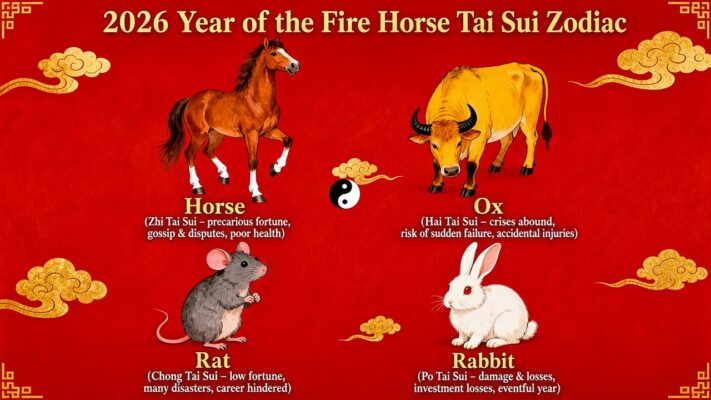
2026 Tai Sui Guide: What the Fire Horse Year Means for Your Zodiac
Introduction When people first hear that a new year brings a new “Tai Sui,” they [...]
Mar
2026 Dog Horoscope: Completing the San He Fire Trine with Loyalty and Follow-Through
Introduction While four zodiac signs face different forms of Tai Sui conflict in 2026, and [...]
Sep