

Introduction
When people first explore Taoism, they often assume it refers to a single, unified tradition. In practice, the word covers two related but distinct layers — a philosophical school of thought, and a fully organized religion — that developed at different times and serve different purposes.
Although Daoism and Taoism are deeply connected historically, they are fundamentally different in nature. One is primarily a philosophical tradition, while the other developed into a complete religious system. Understanding the distinction between the two is essential for anyone exploring Chinese spirituality, philosophy, and traditional culture — a foundation we build on further in our overview of The Origin and Development of Taoism.
This guide explores the difference between Taoist philosophy and Taoist religion by examining three key areas:
- how each tradition emerged historically and what defines it
- the core practical and institutional differences between the two
- why even scholars continue to debate how clean this distinction really is
Taoism as Philosophy vs. Religion
Taoist Philosophy (Daoism)
Taoist philosophy began during the Spring and Autumn and Warring States periods. It focuses on understanding the universe, human nature, and the principles of living harmoniously with the natural world. Thinkers such as Laozi, Zhuangzi, and Liezi shaped its intellectual foundation.
Core philosophical texts include the Tao Te Ching, Zhuangzi, and Liezi. The philosophical tradition emphasizes harmony with nature, simplicity and humility, spiritual freedom, inner tranquility, and living according to the Dao.
For example, the principle that Tao follows nature belongs to Taoist philosophy rather than religious ritual. Likewise, Governing by Non-Interference is a typical ideological viewpoint derived from Taoist philosophy rather than religious practice.
Taoism as Religion
Religious Taoism emerged during the Eastern Han Dynasty and transformed philosophical concepts into a structured spiritual system. It integrated cosmology, immortality practices, ritual traditions, alchemy, meditation, astrology, and folk beliefs.
Unlike philosophical Daoism, religious Taoism includes temples and sacred sites, priests and monastic orders, ritual ceremonies, systems of deities and immortals, talismans and liturgical practices, and religious cultivation methods.
Major Taoist traditions later developed, including Zhengyi Dao and Quanzhen Dao. Religious Taoism also produced a vast canon of scriptures and ritual manuals known as the Daoist Canon, which includes texts collected in The Thirteen Daoist Classics.
Core Differences Between Taoist Philosophy and Taoist Religion
| Aspect | Taoist Philosophy | Taoist Religion |
|---|---|---|
| Nature | Philosophical school | Organized religion |
| Goal | Harmony with Dao | Spiritual cultivation and immortality |
| Key Figures | Laozi, Zhuangzi | Zhang Daoling, Taoist priests |
| Main Focus | Wisdom and natural law | Rituals, cultivation, salvation |
| Institutions | None | Temples, clergy, sects |
| Practices | Meditation, reflection | Rituals, alchemy, chanting |
| Ultimate Pursuit | Spiritual freedom | Becoming immortal or transcendent |
Different Understandings of “Dao”
In philosophical Daoism, the Dao is the natural principle underlying all existence. It cannot be fully described or controlled. The ideal person follows the spontaneous rhythm of life and avoids excessive attachment.
In religious Taoism, the Dao becomes both a cosmic principle and a sacred path of cultivation. Practitioners seek to refine body and spirit through meditation, internal alchemy, moral discipline, and ritual practice.
Taoist Philosophy and Political Thought
One of the greatest contributions of Taoist philosophy is its political theory. The concept of governing society through minimal interference became highly influential in Chinese history.
The idea of Governing by Non-Interference teaches rulers to avoid excessive laws, taxation, and forced control. Instead, society should develop naturally according to human needs and universal order.
This principle strongly influenced the governance strategies of the early Han Dynasty and remains one of the most discussed ideas in classical Chinese philosophy.
Religious Taoism and Spiritual Cultivation
Religious Taoism expanded beyond philosophy into concrete spiritual practices designed to transform human life. These include internal alchemy, breath cultivation, talismans and incantations, ritual offerings, meditation and visualization, and longevity practices.
Taoist temples also serve important cultural and social functions, preserving traditional medicine, martial arts, astronomy, ritual music, and folk customs.
Why People Often Confuse the Two
The confusion largely comes from language translation. In English, both philosophical Daoism and religious Taoism are often called “Taoism,” even though they refer to different layers of the tradition.
In reality, Daoist philosophy is the intellectual foundation, and religious Taoism is the institutional and spiritual development built upon it. They overlap deeply, but they are not identical.
A Scholarly Caveat: Is the Distinction Really So Clear?
While the philosophy-versus-religion framework is useful for newcomers, it’s worth noting that scholars themselves debate how accurate this division really is.
According to the Stanford Encyclopedia of Philosophy’s entry on Religious Daoism, the clean split between a “Taoist school” (Daojia) and a “Taoist religion” (Daojiao) has become something of a scholarly convention — but historical Daoist texts themselves, including the successive editions of the Daoist Canon, never actually made this distinction. In the terms as they were originally used, Daojia and Daojiao were often practically synonymous rather than referring to two separate traditions.
This doesn’t mean the practical differences outlined in this guide aren’t real or useful — the institutional features of religious Taoism (temples, priesthood, ritual) are genuinely distinct from the purely textual, philosophical tradition of the Tao Te Ching and Zhuangzi. But it’s a useful reminder that Taoism, like many long-lived traditions, resists being cleanly sorted into modern Western categories like “philosophy” and “religion” — categories that, as the Stanford Encyclopedia notes, don’t even have direct equivalents in premodern Chinese language.
Cultural Influence
Both philosophical Daoism and religious Taoism profoundly shaped Chinese civilization, influencing traditional Chinese medicine, Feng Shui, martial arts, poetry and painting, meditation traditions, political philosophy, and folk religion and festivals.
Together, they form one of the most influential spiritual and philosophical systems in East Asian history.
Understanding Taoism at Taoist World
Whether approached as philosophy, religion, or both at once, Taoism offers a depth of wisdom that continues to shape how millions of people understand nature, governance, and personal cultivation.
At Taoist World, we draw on both dimensions of this tradition — the philosophical wisdom found in texts like the Tao Te Ching, and the ritual craftsmanship developed within religious Taoism over centuries.
Explore more Taoist philosophy and culture: → Taoist Philosophy & Wisdom
Conclusion
Understanding the difference between Taoist philosophy and Taoist religion offers a clearer view of one of the world’s richest spiritual traditions.
Taoist philosophy provides the intellectual foundation — ideas about nature, simplicity, and effortless action, drawn from figures like Laozi and Zhuangzi. Religious Taoism builds on that foundation with temples, priesthood, ritual, and a path toward spiritual transcendence.
As scholars note, the line between the two is not always as clean as it first appears — but understanding both dimensions offers a far richer appreciation of Taoism than treating it as a single, uniform tradition.
FAQ
It’s both. Taoist philosophy refers to the ideas in texts like the Tao Te Ching, while Taoist religion refers to the organized institution with temples and priests that developed later, building on that philosophy.
Not entirely. Some scholars, including those cited by the Stanford Encyclopedia of Philosophy, argue this division is a modern scholarly convention rather than one found in historical Daoist texts themselves.
Taoist philosophy generally pursues spiritual freedom and harmony with the Dao, while religious Taoism pursues spiritual cultivation aimed at transcendence or immortality.
Yes — many people study and apply Taoist philosophical concepts, such as Wu Wei and harmony with nature, without participating in religious Taoist ritual or institutional practice.
They are the two major schools of religious Taoism that developed historically, each with distinct approaches to ritual, cultivation, and monastic life.
Related Posts
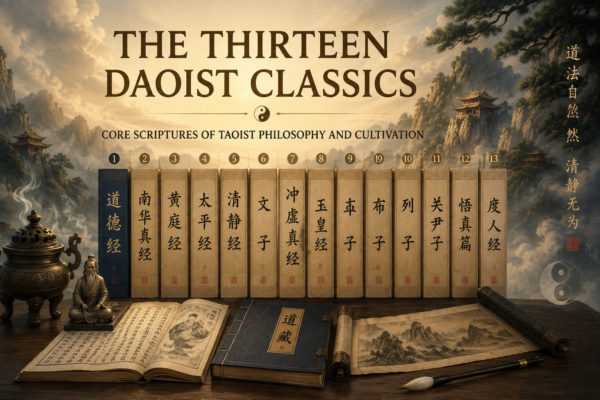
The Thirteen Daoist Classics: Core Scriptures of Taoist Philosophy and Cultivation
Introduction When people first encounter Taoist scripture, they often assume the Tao Te Ching stands [...]
Dec
Governing by Non-Interference in Taoist Philosophy
Governing by Non-Interference in Taoist Philosophy The Taoist principle of governing by non-interference, often associated [...]
Dec
The Origin and Development of Taoism
Introduction When people first ask how Taoism began, they often expect a simple answer — [...]
Dec