
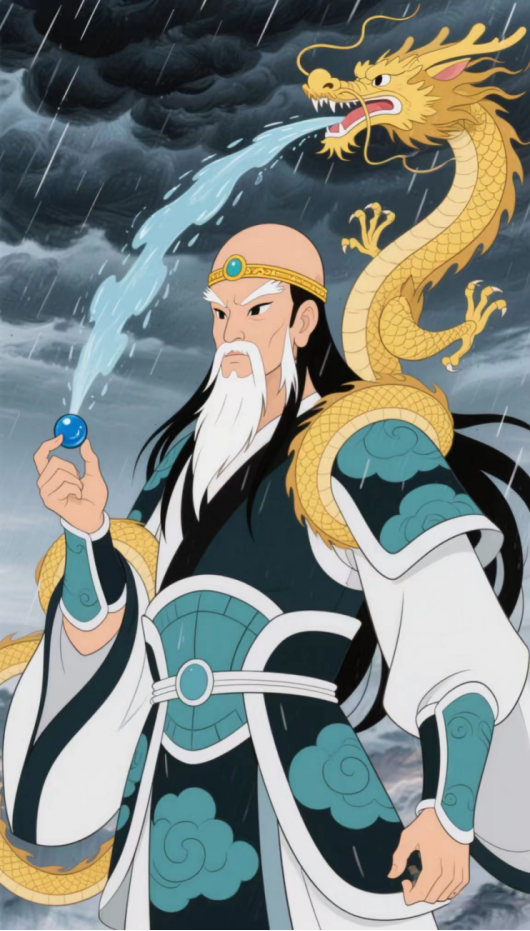
Rain Master, also known as Rain God, Ping Yi, Xuan Ming, or Bi Xing, is a deity in ancient Chinese mythology responsible for rainfall. He functions within the Taoist celestial system and plays an important role in regulating weather patterns and agricultural balance.
In Taoist tradition, his formal title is Rain Master Pu Run Zhen Jun. People view him as the divine embodiment of rainfall, reflecting how ancient agricultural societies understood the relationship between heaven, nature, and human survival.
![Taoist Rain Master deity statue or traditional painting]](https://taoist-world.com/wp-content/uploads/2025/12/image-114.png)
Duties and Functions
Controller of Rainfall
Rain Master governs the rise and fall of rainfall across the world. He regulates when rain appears, how long it lasts, and how it supports agricultural cycles.
Farmers historically depended on his power to secure stable harvests and avoid drought or flooding. His role directly influences agricultural survival and seasonal balance.
In the broader Taoist divine order, Rain Master operates under the authority structure described in The Jade Emperor in Taoism: Supreme Ruler of Heaven and Cosmic Order, where all weather-related deities follow a hierarchical celestial system.
Meteorological Divine Official
Rain Master serves as a celestial officer responsible for executing weather commands issued by the Heavenly Court. He works together with Feng Bo, Lei Gong, and Dian Mu to maintain atmospheric balance.
His activity often appears alongside wind and thunder phenomena. This natural connection explains why his function closely relates to Wind Lord, who governs atmospheric movement and wind circulation in Taoist cosmology.
Rain Master also interacts with thunder activity, since rainfall often follows thunder events in natural cycles, reflecting the coordination between different weather deities.
Cultural Significance and Ritual Traditions
Guardian of Agricultural Civilization
Rain Master worship developed from early agricultural societies that depended heavily on seasonal rain. People viewed him as a guarantee of food production and survival stability.
Historical records such as the Rites of Zhou document his inclusion in state sacrificial systems. Ancient governments officially recognized his importance in maintaining harmony between heaven and human society.
Later dynasties strengthened his ritual status. The Qin and Han dynasties incorporated him into formal sacrifices, while the Tang Dynasty elevated his rank within the imperial ritual system. His worship continued across later dynasties as part of structured state religion.
Taoist Ritual Practice and Folk Worship
Taoist temples often enshrine Rain Master within weather-related ritual spaces. During droughts, priests perform ceremonies to request rainfall and restore agricultural balance.
These ceremonies follow structured ritual procedures described in Introduction to the Procedure of the Dharma Assembly, where invocation methods and ritual sequences are systematically organized.
During such rituals, communities sometimes carry his image in processions and combine worship with other weather deities to strengthen ritual effectiveness.
Related Posts
The Five Water Deities in Taoism: Guardians of Seas, Rivers, and Sacred Waters
The Five Water Deities are among the most important water gods in Taoist belief. They [...]
Dec
Wind Lord Fengbo (风伯): Taoist God of Wind and Weather
Fengbo, also known as Fengshi, Feilian, or Ji Bo, was an ancient wind god in [...]
Dec
The Great Deities of the Five Lakes in Taoism
The Great Deities of the Five Lakes are important water gods in Taoism and Chinese [...]
Dec