
Introduction
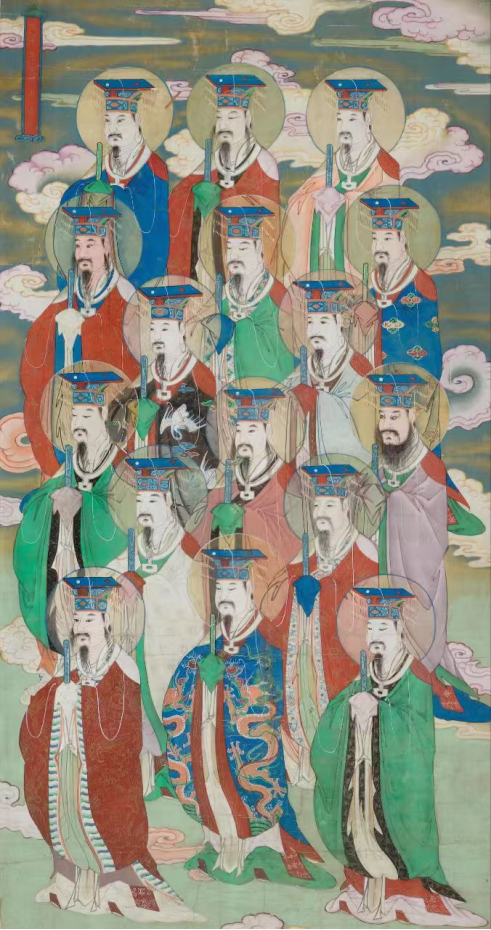
The Thirty-Two Heavenly Emperors are the supreme rulers of the Thirty-Two Celestial Realms described in the Taoist classic The Supreme Numinous Treasure Scripture of Limitless Salvation for All Beings. Within the Lingbao cosmological system, these deities are not ordinary immortals but manifestations of the Dao itself across different dimensions of the cosmos. Together, they uphold celestial order, oversee karmic records, teach sacred scriptures, and guide beings toward transcendence beyond the cycle of reincarnation.
Unlike popular folk deities associated with wealth or protection, the Thirty-Two Heavenly Emperors represent the highest philosophical structure of Taoist cosmology. Their celestial hierarchy reveals how Taoism envisions the universe as a layered and divinely governed system stretching from the mortal world to the realms nearest the Dao.
The Structure of the Thirty-Two Celestial Realms
According to the Lingbao scriptures, the cosmos is divided into Thirty-Two Celestial Realms. These heavens are arranged vertically, with each realm representing a higher level of spiritual purity and proximity to the Dao.
Six Desire Realms
The Six Desire Realms form the lowest celestial tier. Beings in these heavens still possess physical forms and emotional desires, although they enjoy long lifespans and extraordinary blessings. These realms remain connected to sensory attachment and worldly experience.
Eighteen Form Realms
The Eighteen Form Realms transcend ordinary desire. Beings here still retain form, yet they dwell in states of deep meditation and spiritual tranquility. These heavens symbolize the refinement of consciousness and the purification of attachment.
Four Formless Realms
The Four Formless Realms are higher dimensions where beings exist without physical form. Consciousness alone remains. Taoist texts describe these heavens as domains of pure spirit and profound emptiness.
Four Brahma Realms
Above the Three Realms stand the Four Brahma Realms, the highest celestial domains beneath the Three Pure Ones. These heavens are eternal pure lands inhabited by perfected immortals and enlightened sages who have escaped samsara completely.
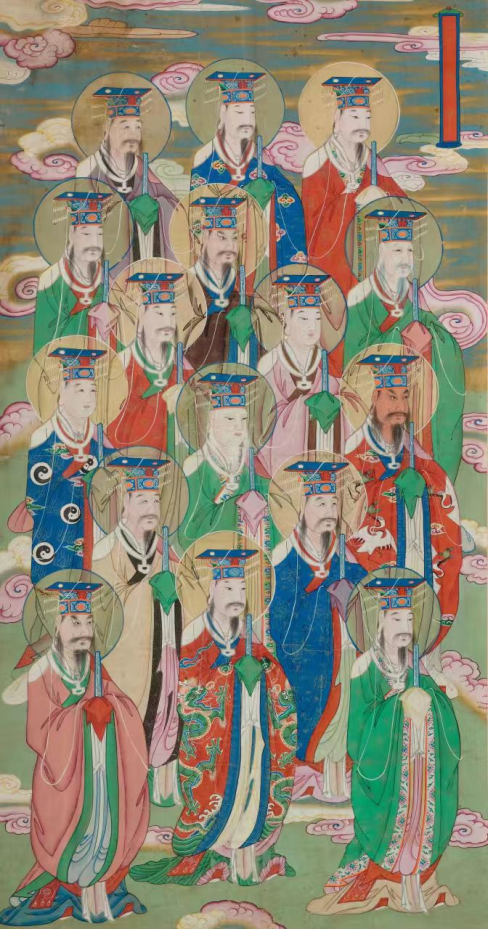
Each of these realms is governed by a corresponding Heavenly Emperor. Their names are usually derived directly from the heavens they rule, emphasizing their identity as living embodiments of cosmic law.
Divine Functions of the Thirty-Two Heavenly Emperors
Manifestations of Dao Qi
The Thirty-Two Heavenly Emperors are not merely anthropomorphic gods. Taoist doctrine describes them as condensations of Dao Qi, the primordial life force of the universe. Their existence maintains the balance and operation of their celestial domains.
Teachers of Sacred Scriptures
The Heavenly Emperors also function as supreme spiritual teachers. Within the Scripture of Salvation, they preach sacred Taoist teachings to enlightened beings and celestial inhabitants. Through these teachings, souls may transcend suffering and escape the cycle of rebirth.
One aspect of this teaching tradition resembles the salvational role described in the article about the Supreme Lord Taiyi Who Saves the Suffering, although the Thirty-Two Heavenly Emperors operate on a far broader cosmological scale.
Guardians of Karmic Order
Every Heavenly Emperor records the deeds, merits, and transgressions of beings within their realm. This reflects the Taoist principle that the cosmos operates according to moral balance and universal law.
Supreme Ritual Deities
In high Taoist rituals such as the Yellow Register Retreat, priests invoke the Thirty-Two Heavenly Emperors through scripture recitation, visualization, and memorial offerings. These ceremonies seek blessings, disaster relief, and spiritual purification.
Position Within the Taoist Pantheon
Above the Jade Emperor
In Lingbao theology, the Thirty-Two Heavenly Emperors possess authority that extends beyond the heavens associated with the Jade Emperor. While the Jade Emperor governs the celestial bureaucracy within the Three Realms, the Thirty-Two Heavenly Emperors preside over the cosmic structure itself.
This distinction reflects a more philosophical layer of Taoist theology, one focused on the organization of existence rather than administrative governance alone.
Relationship with the Three Pure Ones
The Thirty-Two Heavenly Emperors are often viewed as direct assistants or manifestations of the Great Dao beneath the Three Pure Ones. Their authority derives from cosmic principles rather than political rulership.
Distinction from Other Celestial Systems
Unlike the Five Elders of the Five Directions, who regulate elemental balance and directional energy, the Thirty-Two Heavenly Emperors govern entire dimensional realms and the spiritual ascent between them.
Religious and Philosophical Significance
The Ultimate Taoist Cosmology
The belief in the Thirty-Two Heavenly Emperors represents one of the most sophisticated cosmological systems in Taoism. The universe is portrayed as an ordered hierarchy where every realm reflects a different level of spiritual realization.
The Goal of Spiritual Cultivation
For Taoist practitioners, transcendence involves ascending through the heavens governed by these emperors. Cultivation ultimately aims to move beyond the Thirty-Two Celestial Realms and return to the source of the Dao itself.
Sacred Authority of the Scripture of Salvation
The Scripture of Salvation holds immense authority partly because it is believed to be preached throughout all Thirty-Two Celestial Realms. Reciting the scripture establishes a spiritual connection with these cosmic rulers and invites their protection.
Cultural Influence and Modern Interpretation
Although the Thirty-Two Heavenly Emperors are less widely known in folk religion, they remain highly important within Taoist theology and ritual studies. Modern scholars often view this celestial hierarchy as evidence of Taoism’s advanced metaphysical worldview and its attempt to map the structure of the cosmos systematically.
Some modern discussions of Taoist cosmology also compare the Thirty-Two Celestial Realms with Buddhist multilayered heavens, showing how medieval Chinese religion developed through interaction between different traditions.
The Cosmic Meaning of the Thirty-Two Heavenly Emperors
The Thirty-Two Heavenly Emperors stand at the summit of Taoist cosmological thought. They are not simply deities who answer worldly prayers. Instead, they embody the sacred structure of the universe itself, governing the laws of space, time, morality, and spiritual transcendence.
Their theology reflects Taoism’s deepest vision of the cosmos — a universe governed by harmony, hierarchy, and the eternal movement of the Dao. Through understanding these celestial rulers, one gains insight into the profound spiritual architecture that shapes Taoist philosophy and religious practice.
Related Posts
The Thirty-Six Heavenly Generals in Taoism: Guardians of Thunder, Exorcism, and Celestial Justice
The Thirty-Six Heavenly Generals are one of the most important groups of martial guardian deities [...]
Dec
Nine Heavens Creator of Spirits in Taoism
The Nine Heavens Creator of Spirits is a divine system composed of nine celestial emperors [...]
Dec
The Jade Emperor in Taoism: Supreme Ruler of Heaven and Cosmic Order
The Jade Emperor, whose full honorific title is “The Supreme Sovereign of the Heavenly Golden [...]
Dec