Why Taoist Ritual Implements Are Made from Precious Metals ?
Introduction
For many people encountering Taoist ritual implements for the first time, one question naturally comes to mind: Why are so many traditional Taoist ritual objects made from silver, gold, or bronze instead of ordinary materials?
At first glance, it may seem like a matter of wealth or craftsmanship. Precious metals are beautiful, durable, and valuable, so it is easy to assume they were chosen simply because they were expensive. However, within Taoist tradition, the choice of material has never been based solely on material value.
A Taoist ritual implement is not viewed as an ordinary object. It serves as a bridge between ritual practice, philosophical understanding, and personal cultivation. For this reason, every aspect of its creation—including its material—carries symbolic meaning. Gold, silver, and bronze were valued not merely because they were rare, but because they reflected qualities that Taoist practitioners sought to cultivate within themselves: purity, stability, harmony, and transformation.
This perspective also explains why traditional Taoist ritual implements are often treated with great respect and, in many cases, receive personal consecration before becoming part of one’s spiritual practice. As discussed in our guide to personal consecration of Taoist ritual implements, the material, symbolism, and ritual intention all work together rather than existing as separate elements.
Understanding why precious metals became the preferred materials for Taoist ritual implements therefore offers more than historical knowledge. It reveals how Taoist philosophy sees the relationship between the physical world and inner cultivation. In Taoism, matter is never separated from meaning, and even the choice of metal can become part of the path toward understanding the Dao.
Precious Metals Reflect the Taoist Pursuit of Permanence
One of the central ideals in Taoist cultivation is often described as “lasting life and enduring vision” (changsheng jiushi 长生久视). While this concept has many philosophical interpretations, it consistently reflects a pursuit of harmony with the natural order rather than submission to constant decay.
From this perspective, the remarkable physical properties of precious metals held profound symbolic value.
Gold, in particular, attracted the attention of Taoist thinkers because of its extraordinary stability. Unlike iron, which rusts, or many other metals that gradually corrode over time, gold remains almost unchanged even after centuries beneath the earth. It neither oxidizes easily nor loses its brilliance. To ancient observers, this quality appeared almost timeless.
Rather than viewing this durability as merely a scientific phenomenon, Taoist practitioners understood it as a visible reflection of an invisible principle. The Dao is described in the Dao De Jing as something that remains constant while all things continually change. Gold, with its resistance to decay, naturally became a material that symbolized this enduring quality.
This relationship between permanence and cultivation also influenced Taoist alchemical traditions. In Ge Hong’sBaopuzi (Master Who Embraces Simplicity), one of the most influential works on external alchemy, gold is praised for its resistance to fire and corruption:
“Gold does not perish after repeated refinement by fire, nor does it decay after being buried for ages.”
For Taoist practitioners, this observation carried symbolic significance. If a material could remain unchanged through intense heat and the passage of time, it became a natural metaphor for the spiritual refinement that cultivation sought to achieve.
Because of this, precious metals gradually became associated with ritual implements intended to accompany long-term spiritual practice. Their durability represented constancy rather than luxury.
This symbolism can also be found in important Taoist ritual documents. Certain ceremonial registers and sacred talismans were traditionally written using gold powder or gold-based pigments, reflecting the belief that what was recorded should remain pure, enduring, and worthy of communication with the heavenly realm. The use of gold therefore emphasized permanence—not only of the material itself, but also of the commitment and intention it represented.
From a modern perspective, we understand the remarkable stability of gold through chemistry. From a Taoist perspective, however, its enduring nature served as a reminder that genuine cultivation also seeks what cannot be easily corrupted by external circumstances.
The value of precious metals, therefore, begins not with wealth, but with the aspiration to embody qualities that remain unchanged amid the transformations of life.
Gold, Silver, and Bronze Represent Different Cosmic Qualities
In Taoist thought, precious metals are not valued only because they are rare or durable. Each metal is understood to embody a different aspect of the natural order. Their colors, physical characteristics, and long-standing use in ritual gradually became associated with specific qualities of Qi, Yin and Yang, and the harmony of Heaven and Earth.
Rather than viewing all precious metals as interchangeable, Taoist tradition assigns each one its own symbolic role. Gold represents the brilliance of pure Yang, silver reflects the quiet nature of Yin, and bronze serves as a practical medium through which the balanced forces of the cosmos can be expressed during ritual practice.
This symbolic understanding developed over centuries and became deeply integrated into Taoist ritual culture, influencing not only the construction of ritual implements but also the occasions on which different materials were preferred.
Gold — The Essence of Pure Yang
Among all precious metals, gold occupies the highest symbolic position within many Taoist traditions. Its brilliant color remains unchanged over time, making it a natural representation of permanence, vitality, and radiant Yang energy.
Ancient Taoist writings often refer to gold as the “Essence of the Sun” or the “Pure Essence of Geng and Xin” (庚辛之精). Rather than describing astronomical objects literally, these expressions illustrate the belief that gold embodies the strongest and purest manifestation of Yang within the material world.
Because of this association, gold has traditionally appeared on ritual implements connected with powerful ceremonial practices, particularly those involving purification, protection, and the invocation of heavenly authority. Implements used in Lei Fa (Thunder Rituals), for example, were often decorated with gold or finished with gold elements to symbolize the commanding power of pure Yang over disorder and impurity.
This symbolic relationship should not be understood as a claim that gold possesses supernatural power by itself. Instead, Taoist ritual regards the material as participating in a larger symbolic language. The stability and brilliance of gold visually reinforce the intention of the ritual and remind practitioners of the qualities they seek to cultivate within themselves.
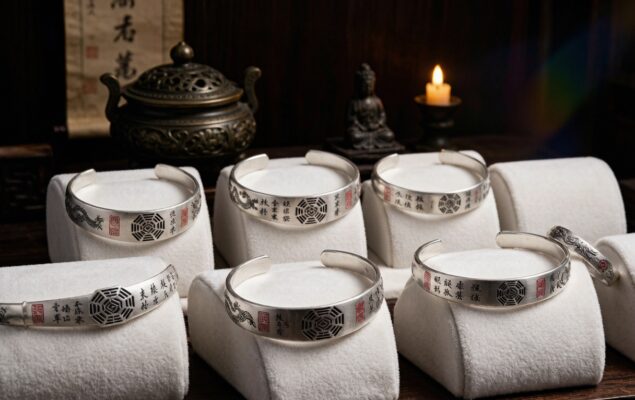
The same symbolism can still be seen today in traditional pieces such as the Heavenly Official’s Blessing Bracelet, whose design draws inspiration from classical Taoist protective traditions while preserving the cultural symbolism associated with gold.
If gold represents the radiant strength of pure Yang, silver has traditionally been associated with the quiet and receptive qualities of Yin. Its soft white appearance naturally reminded ancient Taoist practitioners of moonlight, still water, and the calmness that follows when movement returns to rest.
Within Taoist cosmology, Yin and Yang are not opposing forces competing with one another. Instead, they are complementary aspects of the same natural order. Gold and silver therefore represent different expressions of harmony rather than different levels of importance. Just as day gives way to night and activity returns to stillness, both Yang and Yin are necessary for maintaining balance within nature and within the human body.
Because of this symbolism, silver gradually became associated with rituals emphasizing purification, tranquility, healing, and inner reflection. Traditional Taoist ceremonies involving blessed water, meditation, or spiritual cleansing often preferred silver vessels, believing that their quiet symbolism reflected the peaceful state practitioners sought to cultivate.
This understanding also aligns with a recurring theme found throughout Taoist philosophy. The Dao De Jing repeatedly praises qualities such as softness, humility, and stillness over force and aggression. Rather than conquering through strength alone, the Dao is revealed through harmony and natural balance.
“The highest goodness is like water. Water benefits all things and does not compete.”
This passage does not speak about silver directly, yet it beautifully illustrates the same qualities that silver came to symbolize within Taoist culture—gentleness, clarity, and quiet strength.
For this reason, silver has long been favored for ritual implements connected with contemplation and personal cultivation. Modern pieces inspired by these traditions, such as the Tianpeng Ruler Twenty-Four Gods Pendant, continue to reflect this symbolic relationship between purity, inner stillness, and harmony with nature.
Although bronze does not possess the same rarity as gold or silver, it occupies an exceptionally important position in Taoist ritual tradition. Ancient Taoist texts often refer to bronze as “Jin Tong” (金铜) or one of the “Essences of the Five Metals” (五金之英), emphasizing that its value lies not in its price but in its ability to serve ritual purposes.
Unlike gold, which symbolizes the brilliance of pure Yang, or silver, which reflects the quiet qualities of Yin, bronze is commonly understood as a material that harmonizes opposing forces. Traditional bronze was created by combining different metals through carefully controlled smelting processes, and this transformation naturally became associated with the Taoist principle that harmony arises from the balanced interaction of Yin and Yang.
For this reason, bronze became the most widely used material for many practical ritual implements. Taoist ritual bells, ceremonial seals, ritual swords, and various altar objects have historically been cast in bronze because the material represented stability, balance, and communication between the human and spiritual realms.
The sound produced by bronze also carried symbolic meaning. During Taoist ceremonies, the clear resonance of ritual bells was believed to announce the beginning of sacred rites, gather practitioners’ attention, and establish a solemn atmosphere for communicating with Heaven and Earth. Rather than being viewed as magical in itself, the sound served as a ritual signal that marked the transition from ordinary activity to sacred practice.
This symbolism reflects an important characteristic of Taoist philosophy: transformation is rarely achieved through extremes. Instead, it emerges from the harmonious integration of different qualities. Bronze, formed through the combination of multiple metals, naturally became an appropriate material for ritual implements intended to embody this principle.
Many traditional Taoist ritual objects—including ceremonial rulers, ritual swords, and official seals—continue to be crafted from bronze today. Their enduring presence reflects centuries of ritual practice and preserves one of the most recognizable material traditions within Taoist culture.
Why Precious Metals Were Regarded as Ideal Vessels for Spiritual Transmission
Unlike modern engineering, traditional Taoist ritual theory does not separate the physical world from the spiritual one. Materials, symbols, sound, intention, and ritual action are understood as parts of a single, interconnected system. Within this worldview, the material used to create a ritual implement is not merely structural—it participates in the ritual itself.
For this reason, gold, silver, and bronze gradually came to be regarded as ideal materials for ritual implements. Their exceptional stability, density, and durability made them natural symbols of reliability and continuity. Over time, these observable physical qualities became associated with the ability to preserve ritual intention and support communication between the practitioner and the sacred realm.
It is important to understand this within its historical and religious context. Taoist teachings describe Qi as the vital force that animates the universe, and ritual practice seeks harmony between the practitioner’s own Qi and the larger order of Heaven and Earth. The preference for precious metals belongs to this traditional ritual worldview rather than to modern scientific explanations.
Many Taoist ritual traditions describe cultivation as the process of harmonizing one’s own Qi with the Qi of the universe. During rituals, the practitioner’s intention, breath, visualization, and movements are understood to work together as a unified practice.
Within this symbolic framework, precious metals came to represent ideal mediums through which ritual intention could be expressed. Gold and silver were admired for their remarkable stability, while bronze offered strength and balance. Their physical qualities naturally inspired the belief that they could faithfully accompany and preserve sacred ritual actions.
From a contemporary perspective, we recognize these metals as excellent conductors of heat and electricity. Ancient Taoist practitioners, however, interpreted their consistency and reliability through the language available to them. Rather than discussing electrical conductivity, they understood these qualities as signs that the material was especially suitable for participating in sacred ceremonies.
This symbolic understanding became particularly meaningful in traditions such as Lei Fa (Thunder Rituals), where ritual swords, command tablets, and ceremonial rulers represented the practitioner’s authority to carry out sacred rites. The material itself reinforced the ritual’s symbolic language, expressing clarity, precision, and unwavering intention rather than functioning as a source of supernatural power.
Taoist ritual implements have never been viewed as ordinary tools. Once incorporated into ceremonial practice, they become physical carriers of ritual intention, sacred inscriptions, and spiritual commitment.
This idea can be seen in the long tradition of Taoist seals, talismans, and ceremonial tablets. Important ritual seals were commonly cast in bronze because the material was durable enough to preserve their form through generations of use. Every impression made by the seal represented continuity with an established ritual lineage rather than simply marking ownership.
Similarly, significant ritual documents were sometimes inscribed on durable materials such as metal plates or preserved using gold-based pigments. The purpose was not merely to create beautiful objects, but to symbolize that the vows, prayers, or ritual agreements they recorded should remain enduring and unchanged.
Within this cultural context, precious metals came to represent permanence, trustworthiness, and the faithful preservation of sacred intention.
Ritual Implements as Symbols of Focus and Clarity
Many Taoist ritual implements are carefully designed with forms that encourage concentration and intentional practice. Mirrors, ritual swords, ceremonial rulers, and bells each serve different ceremonial functions, yet they share a common symbolic purpose: directing the practitioner’s attention toward clarity and order.
Traditional Taoist ritual manuals often emphasize that the effectiveness of a ceremony depends primarily on the practitioner’s sincerity, discipline, and cultivated mind rather than on the object alone. The ritual implement supports this process by providing a visible focus through which intention can be expressed.
For example, a ritual mirror reflects light with precision, becoming a symbol of clear perception. A ceremonial sword represents discernment and the ability to cut through confusion. A ritual bell marks transitions within the ceremony, helping practitioners gather their attention before continuing.
When these implements are crafted from precious metals or bronze, the symbolism becomes even richer. The enduring nature of the material reinforces the qualities of stability, focus, and consistency that Taoist cultivation seeks to develop.
Rather than believing that precious metals possess independent spiritual power, Taoist tradition understands them as materials whose observable qualities naturally express deeper philosophical ideas. In this way, the ritual implement becomes not only an object used during ceremony but also a constant reminder of the practitioner’s own path of refinement.
Precious Metals Express Reverence and Sacred Commitment
In Taoist ritual tradition, the value of precious metals extends beyond their physical qualities or symbolic associations. They also represent one of the highest forms of sincerity that a practitioner can offer during sacred ceremonies.
Throughout Chinese history, gold has consistently been regarded as one of humanity’s most valuable materials. Offering something precious was never intended to demonstrate wealth. Instead, it expressed the willingness to dedicate one’s finest possessions in the pursuit of harmony with Heaven, Earth, and the Dao.
For this reason, ritual implements made from precious metals gradually came to embody ideas of reverence, commitment, and responsibility. They remind practitioners that every ritual begins not with the object itself, but with the sincerity of the heart that holds it.
Offering What Is Most Precious
Traditional Taoist rituals inherit a long cultural tradition of respecting Heaven, honoring the ancestors, and maintaining harmony with the natural order. Within this context, the quality of an offering has never been measured solely by its monetary value. What matters most is the sincerity represented by the offering itself.
Gold naturally became one of the highest symbols of this sincerity.
Because it was rare, durable, and difficult to obtain, presenting gold during important ceremonies symbolized a willingness to place spiritual commitment above personal attachment to material possessions. The act was less about displaying wealth and more about demonstrating wholehearted devotion.
This understanding reflects a broader principle found throughout Taoist philosophy: true cultivation often begins with letting go rather than accumulating more. The offering of something valuable therefore becomes a visible expression of inner transformation.
For this reason, precious metals were often reserved for ritual implements used in major ceremonies rather than ordinary daily objects. Their presence reminded practitioners that approaching the sacred required respect, humility, and genuine intention.
Ritual Implements as Symbols of Sacred Agreements
Many important Taoist ceremonies involve commitments rather than requests. Rituals such as ordination, transmission of registers, and formal initiation symbolize the practitioner’s decision to enter a lifelong path of cultivation and responsibility.
Historically, objects made from durable materials—including gold, jade, and bronze—were frequently used as ceremonial tokens during these occasions. Their physical permanence reflected the hope that the promises made during the ritual would remain equally enduring.
Early Taoist traditions, for example, sometimes used golden rings, ritual tablets, or symbolic credentials to represent formal recognition within a religious lineage. These objects were not understood as magical items. Instead, they served as visible reminders that spiritual commitments should be honored with the same consistency and permanence represented by the materials from which they were made.
In this sense, a ritual implement becomes more than a ceremonial tool.
It becomes a witness.
A reminder of the promises made between the practitioner, the tradition, and the path they have chosen to follow.
Authority Comes from Cultivation, Not the Material
Although precious metals were highly respected, Taoist tradition has consistently emphasized that the effectiveness of a ritual never depends solely on the material of the implement.
Classical Taoist teachings repeatedly place greater importance on the practitioner’s cultivation, moral discipline, and sincerity than on external objects. A beautifully crafted ritual implement cannot replace years of self-cultivation, just as an expensive musical instrument cannot replace the skill of the musician who plays it.
The material supports the ritual.
The practitioner gives it meaning.
This distinction is essential for understanding Taoist ritual culture. Gold, silver, and bronze help express reverence because they symbolize permanence, purity, and commitment, but they are never regarded as substitutes for personal cultivation.
A ritual implement therefore reflects the person who uses it.
Its highest purpose is not to display status, but to remind practitioners that the deepest transformation always begins within themselves.
The Deepest Meaning of Precious Metals Lies in Internal Alchemy
Among all the explanations for why Taoist ritual implements are made from precious metals, the symbolism of internal alchemy (Neidan) is perhaps the most profound.
The previous sections have explored physical durability, cosmological symbolism, ritual function, and ceremonial reverence. Yet within Taoist cultivation, these are only the outer layers. The deepest significance does not concern the metal itself, but the transformation that the metal represents.
In other words, a Taoist ritual implement is not merely an object held in the hand.
It is a mirror of the practitioner.
Every ritual implement points back to the same question:
How is one’s own spirit being refined?
For this reason, precious metals became powerful metaphors throughout Taoist internal alchemy. Gold was never valued simply because it was beautiful or expensive. It represented a state of complete refinement—a condition in which all impurities had been removed, leaving only what was genuine, stable, and unchanging.
Gold as the Symbol of the Golden Elixir
Throughout Taoist alchemical literature, the character “Jin” (金) appears repeatedly.
Sometimes it refers to physical gold.
More often, however, it points toward something far more important—the Golden Elixir (Jindan), the ultimate symbol of spiritual realization.
In Taoist internal alchemy, the Golden Elixir is not understood as a physical substance. Rather, it represents the gradual refinement of one’s body, breath, mind, and spirit until they return to harmony with the Dao.
This is why many Taoist classics describe cultivation using the language of metallurgy.
Just as raw ore must pass through repeated washing, melting, and purification before becoming pure gold, human beings are believed to refine themselves through years of discipline, meditation, moral cultivation, and self-reflection.
The process is slow.
It cannot be rushed.
Nor can it be purchased.
A precious metal ritual implement therefore serves as a visible reminder of this lifelong process.
Its value lies not in what it is made from, but in what it encourages the practitioner to become.
From Raw Ore to Pure Gold
One of the most elegant metaphors in Taoist internal alchemy compares spiritual cultivation to the refinement of gold.
Gold found in nature is rarely encountered in a perfect state. It must first be separated from rock and earth, then purified through repeated refinement before its true brilliance appears. Ancient Taoist masters saw in this process a vivid image of human cultivation.
The human spirit, they believed, is much the same.
Everyone possesses an original nature that is pure and complete, yet throughout life it becomes covered by desires, fears, attachments, anger, and countless distractions. These acquired habits do not destroy one’s true nature, but they conceal it—just as soil and stone conceal veins of precious metal beneath the earth.
For this reason, Taoist cultivation has never been understood as creating something entirely new.
Instead, it is a process of uncovering what has always been there.
Internal alchemy describes this journey through stages of gradual refinement. Classical texts often summarize the path as “refining Essence into Qi, refining Qi into Spirit, and refining Spirit until it returns to Emptiness.” Every stage represents the removal of another layer of impurity, allowing one’s original nature to become increasingly clear.
This imagery explains why precious metals became such powerful symbols within Taoist culture.
Gold is not admired because it begins perfect.
It is admired because it becomes pure.
Likewise, Taoist cultivation is not about possessing an extraordinary beginning, but about patiently refining oneself over a lifetime.
Every challenge becomes part of the furnace.
Every hardship becomes another stage of purification.
Every act of self-reflection removes another layer of unnecessary attachment.
The value of gold therefore lies not only in its final brilliance, but also in everything it has endured to reach that state.
For Taoist practitioners, this serves as a constant reminder that genuine transformation cannot be rushed. Like precious metal emerging from repeated refinement, wisdom develops gradually through discipline, humility, and perseverance.
Taoist Ritual Implements Reflect the Practitioner, Not the Metal
Perhaps the most profound lesson hidden within Taoist ritual implements is that they ultimately point back to the practitioner rather than to the object itself.
A ritual sword is more than a beautifully crafted blade. In Taoist symbolism, it represents the Sword of Wisdom, reminding practitioners to cut through greed, anger, ignorance, and confusion within their own minds before attempting to confront disorder in the world.
Likewise, the Ruyi is more than an ornamental object. Traditionally associated with harmony and the fulfillment of rightful intention, it symbolizes the balanced and unwavering mind cultivated through years of practice rather than the granting of worldly wishes.
Even the clear resonance of a ritual bell carries an inward meaning. Its sound does not merely announce the beginning of a ceremony; it also calls the practitioner’s awareness back to the present moment, encouraging the mind to return to stillness before engaging with the sacred.
Seen from this perspective, every Taoist ritual implement functions as a mirror.
The sword reflects one’s wisdom.
The bell reflects one’s awareness.
The seal reflects one’s responsibility.
The precious metal reflects one’s purity.
The ritual itself becomes a continuous reminder that external objects are meaningful only because they point toward an inner reality.
This idea beautifully echoes a recurring theme found throughout Taoist philosophy: the greatest transformation does not occur in the material world alone but within the practitioner who learns to live in harmony with the Dao.
When an experienced Taoist priest holds a ritual implement fashioned from gold, silver, or bronze, the object is not regarded as the source of spiritual power.
Rather, it becomes a visible expression of years of cultivation.
The implement does not create virtue.
It reflects it.
In this sense, precious metals serve as the final metaphor of Taoist cultivation. Just as gold emerges from repeated refinement without losing its essential nature, practitioners are encouraged to refine their own character until their original clarity shines through every thought, action, and intention.
Conclusion
The Material Is Only the Beginning
After exploring Taoist philosophy, ritual traditions, and internal cultivation, one conclusion becomes increasingly clear:
Precious metals are not the source of a ritual implement’s significance—they are simply the most fitting materials to express it.
Gold, silver, and bronze were chosen because their enduring qualities naturally reflected the values that Taoist practitioners hoped to cultivate throughout their lives. Over generations, these materials became part of a symbolic language that connected craftsmanship, ritual, and spiritual practice into a single tradition.
Yet Taoism has never taught that enlightenment can be purchased, nor that a more valuable material guarantees a deeper connection with the Dao.
A beautifully crafted ritual implement may inspire discipline.
It may encourage mindfulness.
It may remind its owner of the path they have chosen.
But it cannot walk that path on their behalf.
Ultimately, every Taoist ritual implement points beyond itself.
It invites the practitioner to look inward rather than outward, asking not whether the metal is pure, but whether the heart has become equally refined through patience, integrity, and continuous cultivation.
That is why precious metals have remained part of Taoist ritual culture for centuries.
They are not simply admired because they endure.
They are respected because they quietly remind us of the kind of person we strive to become.
If you would like to understand how these symbolic materials are combined with traditional Taoist craftsmanship and personal ritual preparation, you may also enjoy reading our guides on traditional Taoist patterns, personal consecration, and the craftsmanship behind handmade Taoist ritual implements.
Taoist ritual implements are traditionally made from gold, silver, and bronze because these materials symbolize qualities that align with Taoist philosophy, including purity, permanence, harmony, and spiritual refinement. Their physical durability also made them ideal materials for ritual objects intended to accompany long-term religious practice.
No. In traditional Taoist thought, precious metals are not believed to possess independent supernatural power. Instead, they serve as symbolic materials that express important spiritual concepts. The effectiveness of a ritual ultimately depends on the practitioner’s cultivation, sincerity, and ritual practice rather than the material alone.
Gold is admired because it remains stable and resists corrosion over time. Taoist practitioners have long viewed these qualities as symbols of permanence, pure Yang energy, and the ultimate goal of spiritual refinement. In internal alchemy, gold also represents the perfected state known as the Golden Elixir (Jindan).
Yes. While gold traditionally symbolizes pure Yang, vitality, and heavenly authority, silver is associated with Yin, tranquility, purification, and inner stillness. Different materials may therefore be preferred for different symbolic purposes within Taoist ritual traditions.
Absolutely. Although gold, silver, and bronze hold important symbolic meanings, many traditional Taoist ritual implements are also made from materials such as peach wood, lightning-struck wood, jade, and other natural substances. Each material carries its own cultural symbolism and is selected according to the purpose of the ritual rather than simply its monetary value.
Owning a ritual implement alone does not improve one’s cultivation. Taoism teaches that genuine progress comes through consistent self-cultivation, ethical conduct, meditation, and understanding of the Dao. A ritual implement serves as a meaningful reminder of these principles, but it cannot replace personal practice.