
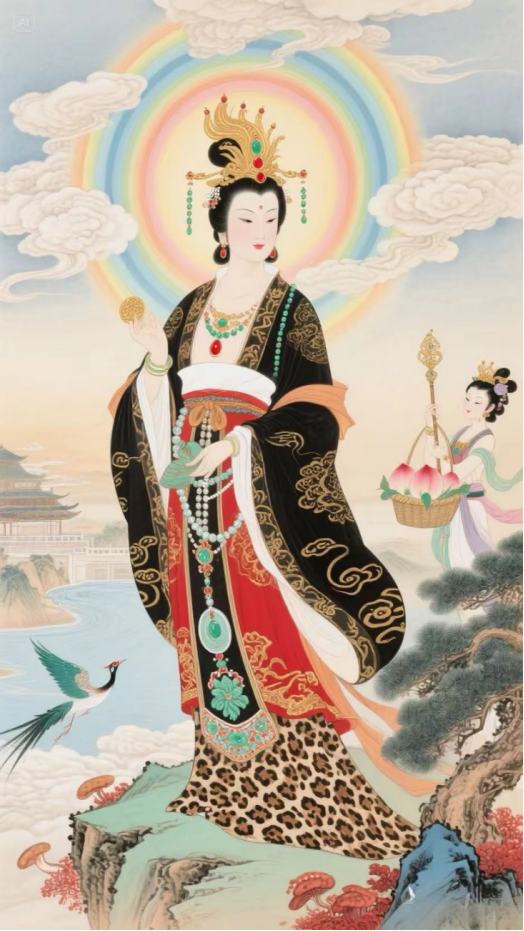
The Queen Mother of the West, also known as Xiwangmu or Goddess Wangmu, is one of the most important female deities in Chinese mythology and Taoism. She governs longevity, immortality, fertility, punishment, and the primordial yin force of the universe. Over thousands of years, her image evolved from an ancient fearsome deity into the majestic ruler of all Taoist goddesses.
The Evolution of Xiwangmu’s Image
Ancient Origins
The earliest records of Xiwangmu appear in the Classic of Mountains and Seas. In ancient mythology, she possessed tiger teeth, a leopard tail, and wild disheveled hair. At that time, she represented divine punishment, plague, and supernatural authority.
However, during the Han Dynasty, Chinese society became deeply interested in immortality and transcendence. As a result, Xiwangmu gradually transformed into a benevolent goddess associated with eternal life and heavenly blessings.
Legend states that she bestowed the elixir of immortality upon Hou Yi. She also welcomed King Mu of Zhou at the Jade Pool of Kunlun Mountain, which later became one of the most famous sacred settings in Chinese mythology.
Transformation Within Taoism
After the Wei and Jin dynasties, Taoism formally integrated Xiwangmu into the celestial hierarchy. She became recognized as the supreme leader of all female immortals and heavenly goddesses.
According to Taoist belief, she resides within the sacred Kunlun Mountains and governs the legendary Peach Garden of Immortality. The peaches ripen once every three thousand years and grant eternal life to those who consume them.
Her divine authority complements the cosmic yang power associated with Dongwanggong, the King of the East. Together, they symbolize the balance of yin and yang within the universe.
This cosmic structure also reflects the celestial order governed by the Jade Emperor, who presides over the heavenly court and the broader Taoist divine system.
Core Divine Functions of Xiwangmu
Goddess of Longevity and Immortality
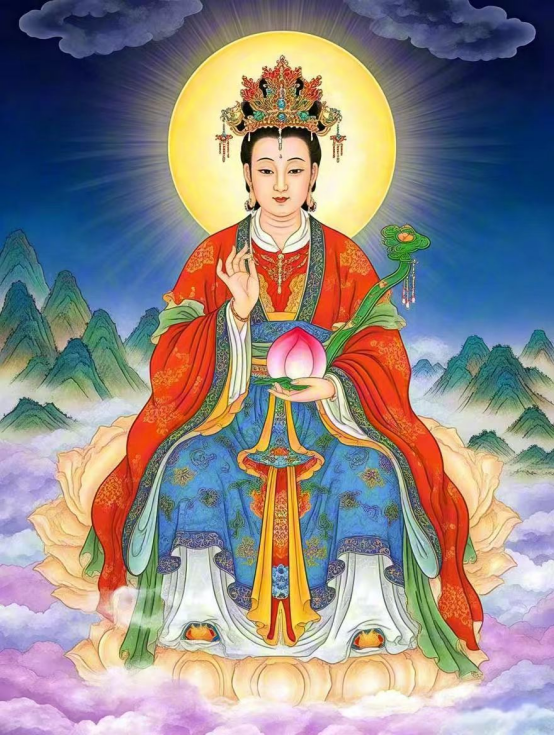
Xiwangmu is most famous for governing immortality and longevity. Her sacred peaches symbolize eternal life, spiritual transcendence, and heavenly blessing.
In Taoist rituals and folk worship, people pray to her for health, long life, and protection from illness.
Patroness of Women and Fertility
In Chinese folk belief, Xiwangmu is also regarded as a protector of women, marriage, childbirth, and family harmony. Many believers worship her to seek healthy children and peaceful family relationships.
Because of this role, she became one of the most beloved motherly deities in Chinese religious culture.
Guardian of Cosmic Balance
Although later traditions emphasize her compassion and wisdom, Xiwangmu still retains aspects of her ancient authority over punishment and disaster. Taoist belief teaches that she can punish evil and restore cosmic balance when moral order is disrupted.
Her role as the embodiment of primordial yin also connects to broader Taoist cosmology and the balance between heaven, earth, and humanity.
This concept of divine order appears throughout Taoist theology, including systems described in The Fire Ministry Emperor, where celestial forces regulate both natural and spiritual harmony.
Xiwangmu in Taoist Belief and Chinese Culture
Within Taoism, Xiwangmu occupies the highest rank among female deities. Taoist legends describe her as the sovereign ruler of immortal women and celestial maidens.
Her birthday festivals remain important religious observances in many Taoist temples. Ceremonies dedicated to her often include prayers for longevity, family harmony, and spiritual blessings.
Xiwangmu also became one of the most influential figures in Chinese literature and folklore. In Journey to the West, the famous Peach Banquet disrupted by Sun Wukong belongs to her heavenly court. In the legend of Chang’e, the elixir of immortality originally came from Xiwangmu as well.
Her sacred authority and celestial residence also reflect the heavenly hierarchy explained in All the Sages of Fengdu, which demonstrates how Taoist divine systems mirror imperial governance and cosmic administration.
Cultural Legacy of the Queen Mother of the West
The evolution of Xiwangmu reflects changing Chinese views about life, death, immortality, and feminine spiritual power. From a primitive mountain deity to the supreme goddess of Taoism, her transformation mirrors the development of Chinese religion and cosmology itself.
Today, Xiwangmu remains a powerful symbol of wisdom, longevity, motherhood, and sacred feminine authority in Taoism and Chinese folk culture.
Related Posts
Third Lady of Mount Hua (Third Holy Mother)
Origins and Mythological Background The Third Lady of Mount Hua, also known as the Third [...]
Dec
The Five Water Deities in Taoism: Guardians of Seas, Rivers, and Sacred Waters
The Five Water Deities are among the most important water gods in Taoist belief. They [...]
Dec
Dongwanggong (Eastern King Father)
Dongwanggong, also known as Mu Gong, Eastern Heavenly Lord, or the Eastern King Father, is [...]
Dec