

Introduction
When people first encounter the Five Elements in Chinese philosophy, they often assume Wood, Fire, Earth, Metal, and Water refer to literal physical substances — much like the classical elements of ancient Greek thought.
However, the Five Elements Theory represents something more dynamic than a list of materials. Rather than describing five literal substances, it represents five fundamental energies and patterns that govern the movement, transformation, and balance of all things in the universe — closely intertwined with the concepts explored in our guide to Qi and Yin-Yang in Taoist Philosophy.
Together with Qi and Yin-Yang, the Five Elements became a foundational framework for Taoist philosophy, medicine, astrology, and cultivation practices — one of the most influential concepts in ancient Chinese cosmology.
This guide explores the Five Elements Theory by examining three key areas:
- what each of the five elements represents and how they relate to the body and seasons
- the two cycles — generation and restraint — that keep the system in balance
- how this theory continues to shape Taoist practice, medicine, and Feng Shui today
What Are the Five Elements?

The Five Elements symbolize five different qualities of energy and transformation found throughout the cosmos. According to Britannica’s entry on Wuxing, the theory was originally associated with the philosopher Zisi (grandson of Confucius) and Mencius, before the sage-alchemist Zou Yan introduced a systematic cosmological version in the 3rd century BCE — one that would go on to dominate Han dynasty intellectual life.
Wood (木)
Wood represents growth, vitality, flexibility, and expansion. It is associated with spring, plants and trees, the liver and gallbladder, and creativity and development. Wood energy reflects upward movement and continuous growth.
Fire (火)
Fire symbolizes heat, brightness, activity, and upward motion. It is associated with summer, the sun, the heart, and passion and enthusiasm. Fire energy represents illumination and transformation.
Earth (土)
Earth represents stability, nourishment, balance, and support. It is associated with late summer, soil and mountains, the spleen and stomach, and harmony and grounding. Earth serves as the center that stabilizes all other elements.
Metal (金)
Metal symbolizes structure, contraction, discipline, and purification. It is associated with autumn, minerals and metals, the lungs, and order and clarity. Metal energy reflects refinement and inward concentration.
Water (水)
Water represents coldness, adaptability, depth, and concealment. It is associated with winter, rivers and oceans, the kidneys, and wisdom and endurance. Water energy flows downward and preserves hidden potential.
The Generating Cycle of the Five Elements
The Five Elements maintain harmony through the cycle of mutual generation, where one element nourishes the next:
- Wood generates Fire
- Fire generates Earth
- Earth generates Metal
- Metal generates Water
- Water generates Wood
This cycle reflects the natural process of growth and renewal throughout the universe. The concept also supports the Taoist principle that Tao Follows Nature, emphasizing that all existence moves according to natural rhythms and transformations.
The Restraining Cycle of the Five Elements
Balance is also maintained through mutual restraint. Each element controls another to prevent excess:
- Wood restrains Earth
- Earth restrains Water
- Water restrains Fire
- Fire restrains Metal
- Metal restrains Wood
This system prevents imbalance and ensures that no single force dominates the whole.
Applications of the Five Elements Theory
Traditional Chinese Medicine
The Five Elements form one of the foundations of traditional Chinese medicine. Each organ system corresponds to an element, and illness is often understood as an imbalance among these energies. Treatment methods seek to restore harmony through herbs, acupuncture, breathing exercises, and dietary adjustments.
Taoist Philosophy and Spiritual Cultivation
In Taoist philosophy, the Five Elements describe the energetic structure of both the cosmos and the human body. Taoist practitioners use Five Element theory in meditation, internal alchemy, Qi circulation, martial arts, and Feng Shui. Understanding elemental balance is considered essential for spiritual harmony and longevity — the same framework underlying practices like Mian Xiang, or Chinese face reading, which categorizes facial structure according to the Five Elements.
Astrology and Feng Shui
Chinese astrology and Feng Shui rely heavily on Five Element interactions to analyze personal destiny, environmental energy, directional balance, and auspicious timing.
The Core Meaning of the Five Elements
At its heart, the Five Elements Theory teaches that the universe is an interconnected and constantly changing system. Everything exists within cycles of generation, restraint, growth, decline, and renewal.
The theory emphasizes balance over conflict, harmony over domination, and transformation over permanence. This holistic worldview became one of the central pillars of Taoist cosmology and continues to influence Chinese culture, medicine, spirituality, and philosophy today.
Five Elements Wisdom at Taoist World
At Taoist World, this same framework informs the materials and symbolism behind much of what we create, reflecting the belief that genuine balance comes from understanding — not overriding — the natural cycles that shape both the cosmos and everyday life.
Explore more Taoist philosophy and wisdom: → Taoist Philosophy & Wisdom Collection
Conclusion
The Five Elements Theory offers one of the most enduring frameworks in Chinese philosophy — a way of understanding the universe not as a collection of fixed substances, but as a continuously shifting web of energies, generating and restraining one another in balance.
From traditional Chinese medicine to Feng Shui, martial arts to face reading, this five-thousand-year-old system continues to shape how millions of people understand health, harmony, and the natural rhythms of change. Understanding its logic — generation, restraint, and cyclical transformation — offers a foundation for appreciating much of Taoist philosophy as a whole.
FAQ
No — Wood, Fire, Earth, Metal, and Water represent dynamic energies and patterns of transformation, not fixed physical materials, despite the common English translation as “elements.”
The generating cycle shows how each element nourishes the next (Wood feeds Fire, for example), while the restraining cycle shows how each element controls another to prevent excess (Wood restrains Earth).
Each element corresponds to specific organ systems, and illness is often understood as an imbalance among these elemental energies, with treatment aimed at restoring harmony.
The philosopher Zou Yan is credited with introducing a systematic cosmological version of the theory in the 3rd century BCE, which became highly influential during the Han dynasty.
Both practices apply the same Five Elements framework — Feng Shui to environments and directions, and Mian Xiang to facial structure and features — as ways of reading balance and energy.
Related Posts
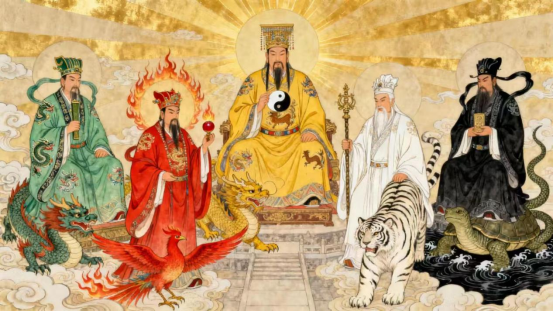
The Five Elders of the Five Directions in Taoism
The Five Elders of the Five Directions are among the highest celestial deities in the [...]
Dec
How Taoist Philosophy Understands the Human Body
Introduction When we think about the human body today, we often imagine a collection of [...]
Jul
What Is Taoism? Understanding Taoist Philosophy and Daily Practice
Introduction When people think of Taoism and Taoist priests, two very different impressions often come [...]
Mar