
The Celestial Officials Who Govern Time and Divine Records
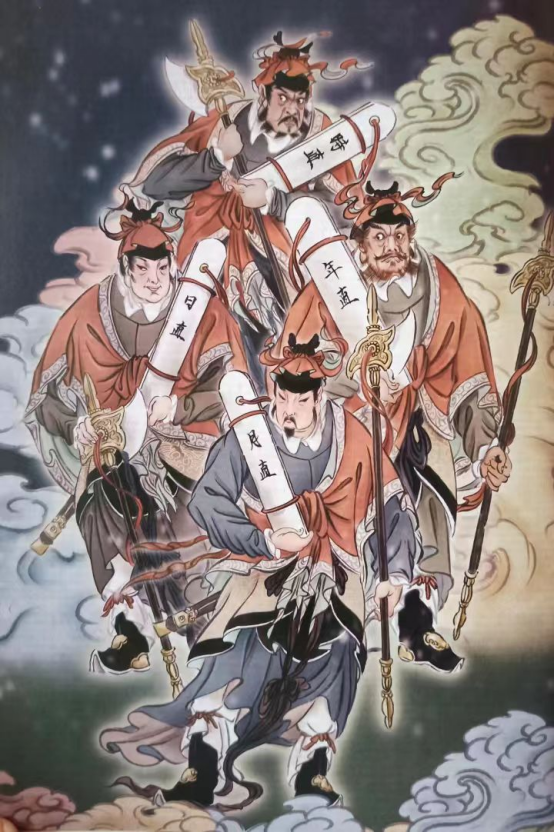
The Four Meritorious Officers of the Time are four important “on-duty” celestial officials within the Taoist heavenly administration system. They are responsible for recording events, transmitting reports, supervising divine decrees, and ensuring communication between Heaven, Earth, and the Underworld. In Taoist belief, they function as the celestial secretaries, archivists, and divine couriers of the Heavenly Court.
The title “Four Duties” refers to the rotation of authority over the year, month, day, and hour, while “Meritorious Officers” originally described administrative officials in ancient China who handled records, documents, and legal archives. Taoism transformed this bureaucratic role into a sacred divine office, creating a complete spiritual system of heavenly supervision and information management.
Unlike warrior gods or astral deities who govern cosmic powers, the Four Meritorious Officers specialize in maintaining the operational order of the celestial bureaucracy. Through them, every action performed by gods, immortals, humans, ghosts, and spirits becomes officially recorded and reported to Heaven.
The Four Celestial Duty Officers and Their Responsibilities
The Yearly Duty Officer — Li Bing
The Yearly Duty Officer oversees all major affairs occurring throughout the year within the Three Realms. He compiles annual records of good deeds, sins, disasters, blessings, and social events before submitting a final yearly report to the Heavenly Court.
Because of this role, he is closely associated with karmic accumulation, long-term fortune, and the annual judgment of mortal conduct. His records influence changes in destiny, prosperity, and heavenly favor.
The Monthly Duty Officer — Huang Chengyi
The Monthly Duty Officer supervises the affairs of each lunar month. He manages monthly reports concerning human morality, local harmony, rituals, and spiritual disturbances.
At the end of every month, he delivers detailed summaries to the celestial administration, ensuring that Heaven continuously monitors the changing condition of the mortal world.
The Daily Duty Officer — Zhou Deng
Among the four officials, the Daily Duty Officer is considered the most active and directly involved with human affairs. He records the events of every single day, documenting both public and private actions.
In many Taoist traditions, the phrase “Daily Duty Officer” is even used collectively to represent all Four Duty Officers because daily recording forms the central foundation of their divine administration system.
His existence reflects the Taoist belief that Heaven constantly observes moral behavior and that no action escapes spiritual accountability.
The Hourly Duty Officer — Liu Hong
The Hourly Duty Officer governs the most immediate and urgent transmission of information. Responsible for records within each two-hour Chinese time period, he acts as the rapid messenger of Heaven.
He reports emergencies, sudden disasters, ritual petitions, spiritual anomalies, and urgent divine matters. Among the Four Officers, he symbolizes speed, efficiency, and uninterrupted celestial communication.
The Heavenly Communication System of Taoism
The Four Meritorious Officers collectively form the “postal and archive system” of the Heavenly Court. Their divine functions mirror the administrative structure of an ancient imperial government.
Recording the Deeds of All Beings
These celestial officials meticulously record the behavior of every entity within the cosmos. Every charitable deed, harmful action, prayer, oath, ritual, or moral violation becomes part of the heavenly archives.
This belief directly connects to the traditional Chinese saying that “there are gods three feet above one’s head,” emphasizing constant divine observation and moral accountability.
The system also reinforces the Taoist concept that good and evil ultimately receive karmic consequences through heavenly judgment.
Delivering Prayers and Ritual Documents
Within Taoist rituals, the Four Duty Officers serve as the essential messengers between mortals and Heaven. When priests conduct ceremonies, they submit ritual petitions, memorials, talismans, and sacred documents through these divine officials.
Without the assistance of the Four Officers, communication between humans and celestial deities cannot properly occur.
During major rituals, Taoist priests often recite invocations requesting the officers to “carry the memorial upward to Heaven,” symbolizing the transmission of prayers to the Jade Emperor and higher gods.
This role closely connects them with Divine Patrol Officer, who also serves as a roaming celestial messenger and spiritual protector across the Three Realms.
Supervisors of Heavenly Law and Moral Order
The Four Officers are not merely divine messengers — they are also celestial supervisors who monitor whether heavenly decrees are properly enforced in the mortal world.
They inspect the execution of divine laws, ensuring that cosmic order remains stable and balanced. Through continuous reporting and observation, they help maintain the harmony between Heaven and humanity.
This supervisory function parallels the work of Divine Officer Wang, the powerful Taoist guardian deity who inspects good and evil throughout the Three Realms and punishes malevolent forces through thunder and divine authority.
Together, these celestial officials form an interconnected spiritual governance system that combines surveillance, judgment, protection, and communication.
Their Role in Taoist Rituals and Folk Belief
The Four Meritorious Officers occupy a central role in formal Taoist liturgy. Nearly every large-scale ritual involving blessings, disaster removal, exorcism, repentance, or merit accumulation requires invoking these celestial officials.
Priests symbolically dispatch ritual reports through fire offerings and sacred documents, trusting the Four Officers to deliver the messages safely into Heaven.
In folk religion, believers view them as witnesses to human morality. Their records are believed to influence lifespan, fortune, official success, and karmic rewards.
Because of this, people often strive to cultivate virtue, avoid wrongdoing, and maintain sincerity in both public and private conduct.
Presence in Literature and Popular Mythology
The Four Duty Officers frequently appear in Taoist-inspired classical literature. In works such as Journey to the West, they are depicted as heavenly assistants, messengers, and spiritual guards who help maintain divine order.
They often cooperate with celestial marshals, guardian gods, and protective spirits during supernatural missions.
Their image also complements the broader heavenly protection network formed by deities such as The Four Sage True Lords, who command divine armies and defend the cosmic order against demonic chaos.
Unlike martial gods who rely on force, the Four Duty Officers represent the quieter but equally essential power of administration, documentation, and lawful order.
Symbolism and Cultural Significance
The belief in the Four Meritorious Officers reveals how Taoism transformed the structure of imperial bureaucracy into a sacred cosmic administration.
Through these celestial officials, Heaven becomes an organized government rather than an abstract spiritual realm. Every action is documented, every prayer is transmitted, and every decree is enforced according to divine procedure.
This system reflects the Taoist understanding that the universe operates through balance, order, communication, and accountability.
The Four Meritorious Officers therefore symbolize:
- Divine supervision of morality
- Heavenly communication and ritual transmission
- Cosmic administrative order
- The connection between human behavior and celestial judgment
- The integration of law, karma, and spiritual governance
Their existence provides believers with reassurance that sincere prayers can reach Heaven, while justice and moral balance are continuously maintained throughout the universe.
Related Posts
The Six Ding and Six Jia Generals in Taoism | Guardian Deities of Divine Protection
Introduction The Six Ding and Six Jia Generals are among the most important guardian deities [...]
Dec
The Five Water Deities in Taoism: Guardians of Seas, Rivers, and Sacred Waters
The Five Water Deities are among the most important water gods in Taoist belief. They [...]
Dec
Four Symbols in Taoism: Azure Dragon, White Tiger, Vermilion Bird and Black Tortoise
The Four Symbols, also known as the Four Divine Spirits or Four Celestial Spirits, are [...]
Dec