
Origins of Bixia Yuanjun
Bixia Yuanjun, also known as the Goddess of Mount Tai, is one of the most influential female deities in Taoism and Chinese folk religion. Her full sacred title is Tianxian Yunu Bixia Yuanjun, while ordinary believers affectionately call her:
- Tai Shan Niangniang
- Tai Shan Shengmu
- Tai Shan Nainai
The term “Bixia” refers to the rosy clouds and radiant glow of dawn in the eastern sky, symbolizing life, hope, renewal, and divine protection. “Yuanjun” is an honorific Taoist title granted to high-ranking female immortals, reflecting her supreme spiritual status.
Over centuries, Bixia Yuanjun evolved into one of the most beloved goddesses in northern China, particularly among families seeking blessings, childbirth protection, health, and peace.
Historical Development of the Faith
The worship of Bixia Yuanjun originated from ancient Mount Tai mountain worship traditions dating back to the pre-Qin era. Her official elevation within Taoism occurred during the Song Dynasty.
In 1009 CE, Emperor Zhenzong of Song visited Mount Tai during a grand imperial fengshan ceremony. According to historical tradition, a sacred jade maiden statue was discovered on the summit. The emperor ordered a new jade statue to be created and established the Zhaozhen Shrine to honor the deity, granting her the title of “Heavenly Immortal Jade Maiden, Lady of the Green Haze.”
During the Ming and Qing dynasties, the influence of Bixia Yuanjun expanded dramatically. Her popularity eventually surpassed many older Mount Tai deities and spread throughout northern China. This growth closely paralleled the regional importance of Bingling Gong, the Righteous Deity of the Three Mountains, another major Mount Tai-associated guardian figure in Taoist belief.
Successive emperors continued to bestow increasingly prestigious titles upon her, emphasizing her role as a universal protector who safeguards all living beings.
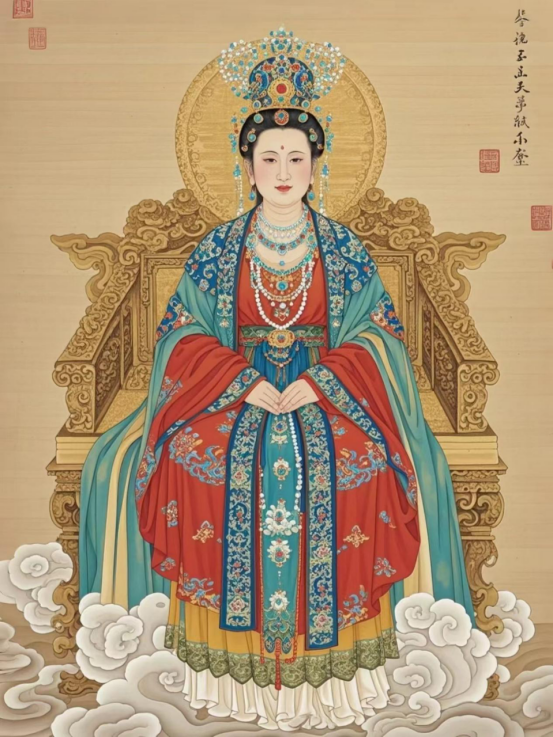
The Sacred Bixia Temple of Mount Tai
The most important center of worship for Bixia Yuanjun is the famous Bixia Temple located at the summit of Mount Tai. Considered one of the highest and most magnificent Taoist temple complexes in eastern China, it is often referred to as the “Heavenly Palace.”
Architectural Features
The temple is renowned for its:
- Golden roof structures
- Sacred mountain setting
- Elaborate imperial decorations
- Symbolic roof ridges representing the days of the year
Inside the temple stand gilded statues dedicated to:
- Bixia Yuanjun
- The Goddess of Eyesight
- The Goddess of Fertility
Imperial inscriptions from the Qing emperors Yongzheng and Qianlong further demonstrate the extraordinary respect granted to the goddess by the imperial court.
Divine Functions and Popular Worship
Protector of Families and Women
Among ordinary believers, Bixia Yuanjun is best known as a compassionate mother goddess who protects:
- Women and children
- Safe childbirth
- Family harmony
- Longevity and health
- Fertility and prosperity
Her compassionate image made her one of the most approachable Taoist deities for common people.
Guardian of Mount Tai and Human Destiny
In Taoist tradition, Bixia Yuanjun is also regarded as a spiritual guardian overseeing Mount Tai’s sacred energies and monitoring the moral conduct of humanity.
Many believers viewed her as a deity capable of:
- Dispelling disasters
- Responding to prayers
- Supervising good and evil
- Protecting travelers and pilgrims
Her sacred authority complements the larger cosmological role associated with Dongwanggong, who represents the eastern yang principle and celestial order within Taoist theology.
Expansion of the Bixia Yuanjun Belief Network
Centered around Mount Tai, the worship of Bixia Yuanjun gradually spread across northern and eastern China through pilgrimage routes and the Grand Canal trade network.
Large temples dedicated to her appeared in:
- Beijing
- Tianjin
- Hebei
- Henan
- Shanxi
These temples were commonly known as “Grandma Temples” among local communities.
Her influence became so widespread that she was eventually compared to Mazu, the great sea goddess of southern China. Together, they formed the two major regional goddess worship systems of traditional Chinese religion:
- “Bixia Yuanjun in the North”
- “Mazu in the South”
Cultural Influence in Chinese Society
During the Ming and Qing dynasties, devotion to Bixia Yuanjun expanded far beyond formal religion. Her image entered:
- Folk festivals
- Traditional opera
- Temple fairs
- Woodblock prints
- Family rituals
- Literary works
She became a symbol of maternal compassion, divine protection, and moral guidance within Chinese society.
The enduring popularity of Bixia Yuanjun demonstrates how Taoist mountain worship gradually merged with folk spirituality and family-centered beliefs, allowing her to remain one of the most revered goddesses in Chinese religious culture today.
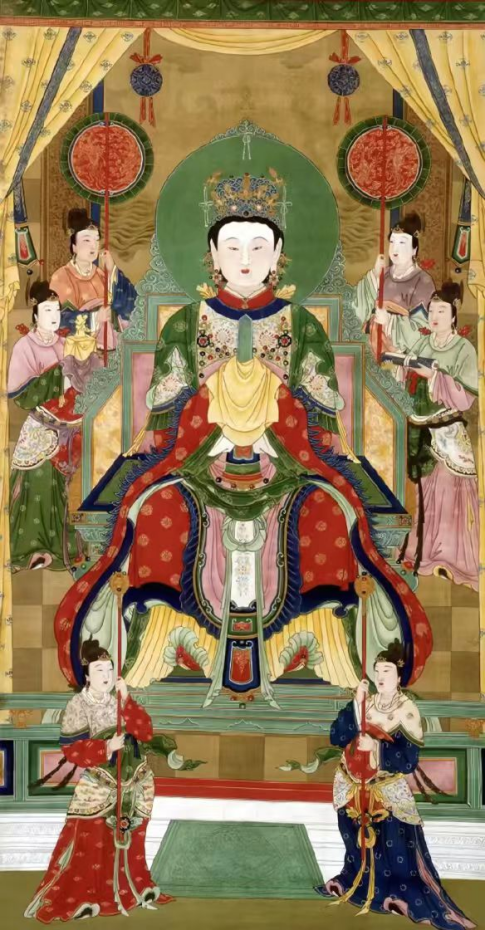
Enduring Legacy of Bixia Yuanjun
Bixia Yuanjun represents the fusion of imperial mountain worship, Taoist theology, and popular folk devotion. As the sacred mother goddess of Mount Tai, she embodies compassion, protection, vitality, and spiritual blessing.
Her temples, legends, and rituals continue to attract worshippers and pilgrims across China, preserving her role as one of the most important female deities in Taoist tradition.
Related Posts
The Great Deities of the Five Lakes in Taoism
The Great Deities of the Five Lakes are important water gods in Taoism and Chinese [...]
Dec
The Five Water Deities in Taoism: Guardians of Seas, Rivers, and Sacred Waters
The Five Water Deities are among the most important water gods in Taoist belief. They [...]
Dec
Third Lady of Mount Hua (Third Holy Mother)
Origins and Mythological Background The Third Lady of Mount Hua, also known as the Third [...]
Dec