
The Great Emperors of the Five Great Mountains are central figures in Taoism’s sacred mountain deity system. They are the divine rulers of China’s Five Sacred Mountains (Wuyue) and serve as guardians of mountains, rivers, land, fortune, and cosmic order. Rooted in both ancient mountain worship and Taoist cosmology, they embody the spiritual power of the Five Directions and the Five Elements, linking the natural world with human destiny.
These five mountain deities protect different regions of the world and govern blessings such as longevity, prosperity, peace, and spiritual stability. Their worship reflects the Taoist ideal of harmony between heaven, earth, and humanity.
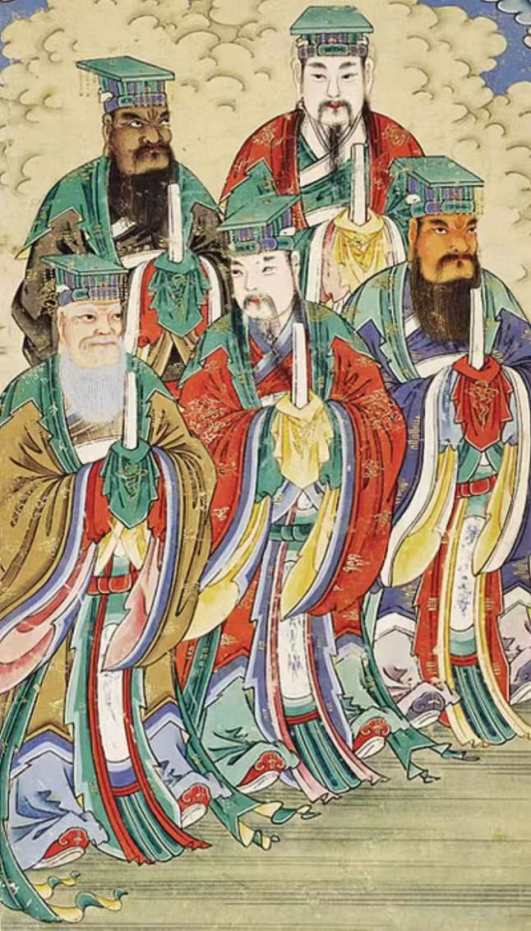
The Eastern Great Mountain Emperor (Mount Tai)
Mount Tai, located in Shandong Province, is known as the foremost of the Five Great Mountains. Its corresponding deity is the Eastern Great Mountain Emperor, formally titled the Tianqi Daisheng Rensheng Emperor.
Among all five mountain rulers, he holds the highest status. He governs human life and death, fortune and disgrace, and is closely associated with the supervision of the underworld. This spiritual authority connects naturally with the sacred judicial themes found in The Three Great Emperor-Officials, where divine powers oversee blessing, pardon, and cosmic balance.
In popular belief, Mount Tai governs the spirits of the deceased, and many traditions hold that souls pass under his authority after death.
The Southern Great Mountain Emperor (Mount Heng)
The Southern Mountain, located in Hunan Province, corresponds to the Southern Great Mountain Emperor, known as the Zhaosheng Emperor.
His divine responsibilities include overseeing longevity, academic success, climate harmony, and blessings related to vitality. Taoist tradition often links him with Zhu Rong, the ancient fire deity, whose sacred fire symbolism also appears in Fire Ministry Emperor.
Because Mount Heng symbolizes life extension and health, worshippers often pray to him for long life, family prosperity, and success in examinations.
The Western Great Mountain Emperor (Mount Hua)
Mount Hua in Shaanxi Province represents the western direction and corresponds to the Western Great Mountain Emperor, formally known as the Jintian Shunsheng Emperor.
He governs military affairs, metal, justice, and protection. His role reflects the Five Element of Metal, symbolizing discipline, purification, and strength.
He is especially honored by those seeking protection, stable careers, and success in official or business life.
The Central Great Mountain Emperor (Mount Song)
Mount Song, located in Henan Province, stands at the symbolic center of the Chinese sacred landscape. Its deity is the Central Great Mountain Emperor, called the Zhongtian Chongsheng Emperor.
He governs land, grain, family stability, and the central balance of all things. His role as the harmonizing force among the five mountains reflects the cosmological structure explained in The Five Elders of the Five Directions, where each direction contributes to universal equilibrium.
Believers pray to him for household peace, family continuity, and lasting prosperity.
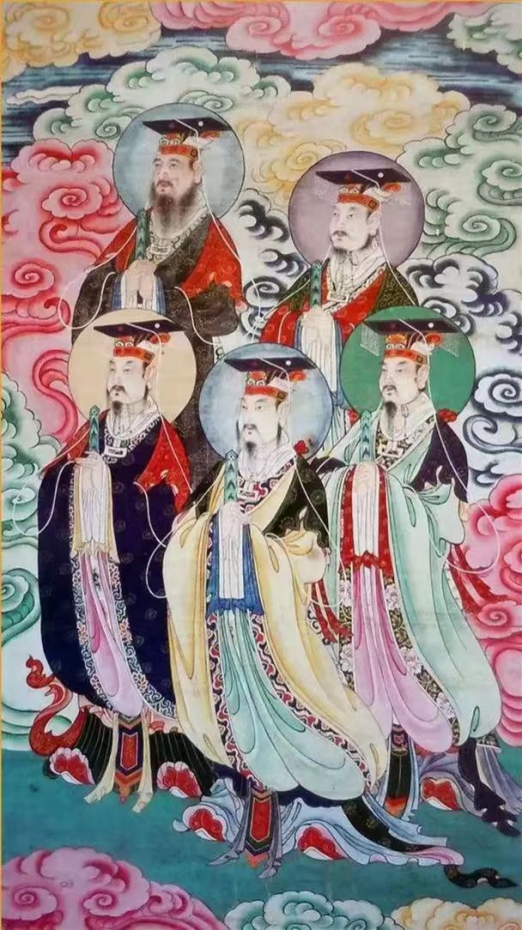
Taoist Meaning of the Five Great Mountain Emperors
Guardians of the Five Directions
Each mountain corresponds to one of the Five Elements—Wood, Fire, Metal, Water, and Earth—and together the Five Emperors create a sacred protective system surrounding the land.
Their authority reflects Taoist beliefs in cosmic geography and spiritual guardianship.
Harmony Between Heaven and Humanity
The worship of the Five Great Mountains expresses the Taoist principle of harmony between heaven and humanity, where natural forces and divine powers shape human destiny.
This worldview is deeply connected to broader Taoist teachings explored in What Is Taoism? Understanding Taoist Philosophy and Daily Practice.
Enduring Cultural Influence
Beyond religion, the Five Great Mountain Emperors continue to influence Chinese architecture, temple traditions, jewelry symbolism, and protective talismans. They remain powerful symbols of national stability, sacred protection, and the enduring relationship between humanity and the natural world.
Related Posts
The Great Deities of the Five Lakes in Taoism
The Great Deities of the Five Lakes are important water gods in Taoism and Chinese [...]
Dec
Dragon Kings of the Five Emperors in Taoism
The Dragon Kings of the Five Emperors are a group of five directional dragon kings [...]
Dec
The Four River Source Kings in Taoism: Guardians of China’s Sacred Rivers
The Four River Source Kings are revered water deities in Chinese mythology and Taoism, each [...]
Dec