

Introduction
The year 2026 marks the Bing Wu (丙午) Year of the Horse, a combination of the Heavenly Stem Bing (丙) and the Earthly Branch Wu (午). In traditional Chinese calendrical thought, both are associated with the Fire element, which is why 2026 is commonly described as a Fire Horse year or a year with a strong Fire character.
The traditional lunar calendar begins the 2026 Horse year on February 17, 2026, the first day of the first lunar month. However, some Chinese metaphysical systems use Li Chun (立春), the Beginning of Spring, on February 4, as the boundary for interpreting the annual Heavenly Stem and Earthly Branch. These are different calendrical conventions and should not be treated as contradictory.
The Horse has a particularly prominent place in Chinese culture. The Metropolitan Museum of Art notes that the twelve-animal zodiac has a long history in China and that the Horse has traditionally been associated with qualities such as power, strength, and vitality.
Within traditional Tai Sui belief, however, 2026 is more than simply another Year of the Horse. Each year is associated with a particular Tai Sui deity, and the relationship between the year’s Earthly Branch and the zodiac branches is traditionally used to determine which signs are considered to be in conflict with Tai Sui.
This guide examines the 2026 Tai Sui tradition from three perspectives:
- what Tai Sui represents in traditional Chinese religious and folk culture
- which zodiac signs have the main Tai Sui relationships in 2026
- how traditional customs such as temple worship, talismans, offerings, and directional practices are understood — together with a balanced modern perspective
What Is Tai Sui in Chinese Tradition?
Tai Sui (太岁) is one of the most recognizable concepts in traditional Chinese astrology, religious practice, and folk belief.
The term has a complicated history because it can refer to both a calendrical concept and a personified divine figure. In traditional systems, each year is associated with one of a cycle of sixty Tai Sui generals, corresponding to the sixty combinations of the Heavenly Stems and Earthly Branches.
The sixty-year cycle itself comes from the combination of the ten Heavenly Stems and twelve Earthly Branches. The Metropolitan Museum of Art notes that these calendrical elements were combined into a rotating sixty-year cycle that was used for counting years in China.
Over time, these calendrical relationships became connected with religious and folk traditions in which the annual Tai Sui was understood as a divine figure overseeing the year’s changing circumstances.
For a broader introduction, see our guide:
What Is Tai Sui? Understanding the Chinese Zodiac’s Guardian Deities
It is important to distinguish this traditional belief from a scientific claim. Tai Sui is best understood as part of a historical system of Chinese calendrical, astrological, religious, and folk traditions rather than as a scientifically established force that determines individual events.
Who Is the Tai Sui Deity for 2026?
According to contemporary temple and traditional Tai Sui sources, the 2026 Bing Wu year is associated with General Wen Zhe (文哲大将军).
One particularly useful contemporary source is Sik Sik Yuen Wong Tai Sin Temple in Hong Kong, which explicitly identifies Wen Zhe Dajiangjun as the 2026 annual Tai Sui and includes him in its 2026 Tai Sui worship arrangements.
Traditional accounts identify Wen Zhe with Wang Zhen (王缜), courtesy name Wen Zhe, a Ming-dynasty official. Accounts of his life emphasize his integrity, administrative ability, and willingness to speak frankly on matters of government.
The historical biography associated with Wen Zhe is important because Tai Sui generals are not simply abstract zodiac symbols in the popular tradition. They are commonly represented as individual historical or semi-historical figures whose biographies provide moral and cultural meaning to the year’s Tai Sui.
In this sense, the story of Wen Zhe emphasizes qualities such as:
- integrity
- responsibility
- discipline
- careful judgment
- concern for public welfare
These qualities also provide a useful cultural interpretation of the 2026 Tai Sui tradition: strong energy should be accompanied by restraint, responsibility, and thoughtful action.
Why Is 2026 Called the Bing Wu Fire Horse Year?
The traditional Chinese calendrical system combines Heavenly Stems and Earthly Branches to produce a sixty-year cycle.
In 2026:
- Bing (丙) is the third Heavenly Stem and is traditionally associated with Yang Fire.
- Wu (午) is the seventh Earthly Branch and corresponds to the Horse.
- Together they form Bing Wu (丙午).
This is why 2026 is traditionally described as a Fire Horse year.
The term “double Fire” is useful as a description within the traditional Five Elements framework, but it should not be interpreted as a literal increase in physical heat or a scientific measurement of energy. It belongs to the symbolic language of traditional Chinese cosmology.
The Horse itself has a long-standing cultural significance in China. The Metropolitan Museum of Art describes the animal as a major symbol of power, strength, vitality, and prosperity and highlights its importance in Chinese agriculture, transportation, warfare, art, and political culture.
The Metropolitan Museum of Art — Celebrating the Year of the Horse
Which Zodiac Signs Offend Tai Sui in 2026?
Within the traditional Earthly Branch system, the Horse corresponds to Wu (午).
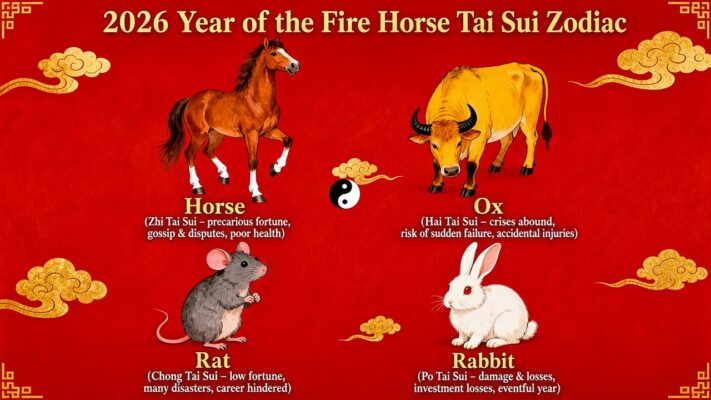
Other zodiac branches form specific relationships with Wu. In the common 2026 Tai Sui framework, four zodiac signs receive particular attention:
| Zodiac Sign | Earthly Branch | Traditional Relationship | Common Term |
|---|---|---|---|
| Horse | Wu (午) | Own year + self-punishment | Ben Ming Nian / Xing Tai Sui |
| Rat | Zi (子) | Direct clash | Chong Tai Sui |
| Ox | Chou (丑) | Harm | Hai Tai Sui |
| Rabbit | Mao (卯) | Break | Po Tai Sui |
These classifications come from traditional relationships among the twelve Earthly Branches rather than from a prediction that a specific event must happen to everyone born under a particular zodiac sign.
For a deeper overview, see our 2026 Tai Sui Guide: What the Fire Horse Year Means for Your Zodiac
1. Horse — Ben Ming Nian and Xing Tai Sui
People born under the Horse sign enter their Ben Ming Nian (本命年) in 2026 because the annual branch is also Wu (午).
The Horse also has a traditional Wu-Wu self-punishment relationship (午午自刑) in this framework.
This is different from a direct clash with another zodiac sign. Rather than describing opposition between two different branches, self-punishment is traditionally interpreted as an intensification of one’s own tendencies.
That is why Horse years are often associated with themes such as:
- heightened self-awareness
- impulsiveness
- restlessness
- pressure created by one’s own decisions
- the need for patience and self-discipline
For a detailed discussion, see:
2026 Horse Horoscope: Navigating Your Own Year and the Wu-Wu Self-Punishment
2. Rat — Chong Tai Sui
The Rat corresponds to Zi (子), which forms the famous Zi-Wu clash (子午冲) with the Horse.
This is traditionally regarded as a direct opposition between two Earthly Branches.
Traditional interpretations associate Chong Tai Sui with themes of:
- change
- movement
- instability
- disagreement
- disrupted plans
These interpretations belong to Chinese astrological and folk traditions and should not be treated as guaranteed predictions.
See our detailed guide:
2026 Rat Horoscope: Navigating the Direct Clash in the Year of the Fire Horse
3. Ox — Hai Tai Sui
The Ox corresponds to Chou (丑) and forms the traditional Chou-Wu harm relationship (丑午害) with the Horse.
Hai Tai Sui is commonly translated as harm.
Compared with a direct clash, the traditional interpretation tends to emphasize quieter forms of friction — especially misunderstandings, interpersonal tension, and gradual disruption.
See:
2026 Ox Horoscope: Navigating the Hidden Harm of the Chou-Wu Relationship
4. Rabbit — Po Tai Sui
The Rabbit corresponds to Mao (卯) and forms the traditional Mao-Wu break relationship (卯午破) with the Horse.
Po Tai Sui is often translated as break or disruption.
Rather than interpreting Po as inevitable disaster, traditional explanations commonly associate it with things becoming fragmented, delayed, redirected, or unexpectedly changed.
See:
2026 Rabbit Horoscope: Understanding the Mao-Wu Break in the Year of the Fire Horse
What Does “Offending Tai Sui” Actually Mean?
The phrase Fan Tai Sui (犯太岁) is often translated as “offending Tai Sui.”
This wording can sound much more severe in English than the underlying tradition necessarily implies.
In traditional Chinese practice, Fan Tai Sui can refer to different relationships between a person’s zodiac branch and the year’s Tai Sui branch, including:
- Zhi / Ben Ming (值太岁) — meeting or being associated with the year’s own branch
- Chong (冲) — clash
- Hai (害) — harm
- Po (破) — break
- Xing (刑) — punishment or self-punishment
Not every tradition interprets these relationships in exactly the same way, and terminology can vary between temples, almanacs, and different schools of Chinese metaphysics.
For that reason, it is better to understand Fan Tai Sui as a traditional classification of annual relationships, rather than as a prediction that someone will necessarily experience misfortune.
Traditional Ways of Responding to Tai Sui
Traditional Chinese culture has developed a variety of practices for people who believe they are affected by Tai Sui.
These practices differ considerably by region, temple, family tradition, and religious lineage.
1. Visiting a Tai Sui Temple
One of the most recognizable practices is visiting a temple or religious institution to worship Tai Sui.
Contemporary temple practice provides a useful example. Sik Sik Yuen Wong Tai Sin Temple’s 2026 arrangements specifically included a Tai Sui Yuanchen Hall, where visitors could worship Doumu Yuanjun, the annual Tai Sui Wen Zhe Dajiangjun, and their own natal Tai Sui.
This is important because it demonstrates that Tai Sui worship is not simply an internet horoscope trend. It continues to exist as a living religious and cultural practice in contemporary Chinese communities.
Sik Sik Yuen Wong Tai Sin Temple — 2026 Tai Sui Worship Arrangements
2. Wearing Protective Talismans and Amulets
Another widespread custom involves carrying or wearing symbolic protective objects.
These may include:
- Tai Sui talismans
- red cords
- amulets
- zodiac-themed pendants
- religious inscriptions
- consecrated objects obtained through a temple or religious practitioner
The meaning of these objects depends heavily on the tradition in which they are made and used.
For Taoist World, this is an important distinction: a traditional amulet should be presented as a religious or cultural object rather than as a scientifically proven device capable of preventing specific events.
3. Offerings and Prayer
Traditional Tai Sui worship can involve offerings, incense, prayer, written petitions, and other ritual practices.
The exact procedure is not universal.
For example, the 2026 worship arrangements at Sik Sik Yuen specify a particular sequence of worship inside the Tai Sui Yuanchen Hall, including worship of Doumu Yuanjun, the annual Tai Sui, and one’s natal Tai Sui.
This illustrates why visitors should follow the instructions of the particular temple or religious tradition they are visiting rather than assuming that one online ritual applies everywhere.
4. Directional Customs
Tai Sui traditions are also connected with annual directions in some Feng Shui and Chinese metaphysical systems.
A common 2026 framework places the annual Tai Sui position in the South and the Sui Po position in the North. However, directional interpretations and practical recommendations can vary between schools.
For this reason, it is better to describe these practices as school-specific Feng Shui customs rather than universal Taoist rules.
In traditional practice, people may be advised to keep the relevant annual sector relatively quiet and avoid unnecessary disturbance.
This can include avoiding unnecessary renovation, drilling, or major construction in a particular annual sector.
These recommendations belong to traditional Feng Shui practice and should not be presented as scientifically demonstrated effects.
5. Red Clothing and Auspicious Objects
Red is strongly associated with celebration, protection, vitality, and auspiciousness in many Chinese cultural contexts.
During Ben Ming Nian, wearing red clothing or accessories is a particularly familiar custom.
Common examples include:
- red bracelets
- red cords
- red clothing
- red waistbands
- red accessories
However, the importance of wearing red varies between families and traditions. It should therefore be presented as a folk custom, not as a universal religious requirement.
6. Doing Good and Maintaining Good Conduct
Perhaps the most culturally meaningful interpretation of Tai Sui customs is not the object itself but the behavior surrounding it.
Traditional practice often emphasizes:
- avoiding unnecessary conflict
- acting responsibly
- maintaining respectful relationships
- showing gratitude
- helping others
- practicing restraint
- being cautious before making major decisions
From this perspective, “resolving Tai Sui” can be understood not simply as finding an object to wear, but as using the beginning of a new year as an opportunity for reflection and more deliberate behavior.
The Cultural Meaning of Tai Sui in Modern Life
For a modern reader, Tai Sui can be approached in several different ways.
A person may understand Tai Sui as:
- a religious belief involving annual deities;
- a traditional Chinese calendrical and astrological system;
- a family or cultural custom passed between generations;
- a symbolic framework for reflecting on uncertainty and personal behavior.
These perspectives do not necessarily have to be mutually exclusive.
Someone can appreciate the cultural history of Tai Sui without treating every prediction as a literal certainty.
This distinction is particularly important when discussing health, finances, relationships, or major life decisions.
Traditional Tai Sui beliefs may encourage caution and reflection, but they should not replace medical care, professional financial advice, legal advice, or ordinary risk assessment.
A Note on “Double Fire” and Rational Interpretation
The expression “double Fire” is useful within traditional Chinese cosmology because both Bing (丙) and Wu (午) are associated with Fire.
But it is important to understand what that statement means.
It does not mean that 2026 has physically more heat, that human behavior will objectively become more aggressive, or that the year has been scientifically proven to produce particular outcomes.
Instead, “Fire” is a symbolic category within the traditional Five Elements framework.
The same distinction applies to Tai Sui itself.
Traditional belief can be studied seriously as history, religion, philosophy, folklore, and cultural practice without requiring every supernatural claim to be treated as scientifically established fact.
That balanced approach allows modern readers to appreciate the tradition without either dismissing its cultural importance or overstating its predictive certainty.
What 2026 Tai Sui Traditions Can Teach Us
Whether someone believes in Tai Sui literally or approaches it primarily as cultural heritage, the customs surrounding 2026 contain several themes that remain relevant:
Awareness
The beginning of a new calendrical cycle creates an opportunity to reflect on the previous year and consider what should change.
Restraint
Traditional Tai Sui customs often emphasize avoiding unnecessary conflict and impulsive behavior.
Respect
Temple worship and offerings emphasize respect toward religious traditions, ancestors, deities, and cultural heritage.
Responsibility
Rather than assuming that fate determines everything, traditional customs can also encourage people to pay greater attention to their own conduct.
Continuity
The continued practice of Tai Sui worship demonstrates how older Chinese religious traditions continue to evolve within modern communities.
Tai Sui Guidance at Taoist World
The 2026 Tai Sui tradition is much richer than a simple list of “lucky” and “unlucky” zodiac signs.
Behind the popular horoscope terminology is a much older system involving:
- the Heavenly Stems and Earthly Branches
- the sixty-year calendrical cycle
- zodiac relationships
- annual deities
- temple worship
- talismans and protective objects
- Feng Shui customs
- moral and behavioral traditions
At Taoist World, our goal is to present these traditions in a way that respects their historical and religious context while remaining transparent about the difference between traditional belief and scientifically established fact.
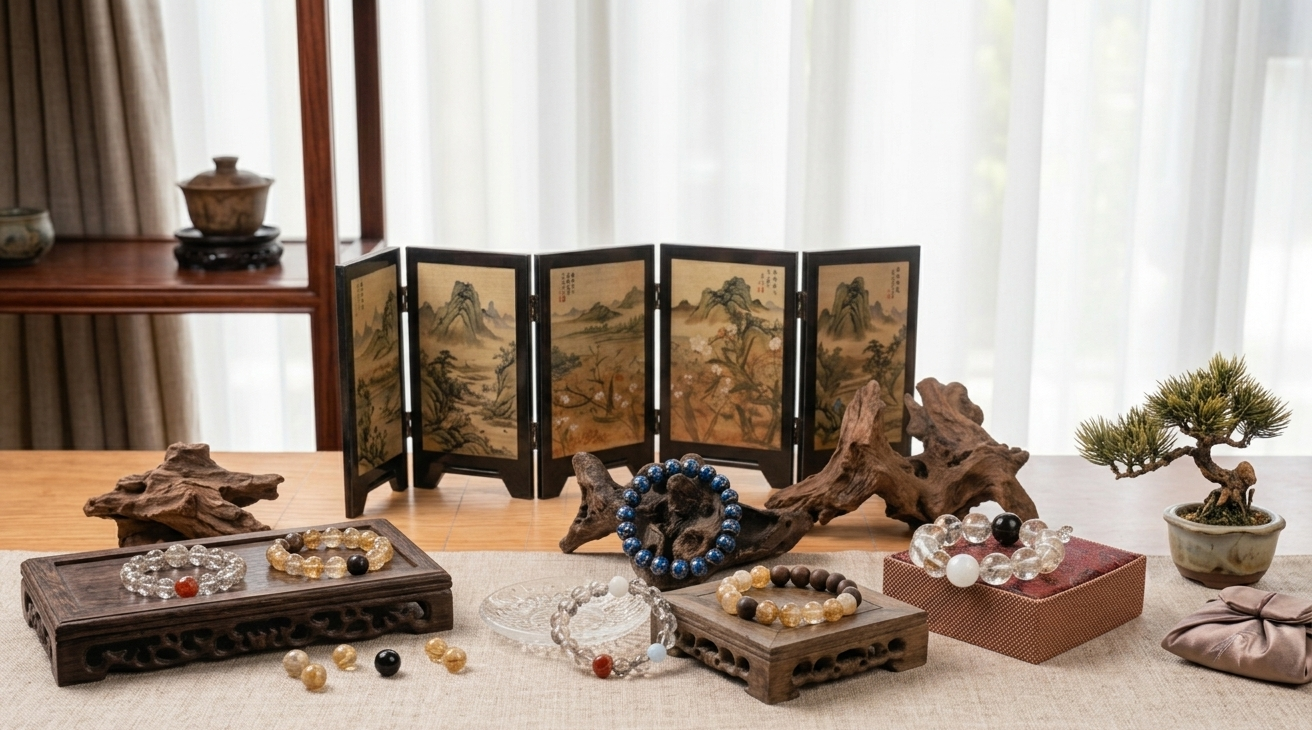
For readers interested in traditional protective objects, explore our:
Taoist Symbols & Spiritual Objects Collection
Conclusion
The 2026 Bing Wu Horse year provides an especially interesting window into the continuing tradition of Tai Sui belief.
The year’s association with Wen Zhe Dajiangjun, the relationships involving the Horse, Rat, Ox, and Rabbit, and the customs surrounding temple worship, talismans, offerings, red clothing, and annual directions all form part of a much broader Chinese cultural system.
For believers, these practices can provide a meaningful framework for prayer, reflection, and seeking reassurance during a new year.
For others, Tai Sui can be appreciated as an important part of Chinese religious history, calendrical culture, folklore, and living tradition.
The most useful modern approach may be neither unquestioning belief nor casual dismissal, but understanding the tradition on its own terms while maintaining a clear distinction between cultural belief and empirical evidence.
In that sense, the enduring value of Tai Sui lies not only in questions of fortune or misfortune, but also in what the tradition encourages people to consider at the beginning of each new year: how to act with greater awareness, restraint, responsibility, and respect for the forces — cultural, social, and personal — that shape our lives.
FAQ
The ruling Tai Sui for the Bing Wu (丙午) year of 2026 is traditionally identified as General Wen Zhe (文哲大将军), whose historical identity is associated with the Ming-dynasty official Wang Zhen (王缜), courtesy name Wen Zhe.
2026 is the Bing Wu (丙午) year. Bing is traditionally associated with Yang Fire, while Wu corresponds to the Horse and is also associated with Fire. Together they produce the commonly used description Fire Horse year.
Tai Sui has historical roots connected to ancient Chinese observations of Jupiter, or Sui Xing, whose approximately twelve-year orbital cycle influenced ancient Chinese calendrical and astronomical systems. Over time, the concept developed into a personified annual deity and eventually the sixty-Tai-Sui system
Within the framework used in this guide, the four primary zodiac relationships are:
Horse — Zhi Tai Sui + Xing Tai Sui
Rat — Chong Tai Sui
Ox — Hai Tai Sui
Rabbit — Po Tai Sui
Different temples, schools, and regional traditions may classify the affected signs somewhat differently.
No.
Ben Ming Nian refers to the year when a person’s zodiac branch matches the year’s branch. This is associated with Zhi Tai Sui.
Xing Tai Sui refers to a traditional punishment relationship. For the Horse in 2026, the relationship is specifically Wu-Wu self-punishment (午午自刑).
Traditional systems commonly place the 2026 Tai Sui direction in the South, while the opposing Sui Po direction is in the North. Different Feng Shui schools may use different technical methods and boundaries when interpreting these directions.
Not exactly. Tai Sui exists across Daoist religious practice, Chinese folk religion, astrology, calendrical traditions, and Feng Shui. Different communities have developed their own interpretations and rituals over time.
Related Posts
2026 Yang Fire Horse Year: A Feng Shui Guide to Choosing and Placing Pets at Home
Introduction When people think about Feng Shui in the home, they often focus on furniture, [...]
Aug
2026 Tai Sui Guide: What the Fire Horse Year Means for Your Zodiac
Introduction When people first hear that a new year brings a new “Tai Sui,” they [...]
Mar
The 12 Chinese Zodiac Animals: A Complete Guide to Their Order, Meanings, and Origins
Introduction When people first learn their Chinese zodiac animal, it is often treated as a [...]
Aug